
29 Range Hood Design Ideas for the Kitchen
By Interior Designer TRACY SVENDSEN | Published November 12, 2025 | Updated August 05, 2026 |
The range hood is the most architecturally significant appliance decision in a kitchen design — it occupies the most visually prominent position in the room, is impossible to ignore, and, unlike most appliances, can be specified in almost any material, finish, or form. For years it was treated as a functional necessity rather than a design opportunity. That’s changed significantly.
Contemporary kitchen designers are now treating the range hood as the room’s primary focal point — the element that sets the material direction and architectural character of the entire space. Hand-carved stone, Venetian plaster, patinated brass, blackened steel, integrated cabinetry panels, and custom wood are among the directions that have transformed what was once a metal box into a genuine design statement.
In my own kitchen renovation, I specified a rectangular quartz hood that matches the countertops and backsplash exactly — the material continuity creating an integrated, architectural quality that a contrasting hood would have disrupted. That single decision informed the rest of the kitchen’s material palette. The 29 ideas in this guide reflect the full range of what’s possible — from the seamlessly concealed to the dramatically sculptural. Feature image courtesy of Alisha Taylor Design.
Key Takeaways – Range Hood Design Ideas for 2026
-
Range hoods have evolved beyond function and are now considered a key architectural and stylistic centerpiece in kitchen design.
-
Material choice defines character, with options such as hand‑carved stone, custom wood, patinated metals, and sculptural plaster that transform hoods into bespoke focal points.
-
Integration and concealment are trending, including fully integrated paneled hoods that integrate cleanly with cabinetry to create a refined, cohesive aesthetic.
-
Finish and detail matter, from bold finishes like brass and copper to neutral plaster tones and eclectic fluting or ribbed textures that enhance personality.
- The cooking wall should be designed as a complete composition – the hood, the surrounding cabinetry, and the shelving on either side are a single architectural moment that works best when considered together rather than specified independently.
-
Design should harmonize with the kitchen, whether by matching hood materials to countertops or by drawing colors from surrounding elements to create a visual rhythm in the space.

Designer Kitchen with Modern Hood
Image courtesy of Ali Budd Interiors
1. Stone Range Hoods
Hand-carved stone range hoods represent one of the most significant material shifts in contemporary kitchen design — moving the hood from a manufactured appliance finish into the same category as the stone countertops and feature walls that define high-end kitchen interiors.
Interior designer Donna Mondi identified this opportunity through her collaboration with Material Bespoke Stone + Tile, producing an innovative collection of hand-carved stone kitchen hoods in marble, travertine, and limestone. Each hood is customizable in size and profile — the material versatility allowing it to work across modern, transitional, and traditional kitchen aesthetics without the hood feeling like an imported element from a different design direction.
Designer Tip: I recommend stone range hoods specifically for kitchens where stone is already a dominant material — marble countertops, a stone backsplash, or a stone feature wall. The repetition of material at hood level creates a cohesive, considered result that connects the hood to the kitchen’s existing stone palette rather than introducing it as a standalone statement piece.

Stone Range Hoods
Image courtesy of Material Bespoke Stone + Tile
2. Wood Range Hood
A custom wood range hood introduces the warmth and furniture-quality craftsmanship that painted or metal hoods can’t replicate — and when the wood connects to an existing element in the kitchen, the hood becomes part of a cohesive material story rather than a standalone feature.
This contemporary farmhouse kitchen by Jennifer Robin shows an unusually considered application. Rather than the conventional hood positioned directly above the range, this custom knotty wood panel hood extends the full length of the countertop — transforming the hood from a ventilation fixture into a defining structural element. The vertical knotty wood panels match the kitchen island base, creating a material connection between the two most prominent elements in the space. White cabinets, countertops, and backsplash recede completely, allowing the wood to carry the kitchen’s visual weight. Character-grade oak cabinetry pairs with leathered quartzite countertops — durable, stain-resistant, and suited to a family kitchen without sacrificing material quality.
Designer Tip: I recommend connecting the wood hood material to one other element in the kitchen — the island base, open shelving, or ceiling beams — rather than introducing it as a standalone wood moment. That material connection is what gives a wood hood its architectural rather than purely decorative quality.

Wood Range Hood
Image courtesy of Jennifer Robin Interiors
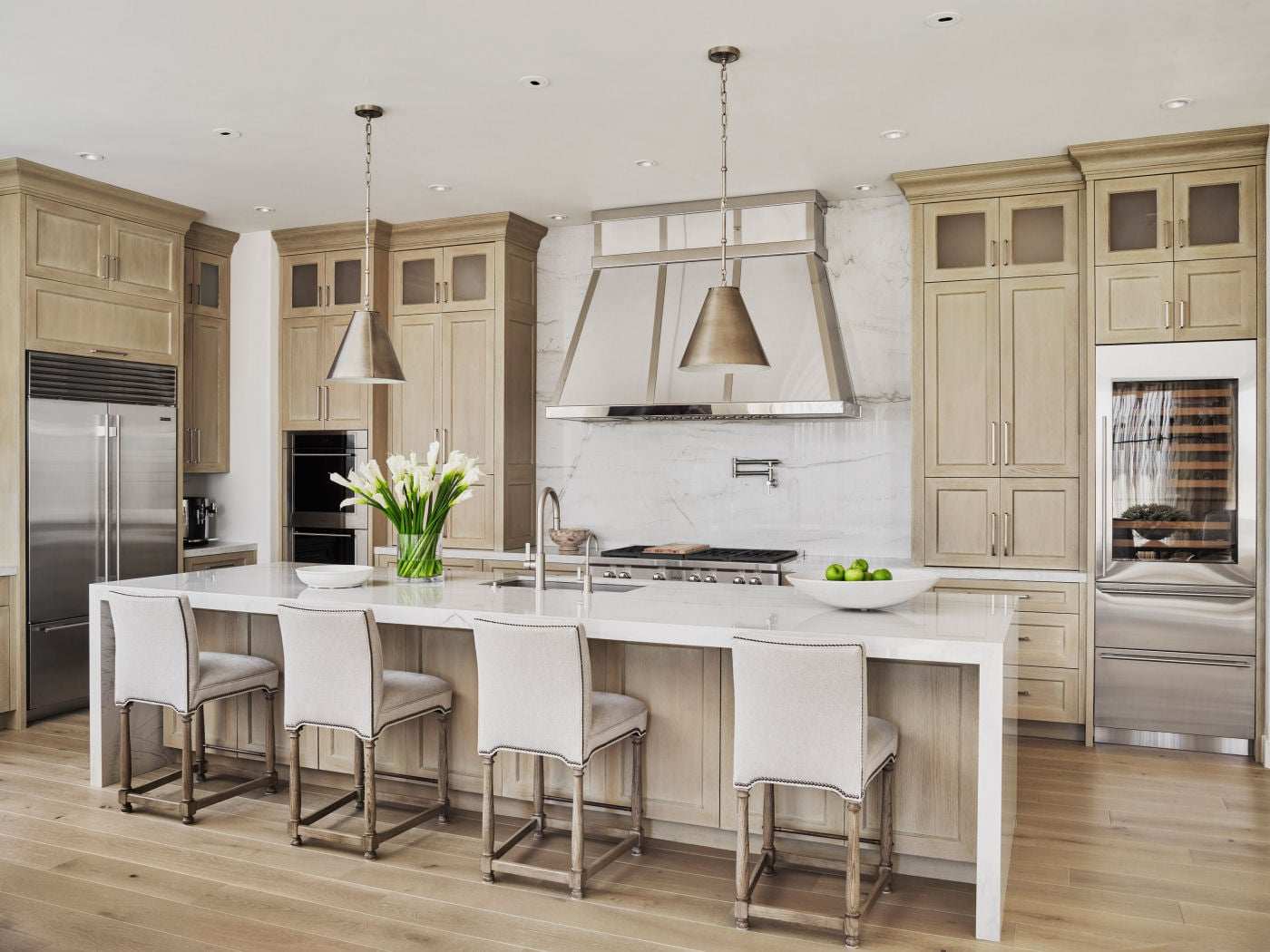
3. Stainless Steel Hood Range
Stainless steel remains one of the most versatile range hood finishes — it pairs naturally with professional appliances, suits both contemporary and transitional kitchens, and ages without showing wear the way painted finishes can.
This contemporary farmhouse kitchen by Lissa Lee Hickman shows stainless steel used with genuine material sophistication. A white hood trimmed in stainless steel connects directly to the appliances and faucet finishes throughout the space, while light oak cabinetry, flooring, and island base establish a warm, natural-material foundation. White quartz countertops with gray veining run from the countertop surface up the wall behind the hood as a full backsplash — the continuous stone surface framing the hood architecturally. The island’s waterfall edge carries the quartz to the floor on both sides. What distinguishes the design is the deliberate mixed metal approach — brushed gold pendant lights above the island and cabinet hardware sit alongside the stainless steel hood and appliances, the warm gold adding a refined decorative layer that complements the natural warmth of the oak throughout.
Designer Tip: I recommend considering mixed metals in a kitchen when the overall palette is warm and neutral — stainless steel appliances and hood paired with brushed gold or brass hardware creates a material layering that prevents the kitchen from feeling too uniform. The key is limiting the mix to two metals and using each one consistently across its own category of element rather than mixing them randomly.
Stainless Steel Hood
Image courtesy of Lissa Lee Hickman Design
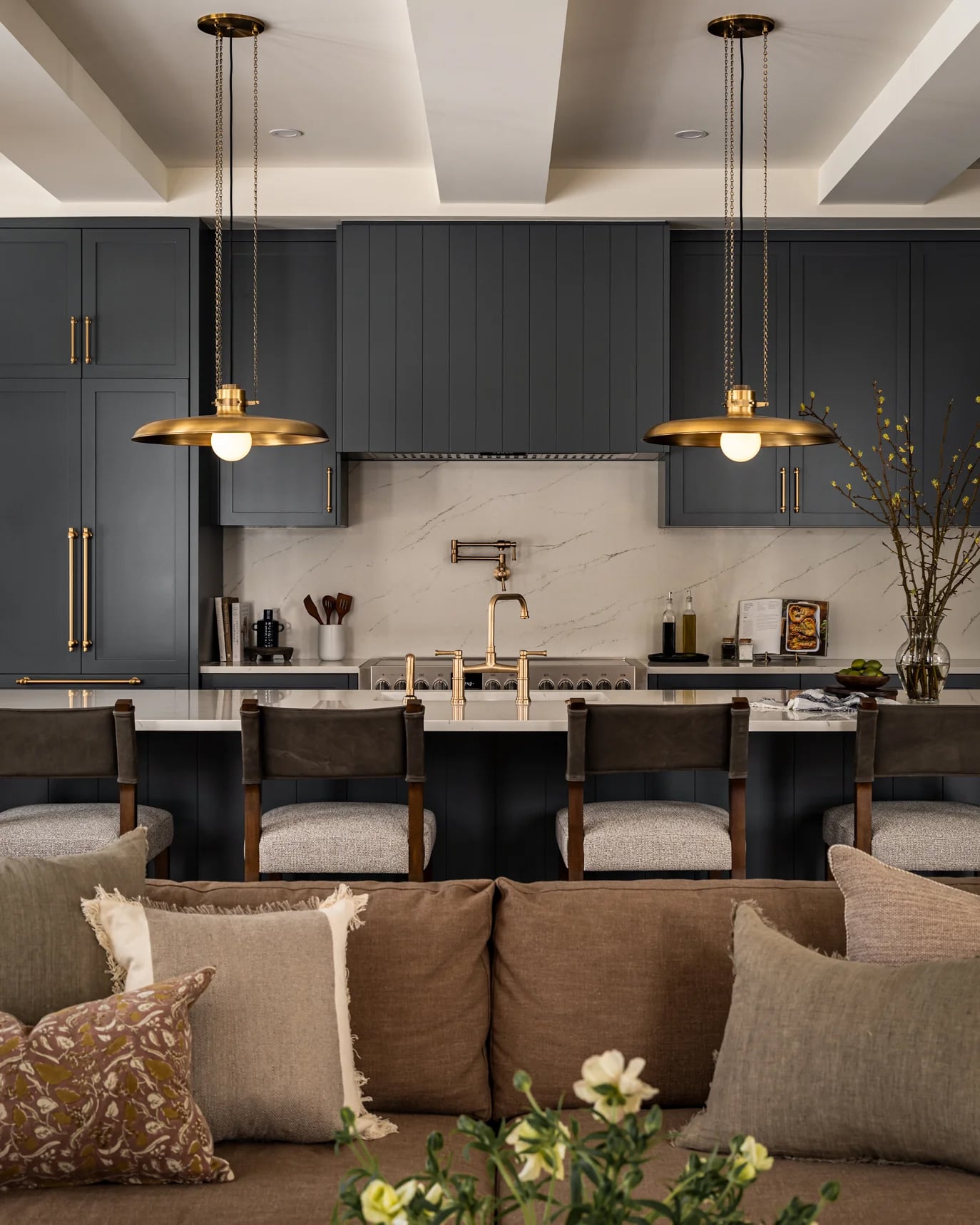
4. Classic Integrated Hoods
An integrated range hood — where the hood is paneled in the same cabinetry finish as the surrounding kitchen — creates the most cohesive possible result. The ventilation disappears into the design rather than announcing itself, and the kitchen reads as a single unified composition.
This kitchen by West of Main shows the approach in navy blue with particular success. Custom cabinetry in navy with charcoal undertones runs throughout, with the range hood paneled in vertical detailing in the same color — the texture of the vertical panels adding depth and visual interest to what could otherwise be a flat expanse of cabinetry. Brass pendant lights above the navy island and brass hardware throughout introduce the warm metallic accent that prevents the deep blue from feeling heavy. White quartz countertops and backsplash provide the light contrast, and warm wood flooring grounds the space. A built-in coffee bar completes the kitchen as a fully considered, multi-functional space.
Designer Tip: When integrating a range hood into a single-color cabinetry, I recommend adding a texture or distinctive finish to the hood panel — vertical paneling, fluting, or a different sheen — to give it subtle definition within the overall composition. Without that detail, the hood can disappear too completely, losing the architectural presence that makes an integrated hood a genuine design decision rather than simply a concealment choice.

Integrated Hood
Image courtesy of West of Main Design
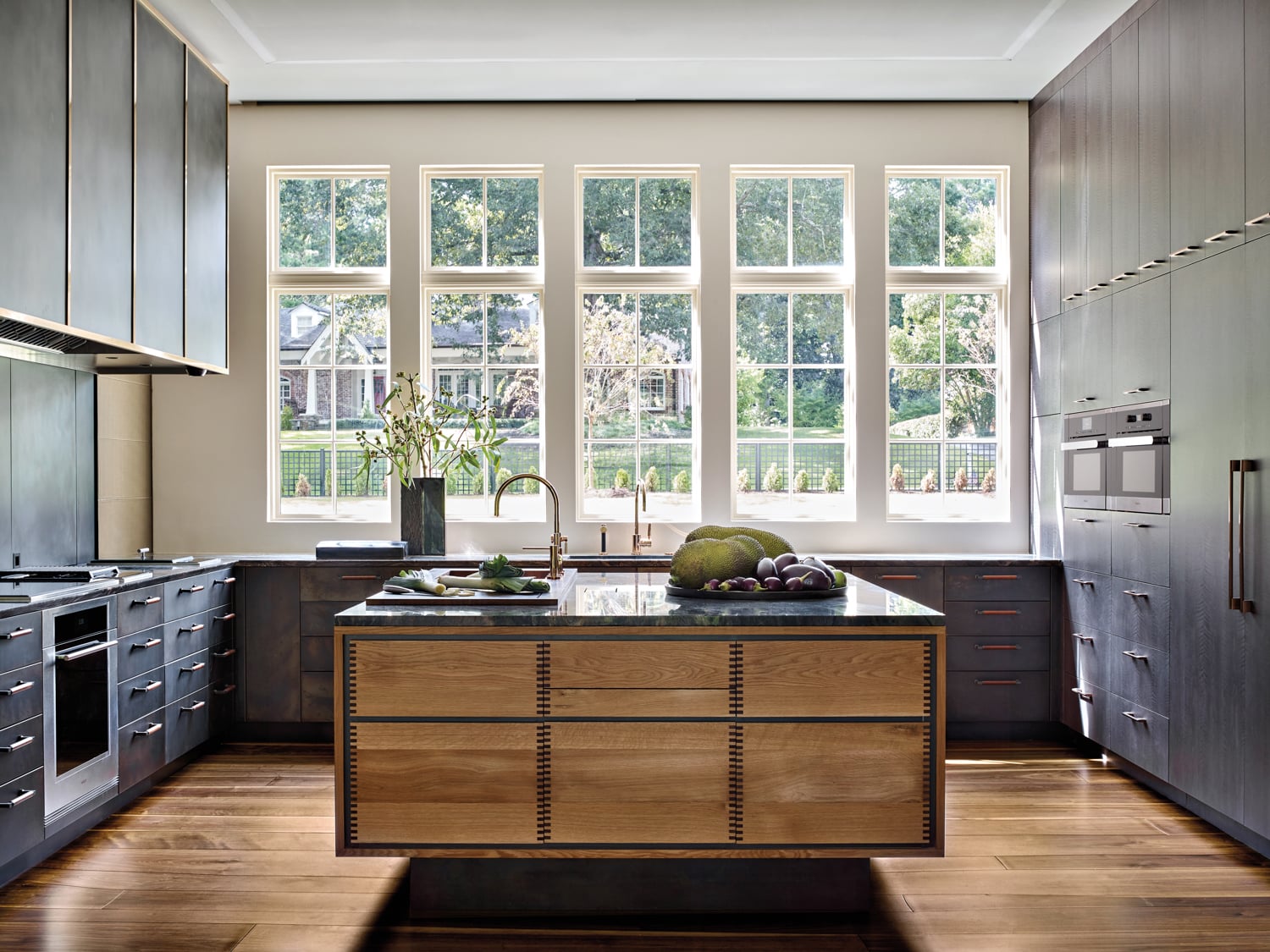
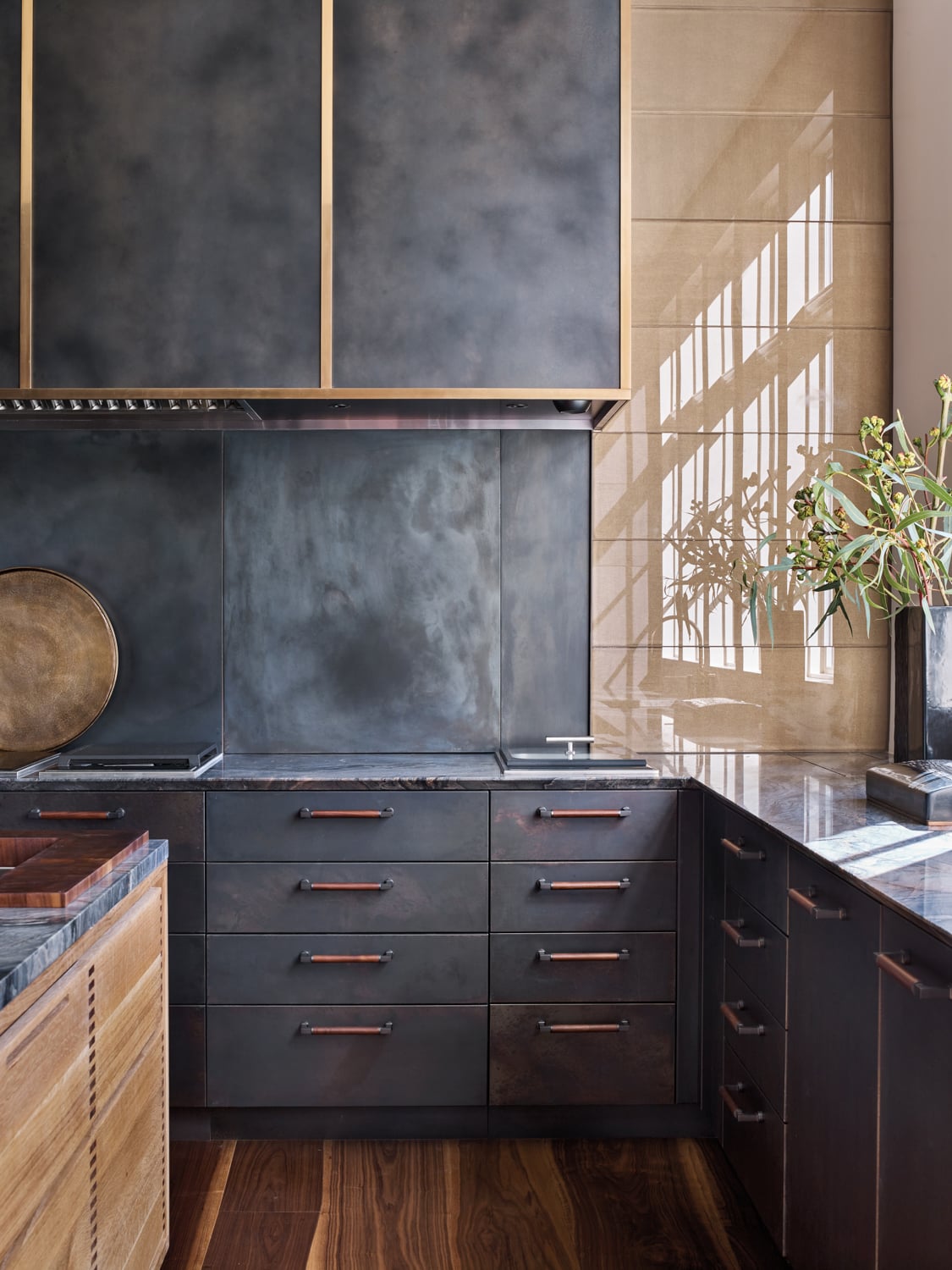
5. Patinated Metal Hood (Copper, Brass, Zinc)
Patinated metal brings a quality to a range hood that no factory finish can replicate — the accelerated aging and oxidation process locks in a unique color and character that give the hood genuine material depth. The result suits old-world, rustic, transitional, eclectic, and modern spaces precisely because patina reads as authentic rather than manufactured.
Interior designer Karen Ferguson of Harrison Design used patinated metal across the hood, cabinetry, and backsplash — a material commitment that gives the kitchen its cohesive, layered quality. Custom glass panels made from laminated fabric reflect light from tall windows, a rose-gold faucet adds warmth at the sink, and an oak island with delicate dovetail details introduces a natural-wood material counterpoint. Fusion Blue Quartzite from Walker Zanger runs across the countertops, its blue-gray tones sitting alongside the rose gold and brass fittings throughout. The hood anchors the composition with contrasting brass trim — a metallic detail that connects the hood directly to the hardware and faucet finish throughout the space.
Designer Tip: I find patinated metal most effective when it appears in at least two distinct locations in the kitchen — the hood and the hardware, or the hood and the backsplash — rather than as a single isolated element. The repetition of the patinated finish across multiple surfaces is what gives it its material authority.

Patinated Metal Hood
Images courtesy of Karen Ferguson of Harrison Design
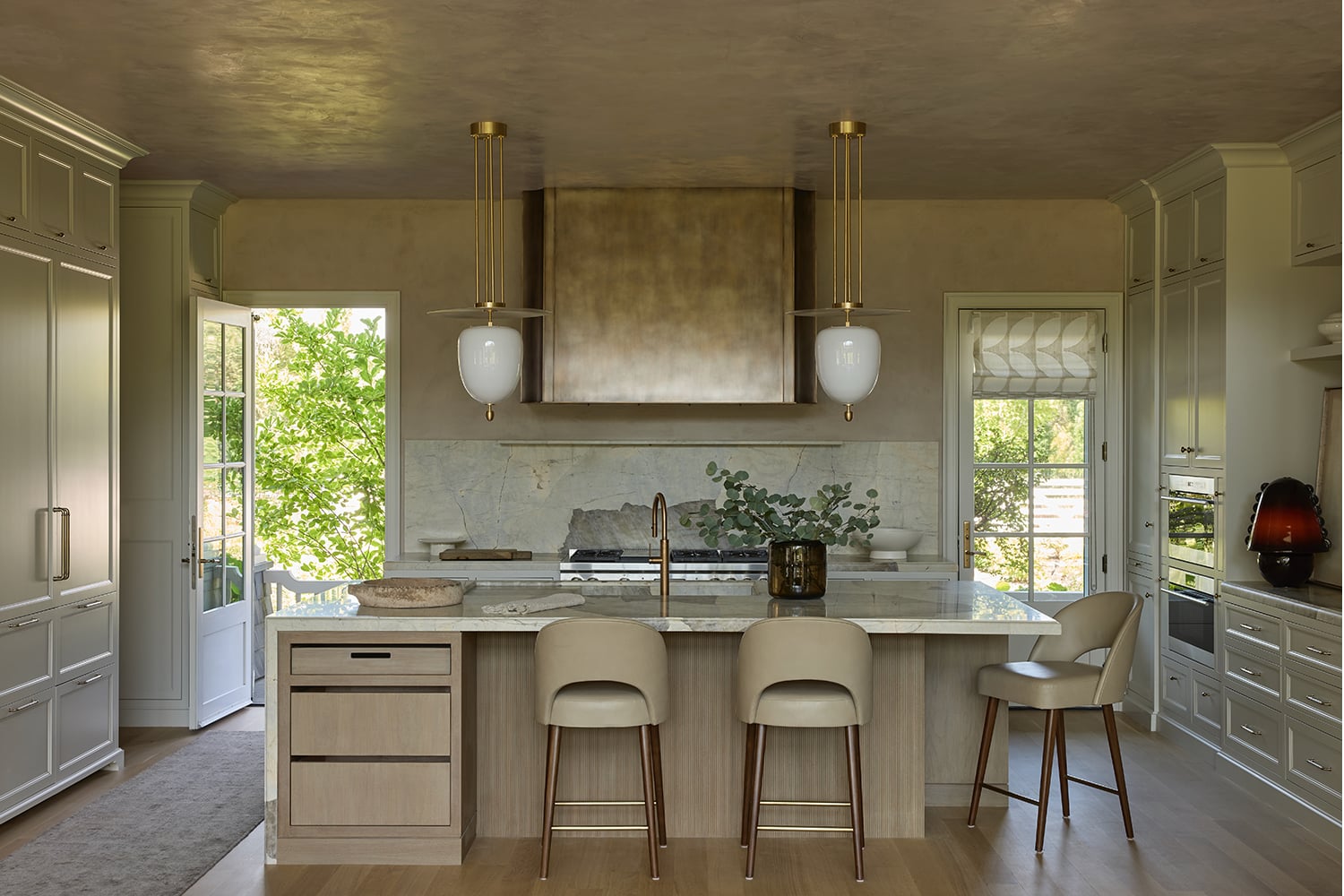
6. Hand-Finished Brass
Hand-finished brass occupies a different category from polished or brushed brass — the manual finishing process creates a surface with genuine depth and variation that mass-produced metal finishes never achieve. The result is a hood that reads as a crafted object rather than a specified appliance.
In this kitchen by AMB Design, every surface decision was built around touch, temperature, and proportion rather than visual impact alone — a design philosophy that produces interiors with genuine material presence rather than surface decoration. The quiet glow of the hand-finished brass hood establishes the moody, earth-connected palette, while walnut grain brings tone and texture at the cabinetry level. Patagonia and Viola stone run throughout the countertop and backsplash surfaces — the material palette remains consistently close to the earth.
Designer Tip: I recommend hand-finished brass for kitchens where warmth and material authenticity are the primary design goals — the slight variations in tone and texture across a hand-finished surface add the kind of depth that a uniform factory finish simply cannot replicate. It ages naturally over time, which only improves its character.
Hand-Finished Brass Hood
Image courtesy of AMB Design (David Duncan Livingston Photo)
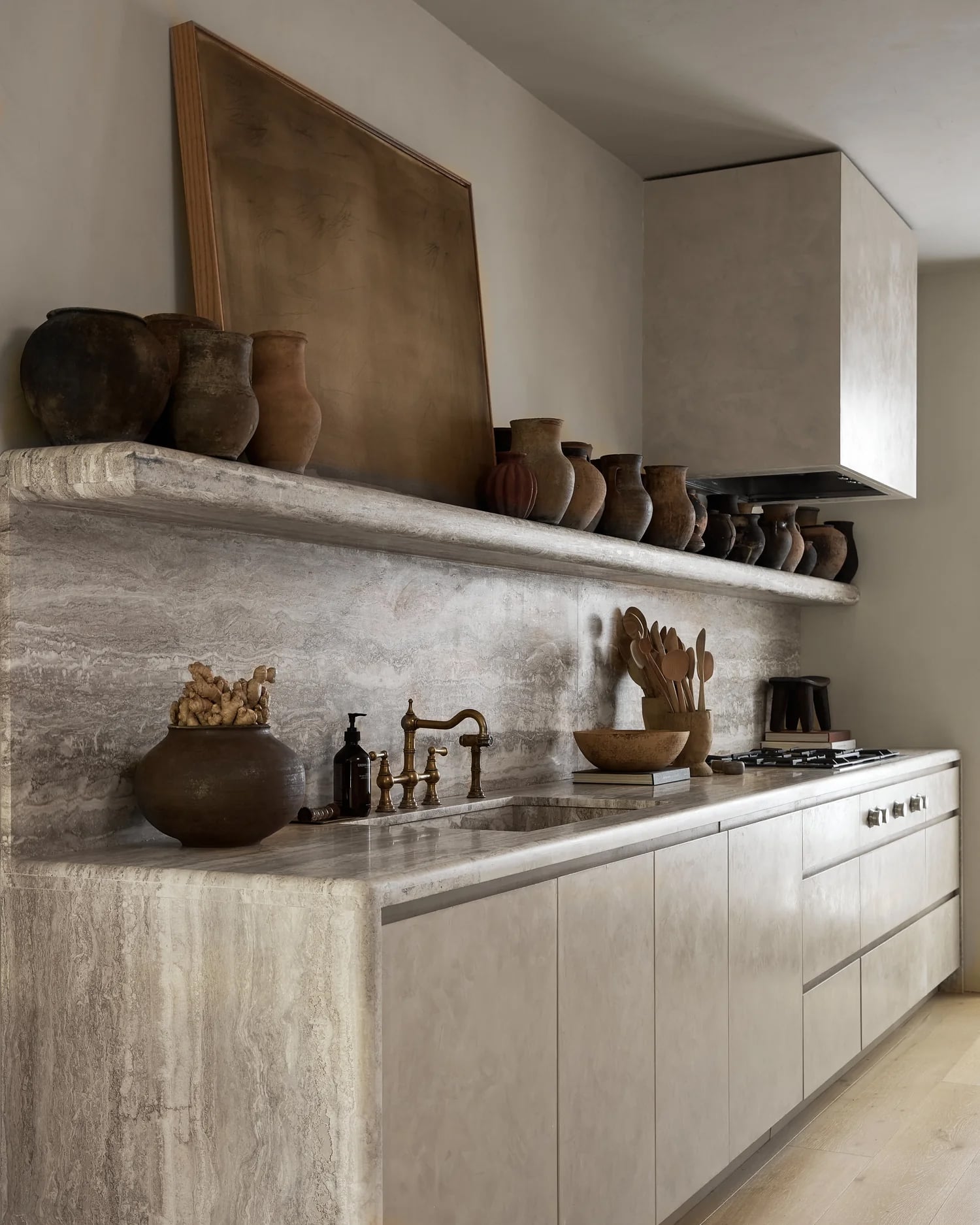
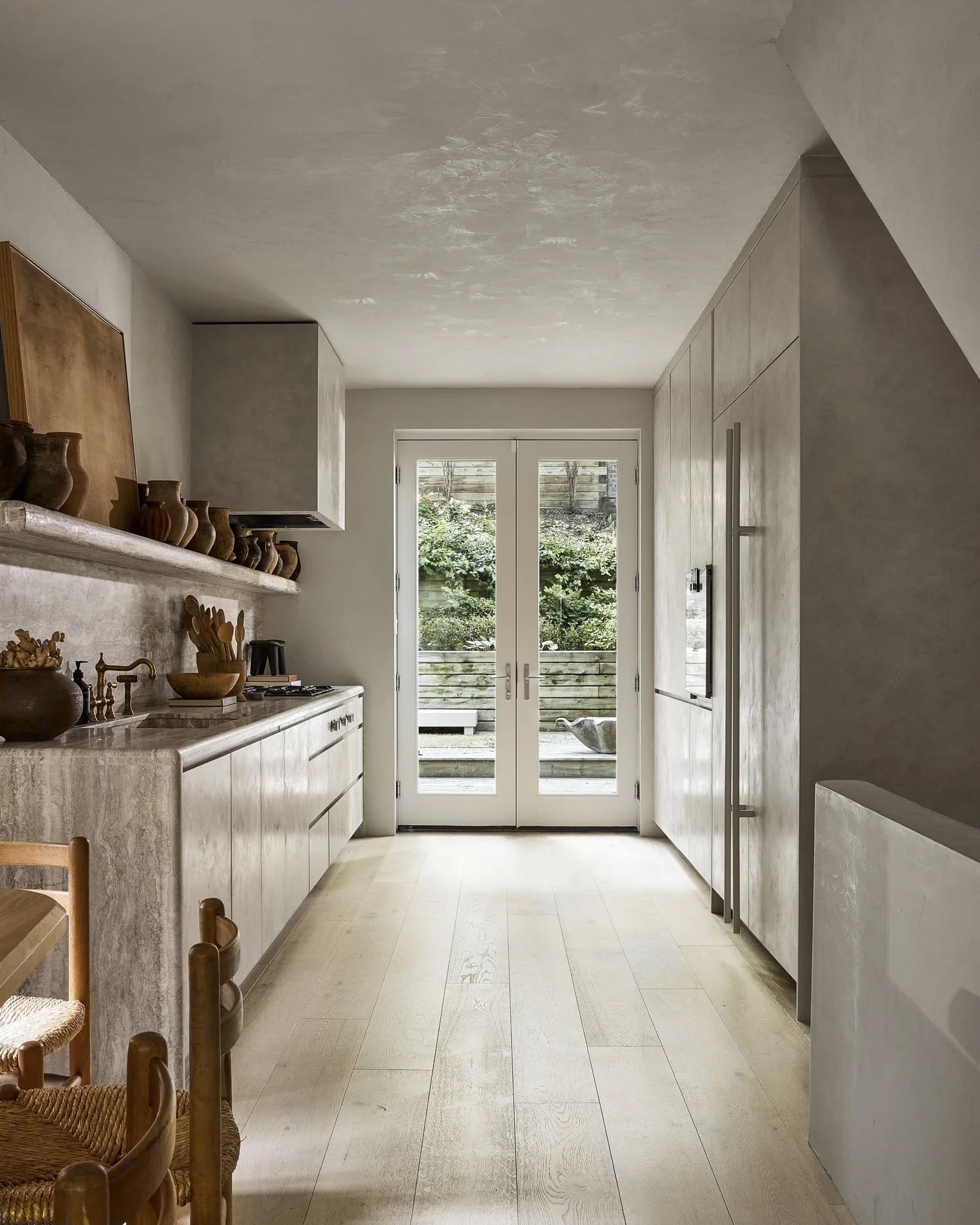
7. Custom Venetian Plaster Range Hood
Venetian plaster applied to a range hood transforms it from a manufactured fixture into something that reads as genuinely architectural — the centuries-old technique creates a depth and softness of surface that no factory finish achieves, and it improves with age rather than showing wear.
In this modern organic kitchen by Montana Labelle, decorative painter Jeanne Shemilt applied the custom Venetian plaster treatment that defines the room’s entire material direction. The long, narrow kitchen is anchored by an open shelf running directly below the hood — a considered design decision that keeps the plaster surface visible while creating a display opportunity filled with rustic pottery, a warm brown earth-tone art piece leaning against the ledge, wooden bowls, and wooden utensils. Neutral marble in warm cream tones covers the shelf, backsplash, and countertops, while a vintage brass faucet adds the warm metallic accent. The Venetian plaster hood suits Mediterranean, French Modern, and minimalist kitchens particularly well — anywhere the goal is material warmth achieved through surface quality rather than color.
Designer Tip: I recommend Venetian plaster for range hoods, especially in kitchens with warm neutral palettes — the slight tonal variation across the plaster surface adds the depth that a flat, painted hood in the same color never achieves, and the material connects naturally to stone countertops and natural-fiber textiles throughout the space.
Custom Venetian Plaster Range Hood
Image courtesy of Montana Labelle Design
8. Blackened Steel
Blackened steel in a deep matte or dark charcoal finish is one of the most architecturally assertive range hood choices — the graphic contrast against light cabinetry gives the hood an immediate presence that draws the eye without requiring any decorative detail.
In this rustic kitchen by Birgit Klein, the charcoal metal hood sits within a material palette built entirely around natural and reclaimed elements. Reclaimed ceiling beams give the space its sense of history and structural permanence, while custom walnut cabinets, Marmi stone worktops, lighting by Allied Makers, and stools by Thomas Hayes complete the considered material selection. The blackened steel hood connects to the dark metal accents throughout while contrasting with the warmth of the walnut and reclaimed wood — the dark finish grounding the natural material palette rather than competing with it.
Designer Tip: I find blackened steel most effective in kitchens where at least one other dark element is present — dark hardware, dark stone, or dark wood — so the hood reads as part of a considered dark accent palette rather than an isolated contrast element.
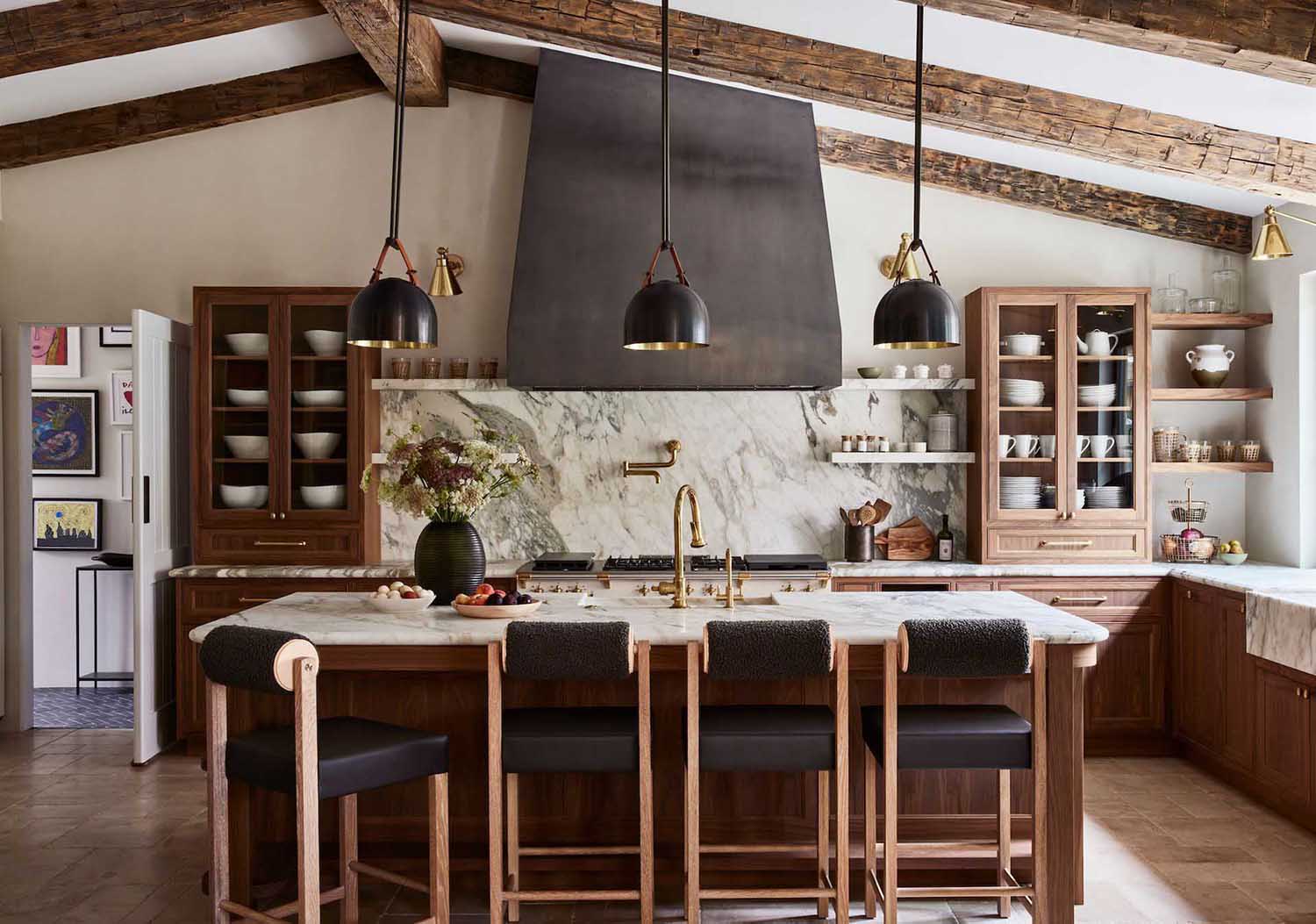
Blackened Steel Range Hood
Image courtesy of Birgit Klein Design
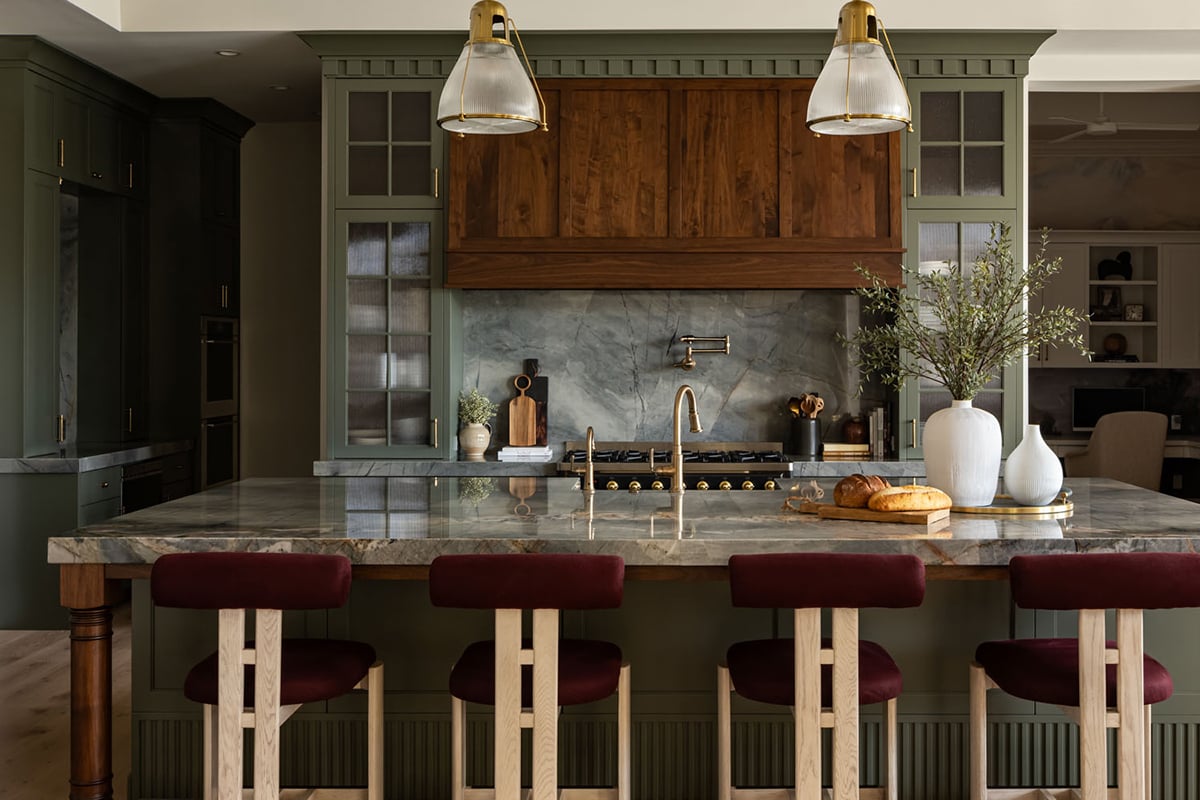
9. Rich, Warm Wood Tones
When the range hood material connects to other wood elements throughout an open-concept space — the island base, the living room, the dining area — it becomes an anchoring material thread that runs through the entire floor plan rather than a single kitchen feature.
This open-concept design by Alisha Taylor is one of the most considered examples of material continuity I’ve come across — the dark warm wood hood connects directly to the kitchen island base posts and the living room coffee table, creating a consistent wood tone that moves through the entire space. Coffered ceilings and white walls provide the architectural backdrop, while dark olive green cabinets set the moody palette that the deep rust velvet island chairs — a reimagined wishbone silhouette with vertical lines, a double-beamed back structure, and a U-shaped upholstered back — bring to life at seating level. Gray and cream marble below the hood, olive green kitchen cabinets, brass fixtures, light wood flooring, and a large white pot with an olive tree complete a living room and kitchen composition that rewards genuine attention to detail.
Designer Tip: I recommend extending the hood material — whether wood, stone, or metal — to at least one other element beyond the kitchen zone in an open-concept space. That material repetition is what gives a large open floor plan its cohesion.
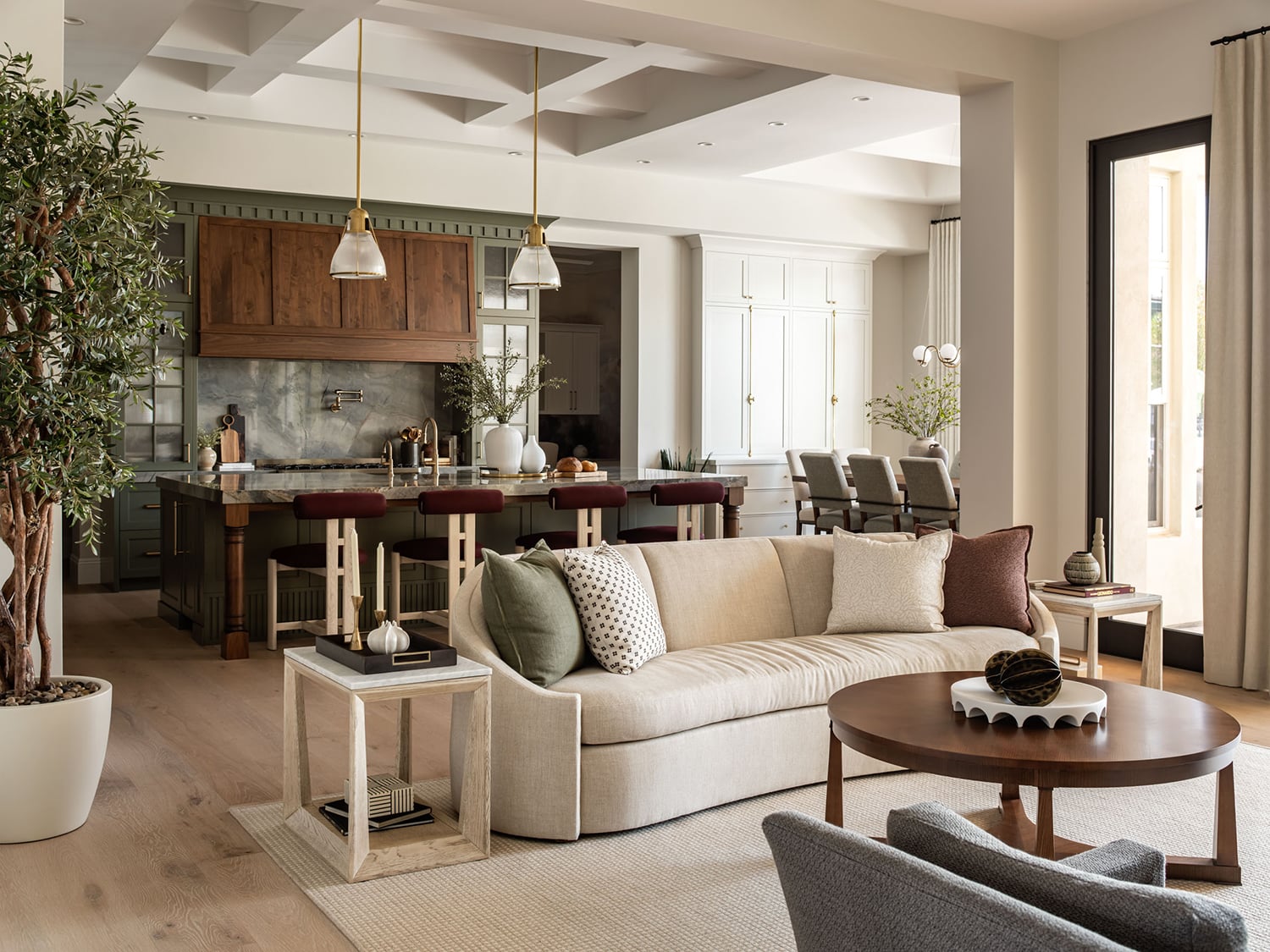
Rich, Warm Wood Tones
Image courtesy of Alisha Taylor Interiors (Joshua Caldwell Photography)
10. Copper Hues
Copper is the warmest of all range hood metal finishes — its reddish-gold tone connects naturally to brick, terracotta, warm wood, and earth tone palettes in a way that brass and stainless steel don’t quite achieve.
This modern farmhouse kitchen by Amber Lewis shows copper used with genuine material intelligence. The linear copper hood extends well beyond the range across the full countertop length — its warm reddish tone connecting directly to the brick accent wall behind it, where cream and terracotta tones in the brick establish the warm palette that runs throughout. Light oak cabinetry with vertical wood panel details picks up the brick tones, wood ceiling beams and parquet flooring reinforce the natural material foundation, and two islands — one with a wood base and white quartz countertop, the second with quartz extending to the base with wood corner posts — provide the functional layout that a serious cooking kitchen requires. Open shelving in front of a window adds the display and storage element that completes the farmhouse kitchen direction.
Designer Tip: I recommend copper as a range hood finish specifically when warm brick, terracotta tile, or reddish wood tones are already present in the kitchen — the copper reads as a natural extension of those warm tones rather than an introduced metallic accent, which gives it a more considered, less decorative quality.
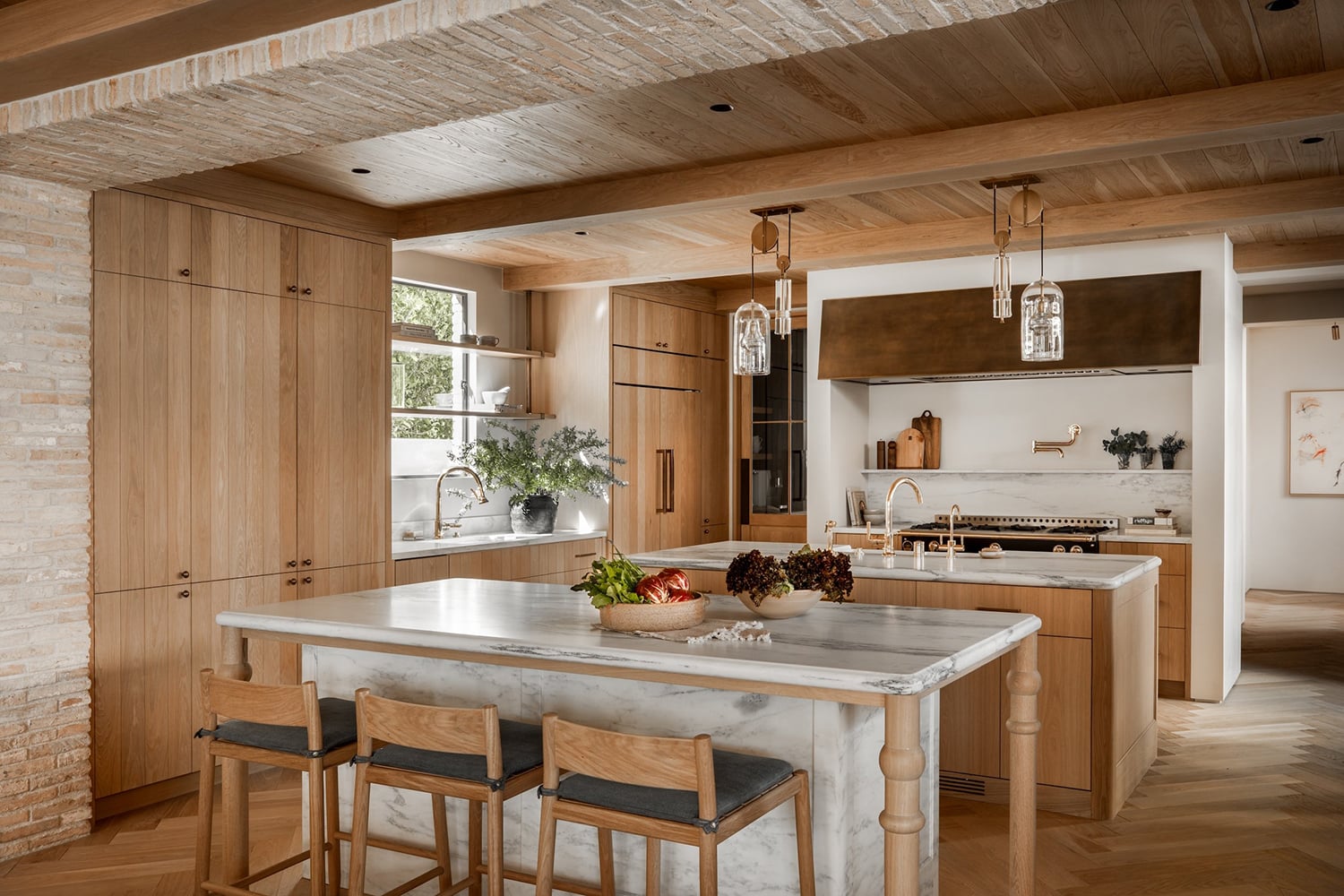
Linear Copper Range Hood
Image courtesy of Eric Olsen Design (Amber Interiors, Shade Degges Photograph)
11. Neutral Tones
A neutral range hood — plaster, stone, or painted in a cream or warm white tone — is the most versatile choice available. It recedes into the kitchen composition rather than asserting itself, allowing the other material decisions to carry the visual weight.
This modern organic kitchen renovation in San Diego by M. Swabb shows a cream-toned stone hood used as a deliberate contrast element within a warm, layered palette. Light warm-toned cabinetry with brass linear hardware sits alongside upper cabinets with black frames and fluted glass — the black framing repeated in the windows throughout. White and gray quartz countertops and backsplash with warm copper veining connect to the brass hardware throughout, while the cream stone hood provides the neutral architectural anchor above. Black counter stools with white seats and cane backs, light oak flooring, and modern pendant lights complete a kitchen that balances warm natural materials with precise contemporary detailing.
Designer Tip: I recommend a cream or warm white hood in kitchens where the backsplash or countertop is the material statement — the neutral hood recedes and allows the stone veining, tile work, or distinctive backsplash to remain the room’s primary visual moment rather than competing with it.
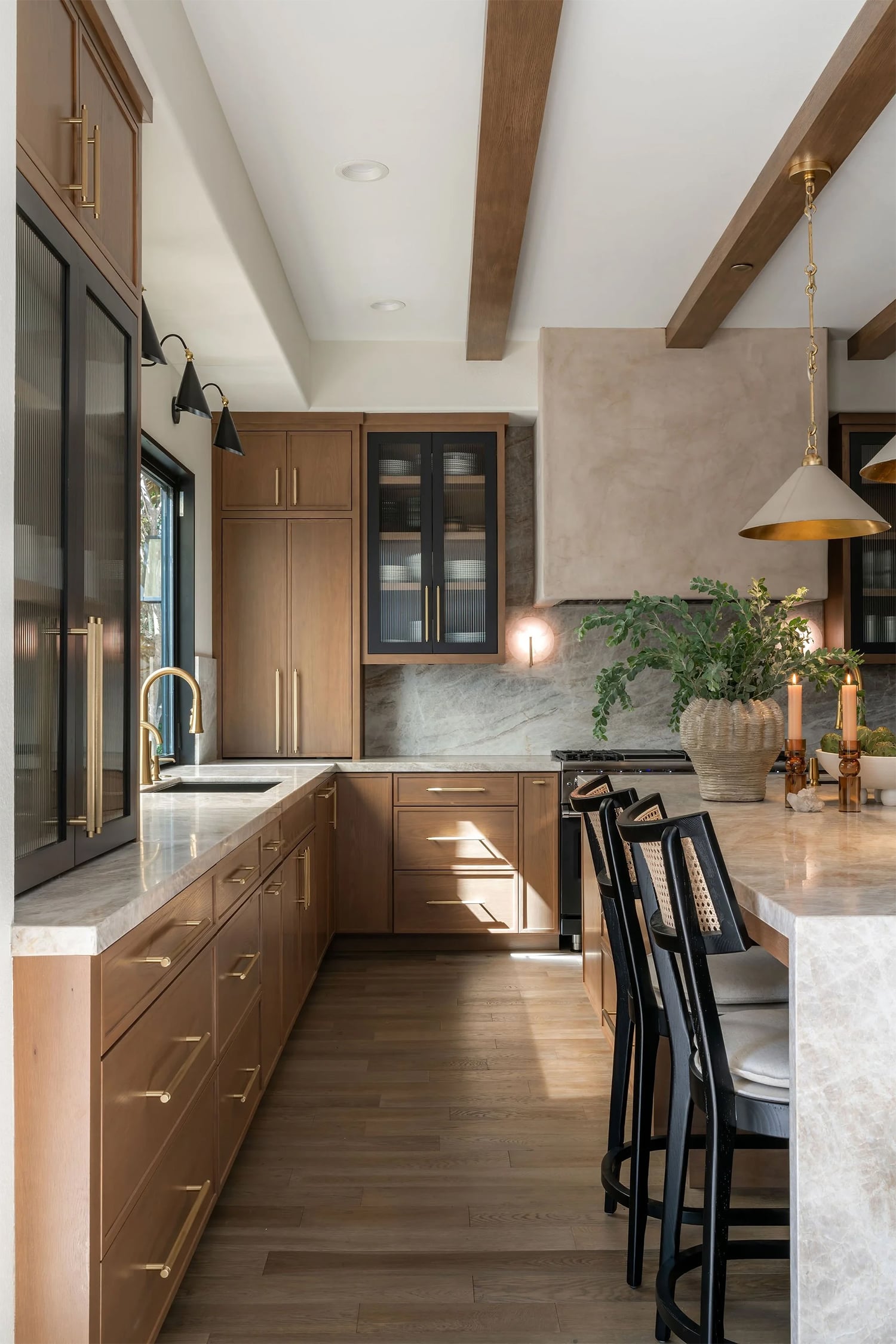
Range Hood in Neutral Tones
Image courtesy of M Swabb Design (Jenna Jo Photography)
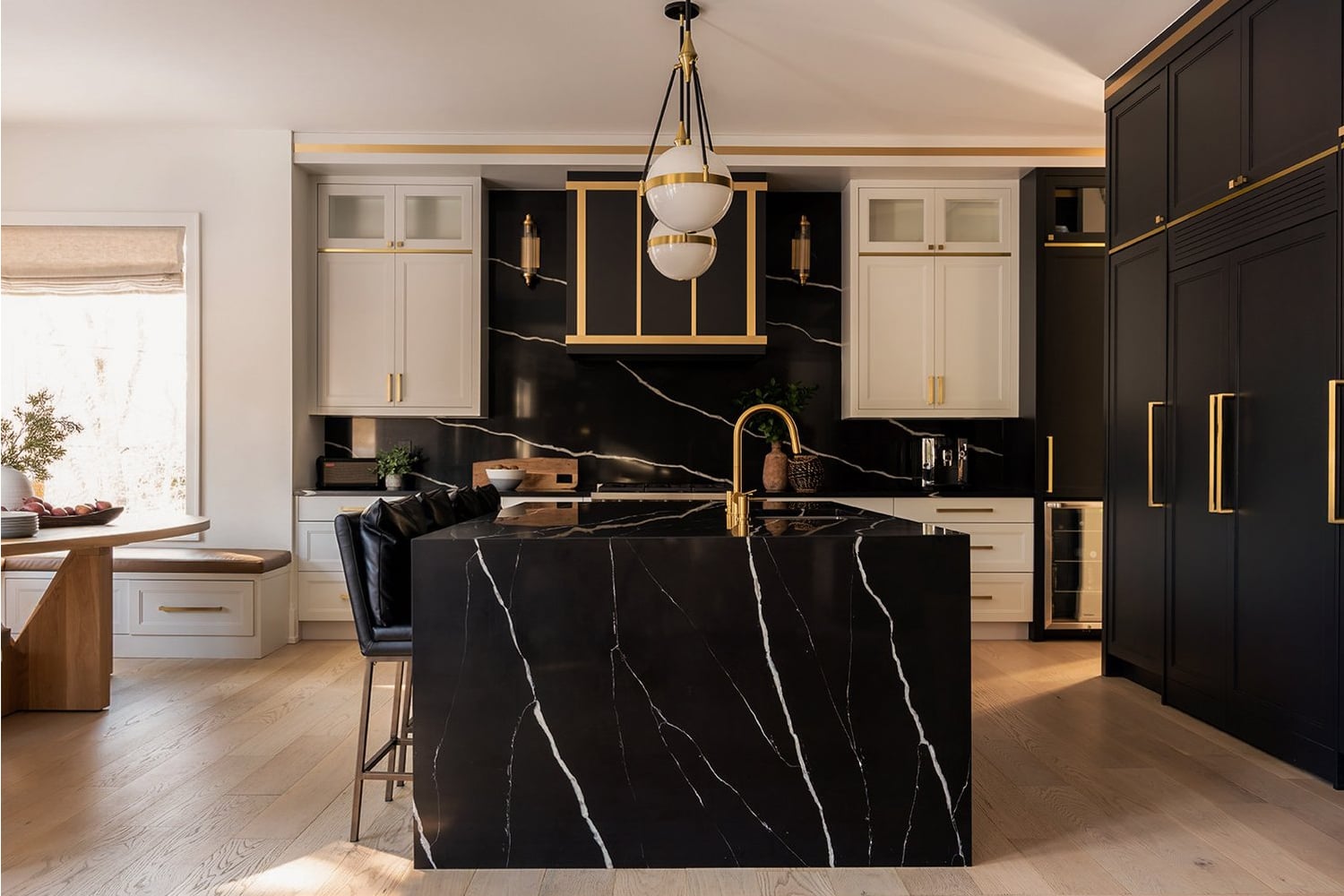
12. Bold Gold Trim
Gold trim on a range hood functions the way jewelry functions on an outfit — a single refined metallic line that defines the form and signals the level of finish without overwhelming the overall composition.
This kitchen by Karin Bennett is one of the most dramatic in this guide. Black lower cabinets with long brass linear handles sit below a horizontal brass trim line running above the tall pantry-style cabinet doors — the same horizontal brass trim repeated on the white upper cabinets on either side of the hood. The black range hood itself takes the brass detail further — black with gold trim framing the perimeter and vertical gold lines on the face, the vertical orientation contrasting deliberately with the horizontal trim running throughout the rest of the kitchen. Black marble with dramatic white veining covers the backsplash, countertops, and island waterfall edges — the continuous marble surface creating the most cohesive possible dark material foundation. White globe pendant lights with black cords and brass detailing, light oak flooring, and white walls provide the contrast that allows the black-and-brass palette to read at full intensity. Every metallic detail in the kitchen — handles, trim lines, faucet, pendant detailing — is brass, creating an unusually disciplined material consistency across a highly dramatic palette.
Designer Tip: I recommend brass or gold trim as the finishing detail on a range hood when the kitchen already features brass hardware throughout — the trim connects the hood directly to the existing metallic palette rather than introducing a new finish. Even a simple brass trim line around the hood perimeter creates a custom, considered quality without requiring the full cabinetry treatment shown here.
Gold Trim Detailing
Image courtesy of Karin Bennett Design
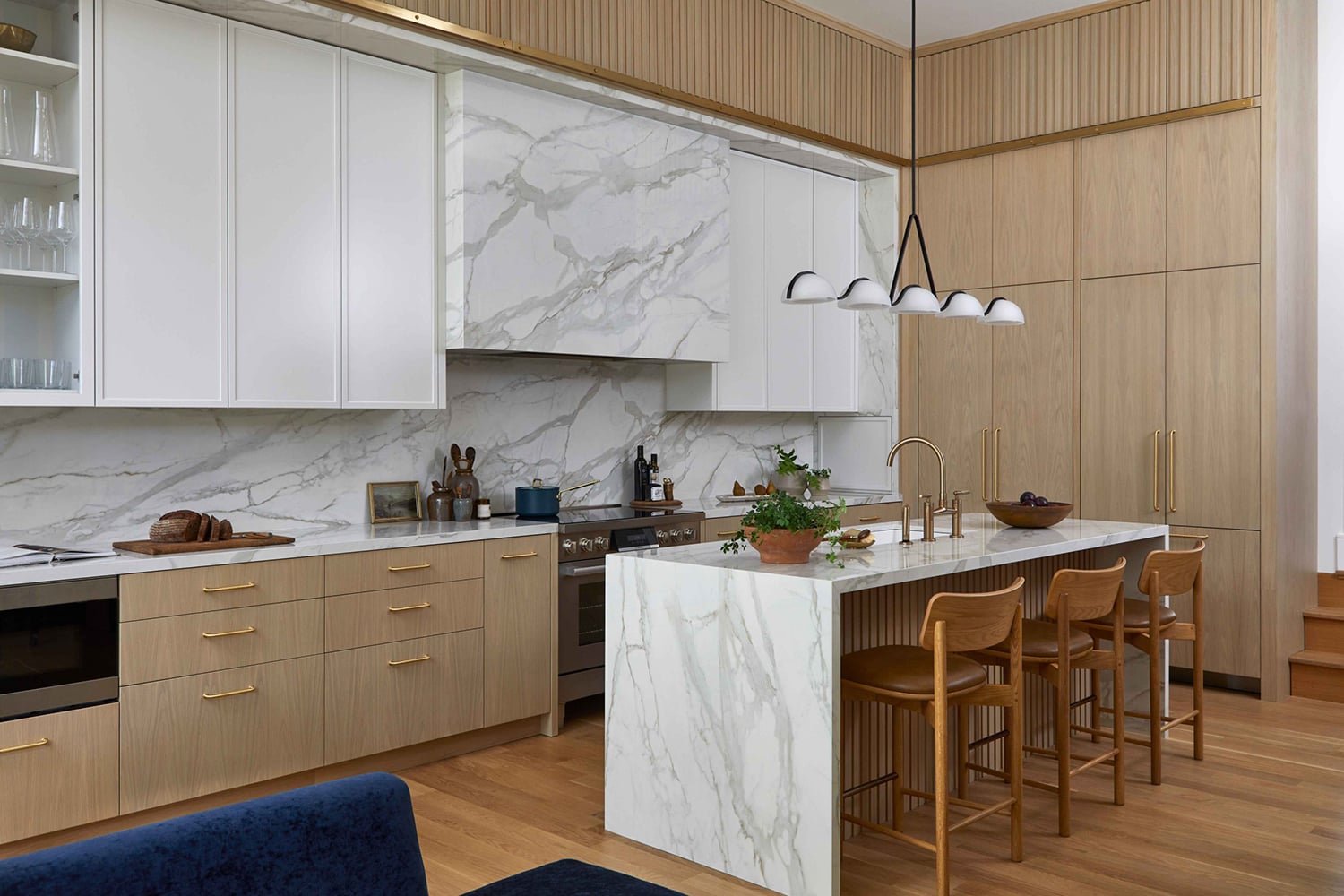
13. Match the Hood with the Countertops
Matching the range hood material to the countertops and backsplash creates the most integrated possible result — the hood becomes part of a continuous material surface rather than a separate fixture sitting above it.
This contemporary kitchen by Dart Studio uses Dekton — an ultracompact surface by Cosentino made from a blend of natural minerals including glass, quartz, and porcelain — across the countertops, backsplash, and hood in a single uninterrupted material. Light oak lower cabinets with brass handles sit below white upper cabinets without hardware, the two-tone cabinetry keeping the focus on the Dekton surface running from counter to ceiling. Brass detailing and a contemporary light fixture complete the two-tone cabinet composition.
Dekton Range Hood
Image courtesy of Dart Studio
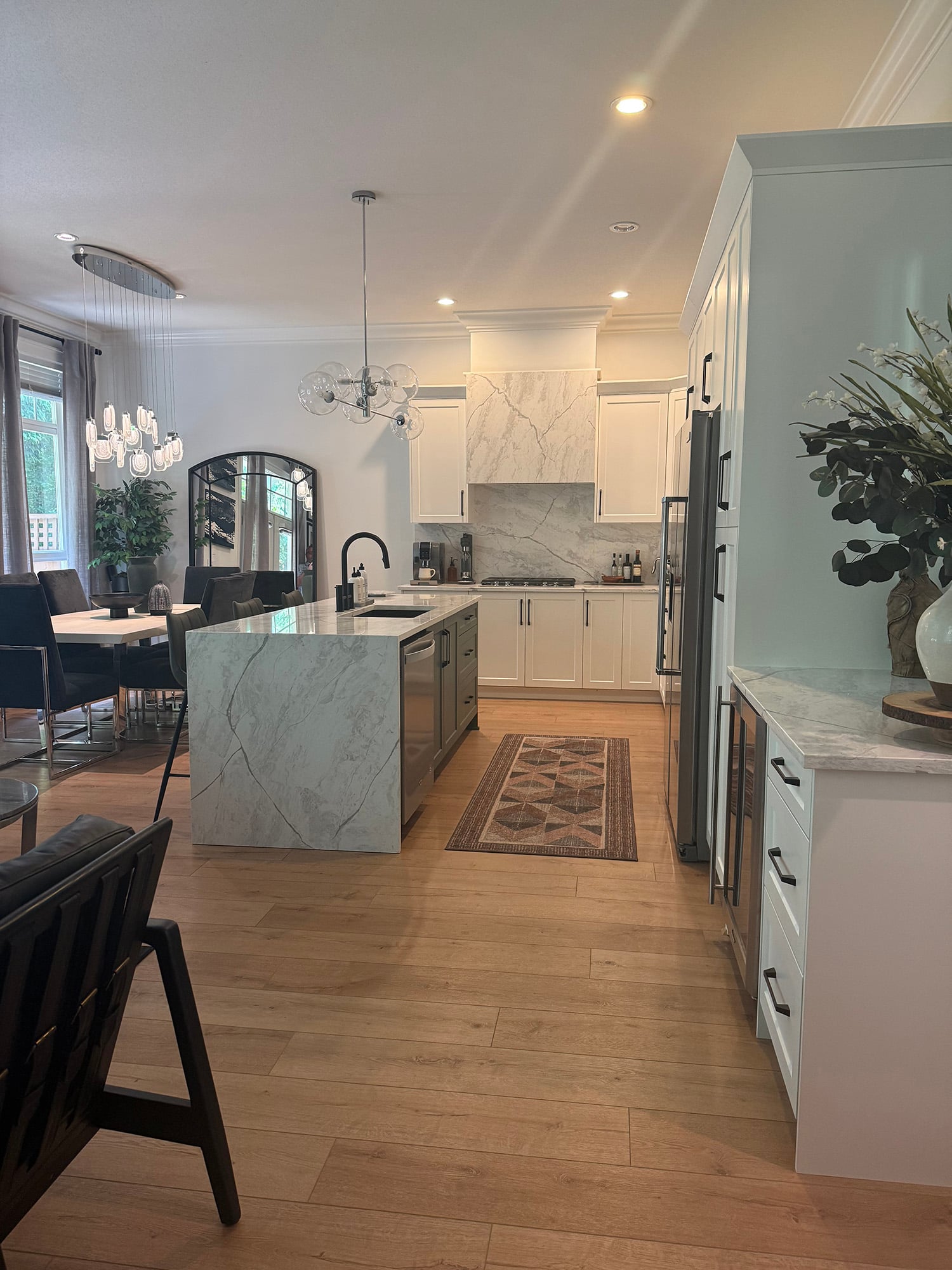
In my own kitchen renovation, I made the same design decision — a rectangular white quartz hood with subtle gray veining that matches the countertops and backsplash. The material continuation from countertop to backsplash to hood creates an integrated, architectural quality that a contrasting hood rarely achieves. White cabinets on either side of the hood, light oak flooring, an olive green island front with a quartz waterfall edge, and a black faucet complete the palette — the hood becoming part of the overall material composition rather than a separate element within it.
Designer Tip: I recommend this approach specifically when the countertop or backsplash material is distinctive — a strongly veined marble, a dramatic quartzite, or a textured stone. Extending that material to the hood amplifies the stone’s presence in the kitchen rather than interrupting it with a contrasting hood finish.
My Kitchen with a White Quartz Range Hood
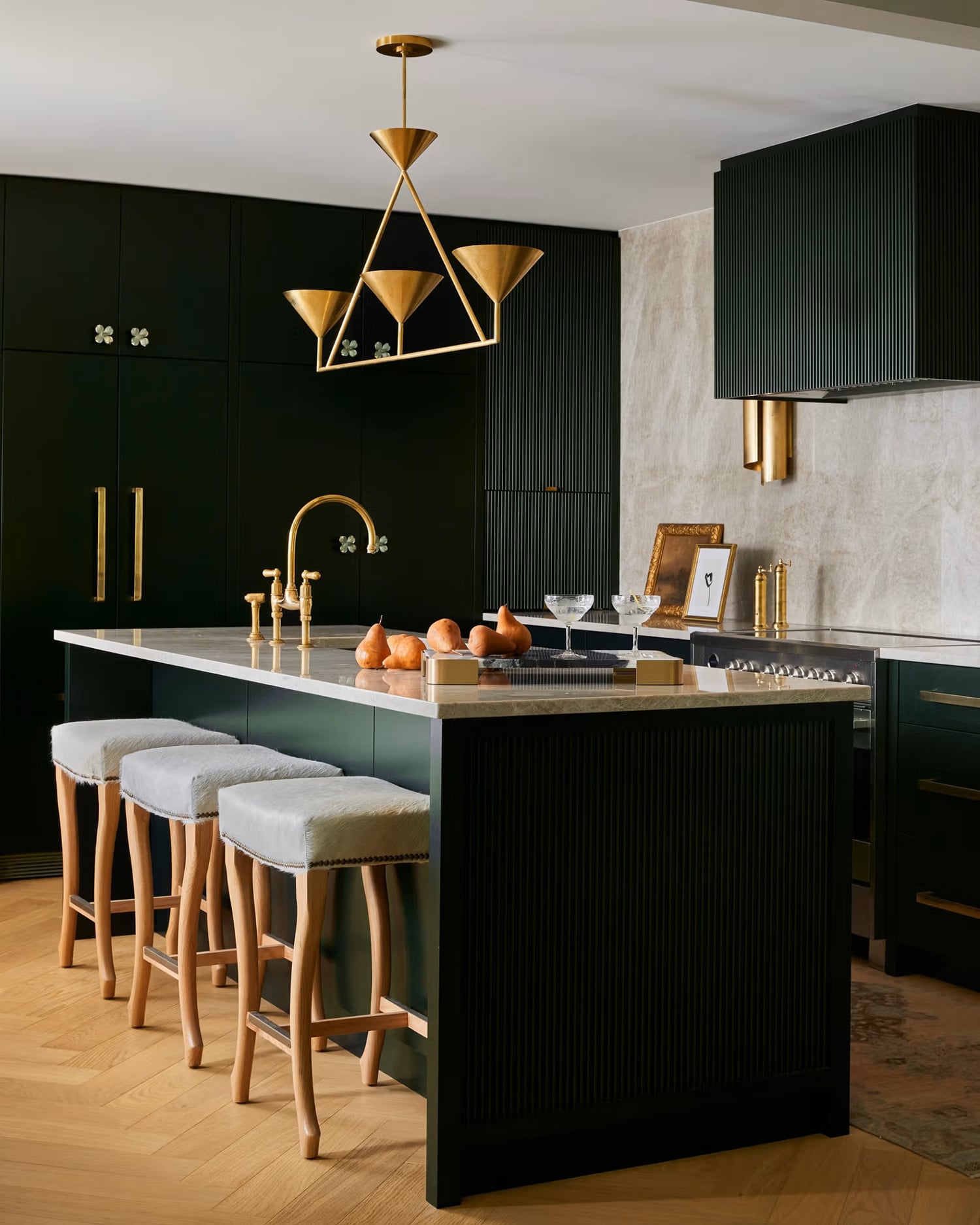
14. Fluting Details on the Range Hood and Cabinetry
Fluting has become one of the most prevalent surface treatments in contemporary kitchen design — the vertical channel detail adds depth and tactile quality to flat cabinet and hood surfaces without introducing color or pattern, making it one of the most versatile texture choices available.
This kitchen by Cristina Kirby of For Studio shows fluting applied with full commitment across both the range hood and upper cabinetry in dark green — the texture adding definition and visual depth to what could otherwise read as a heavy expanse of single-color cabinetry. Gray, cream, and tan marble countertops and backsplash provide the natural material contrast below, while the dark green island base connects the upper and lower kitchen in the same color. Light wood parquet flooring introduces warmth at floor level, and contemporary brass pendant lighting above the island with curvilinear brass wall sconces on either side of the hood add the warm metallic accent that lifts the deep green palette. The kitchen cabinetry fluting detail is the decision that gives the entire room its distinctive character.
Designer Tip: I recommend fluting as a hood surface treatment when the hood and surrounding cabinetry share the same color — the texture provides the visual separation and definition that prevents a single-color upper kitchen from feeling flat, without requiring a contrasting finish or material.
Dark Green Fluted Hood
Image courtesy of For Design
15. Drawing the Hood Color from the Backsplash
Pulling the range hood color directly from the backsplash tile palette is one of the most considered approaches to hood specification — the material connection between the two surfaces creates a cohesion that feels designed from the beginning rather than assembled from separate decisions.
Interior designer David Frazier applied this principle in a neutral kitchen where a custom plaster hood in a warm tan shade draws its color directly from the glossy tonal backsplash in warm cream and light brown tones. The result is a large, sculptural hood that feels native to the kitchen rather than placed within it. Custom white oak cabinetry and reclaimed European white oak — chosen for its rustic yet modern aesthetic — establish the natural material foundation, while Arabescato marble from Ciot covers the countertops. Origin Made stools from Design Within Reach, warm white walls, light oak flooring, and dramatic black accents complete the layered, kitchen remodel composition that balances warmth and precision throughout.
Designer Tip: I recommend this approach when the backsplash tile has a distinctive color or tone worth amplifying — extending that color to the hood creates a visual anchor above the cooking zone that connects the two most prominent surfaces in the kitchen into a single composition.
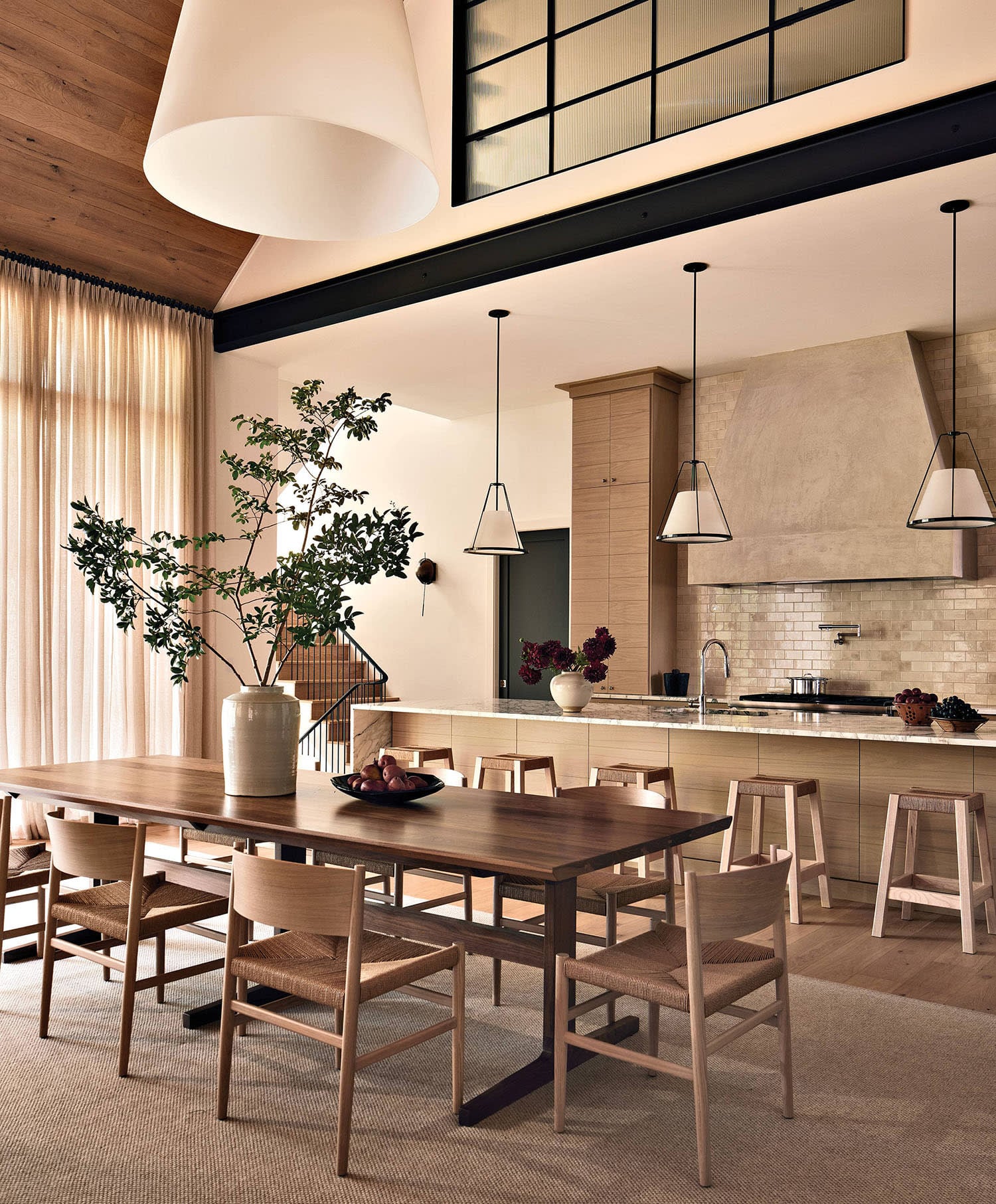
Using the Backsplash for Color Inspiration
Image courtesy of David Frazier Design
16. Curving Forms
Curved range hood forms introduce a softness to kitchen architecture that rectilinear hoods can’t achieve — the organic silhouette contrasts with the hard lines of cabinetry and countertops in a way that makes the hood feel genuinely sculptural rather than purely functional.
Donna Mondi’s Hidden Lakes Project shows curving forms applied with complete material confidence. The glossy black hood rises vertically with curving edges — its reflective surface amplifying the dramatically veined countertops and backsplash, likely Cristallo Bakayal quartzite with its bold contrast of white, black, and soft gray tones. Black cabinetry flanked by black-framed upper cabinets with reeded glass creates the dark architectural envelope that makes the veined stone and curved hood read at maximum intensity. A light oak island base with curved edges introduces the warm natural material counterpoint, and curving counter stool backs echo the hood’s organic form throughout. As Mondi describes the project: the design achieves its impact through restraint, craftsmanship, and a nuanced understanding of texture — every finish selected to soften the rigor of the architecture while creating a cohesive experience that feels both considered and deeply personal. A wood ceiling and dark cabinetry complete the contemporary composition.
Designer Tip: I recommend curved hood forms when the design intention is to introduce an organic, sculptural quality to the kitchen — the curved silhouette signals a level of custom craftsmanship that a standard rectilinear hood never achieves, and it softens the overall architectural character of the space in a way that feels considered rather than decorative.
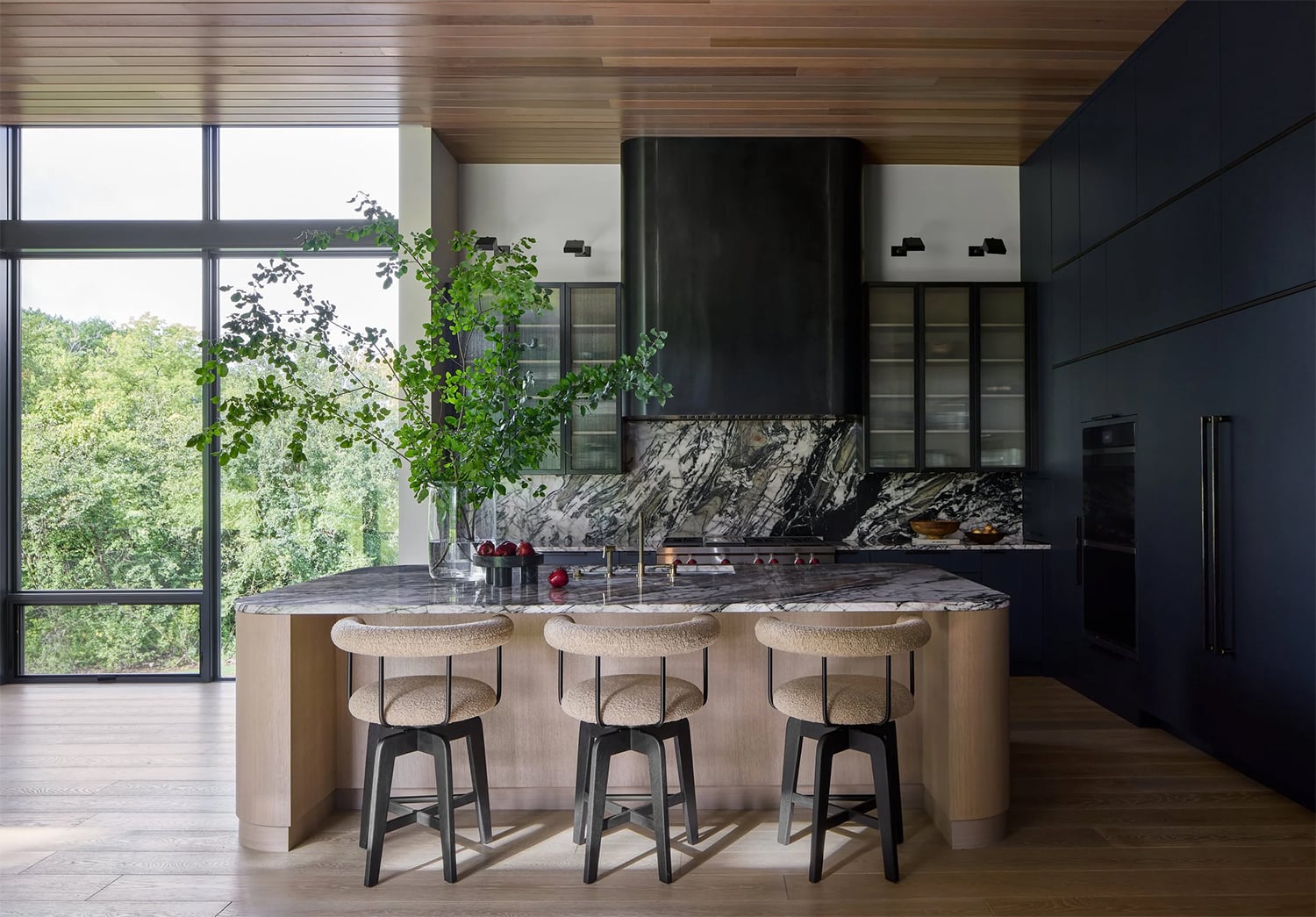
Curved Vent Hoods
Image courtesy of Donna Mondi Design
17. Consider What Flanks the Range Hood
The range hood doesn’t exist in isolation — the cabinetry, shelving, and display on either side of it create the full cooking wall composition that determines whether the hood reads as a considered architectural element or simply a ventilation fixture.
This kitchen by Lindye Galloway shows a cooking wall composition of genuine complexity. A large rectangular fluted hood anchors the center, flanked immediately on each side by black-framed cabinets with reeded glass, then open wood shelving beyond — the three distinct elements creating a layered wall composition that moves from the formal reeded glass to the more relaxed open shelving as it extends outward. The open shelving is styled with artwork, serving ware, and sculptural pieces — the display quality giving the cooking wall the same considered character as a living room bookshelf. Two kitchen islands with light oak bases — one with white marble waterfall edges, one with black — anchor the floor space, their contrasting tops creating the rustic-modern balance that defines the kitchen’s character.
Designer Tip: I recommend designing the full cooking wall — hood, flanking cabinetry, and shelving — as a single composition rather than making each element decision independently. The relationship between the hood and what sits beside it is what gives the cooking wall its architectural coherence.
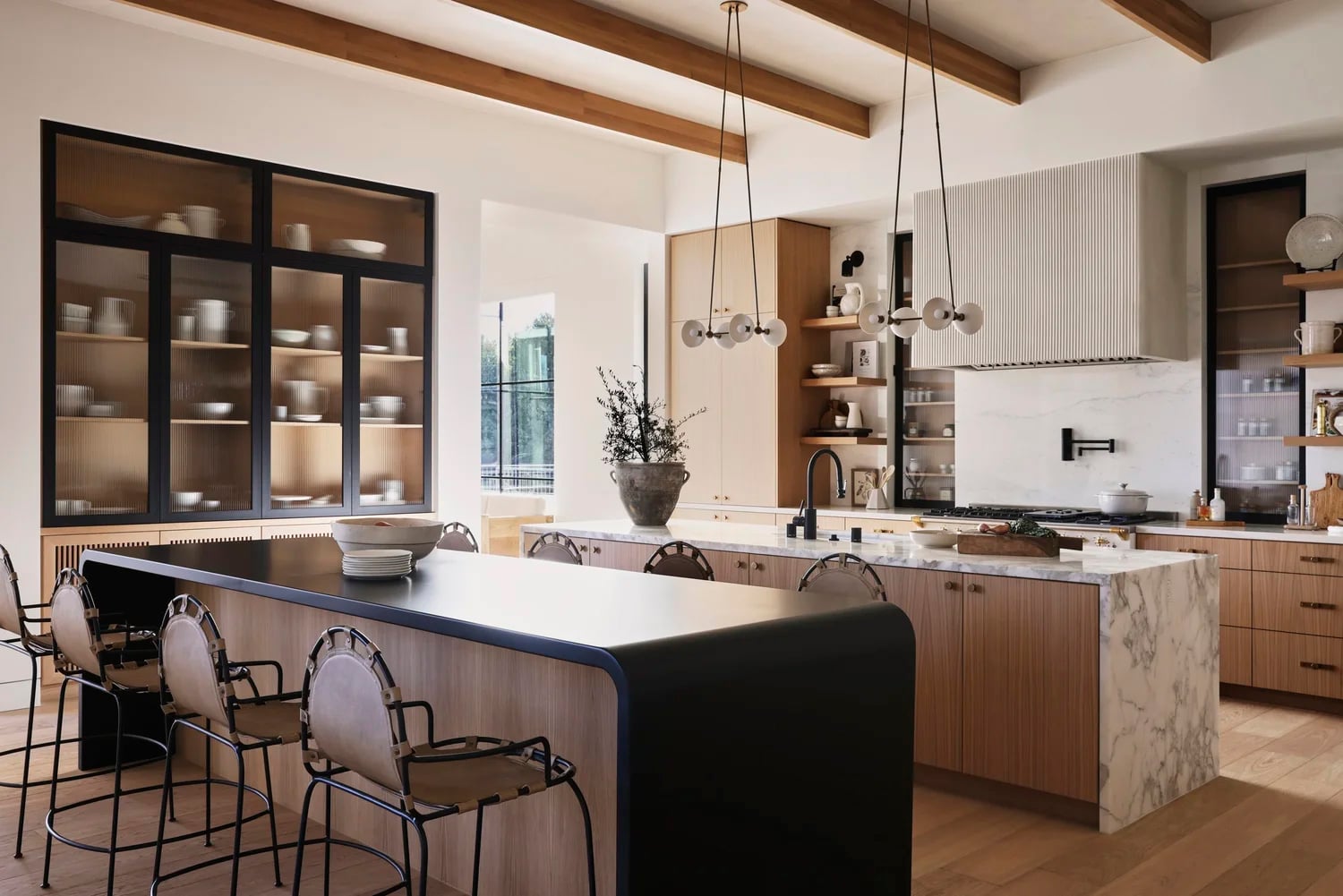
Fluted Range Hood Design
Image courtesy of Lindye Galloway Design
18. When Luxurious Finishes Do the Work
The most restrained kitchen designs often have the highest material investment — when every finish is genuinely luxurious, a simple sculptural hood and clean cabinetry lines carry more visual weight than a heavily detailed kitchen with modest materials.
This kitchen by Erik Maille demonstrates that principle throughout. A gently curving vent hood in a warm neutral tone sits above two-toned taupe and cream cabinetry — the hood’s simple sculptural form doing its work quietly against the richly veined marble countertops in white with gray and copper-brass toning that connects naturally to the brass details throughout. Brass open shelving, thick marble slab countertops, herringbone light oak floors, and a fluted island base with one straight edge curving generously to accommodate six chairs — each finish chosen for its material quality rather than its decorative impact. The brass tones in the marble veining, the brass shelving, and the brass hardware create a material consistency that feels genuinely considered rather than accumulated. Contemporary lighting completes the composition.
Designer Tip: I find that a simple hood form works most effectively when the surrounding materials are doing the heavy lifting — heavily veined marble, hand-finished brass, and herringbone flooring provide enough visual richness that an elaborate hood shape would compete rather than contribute.
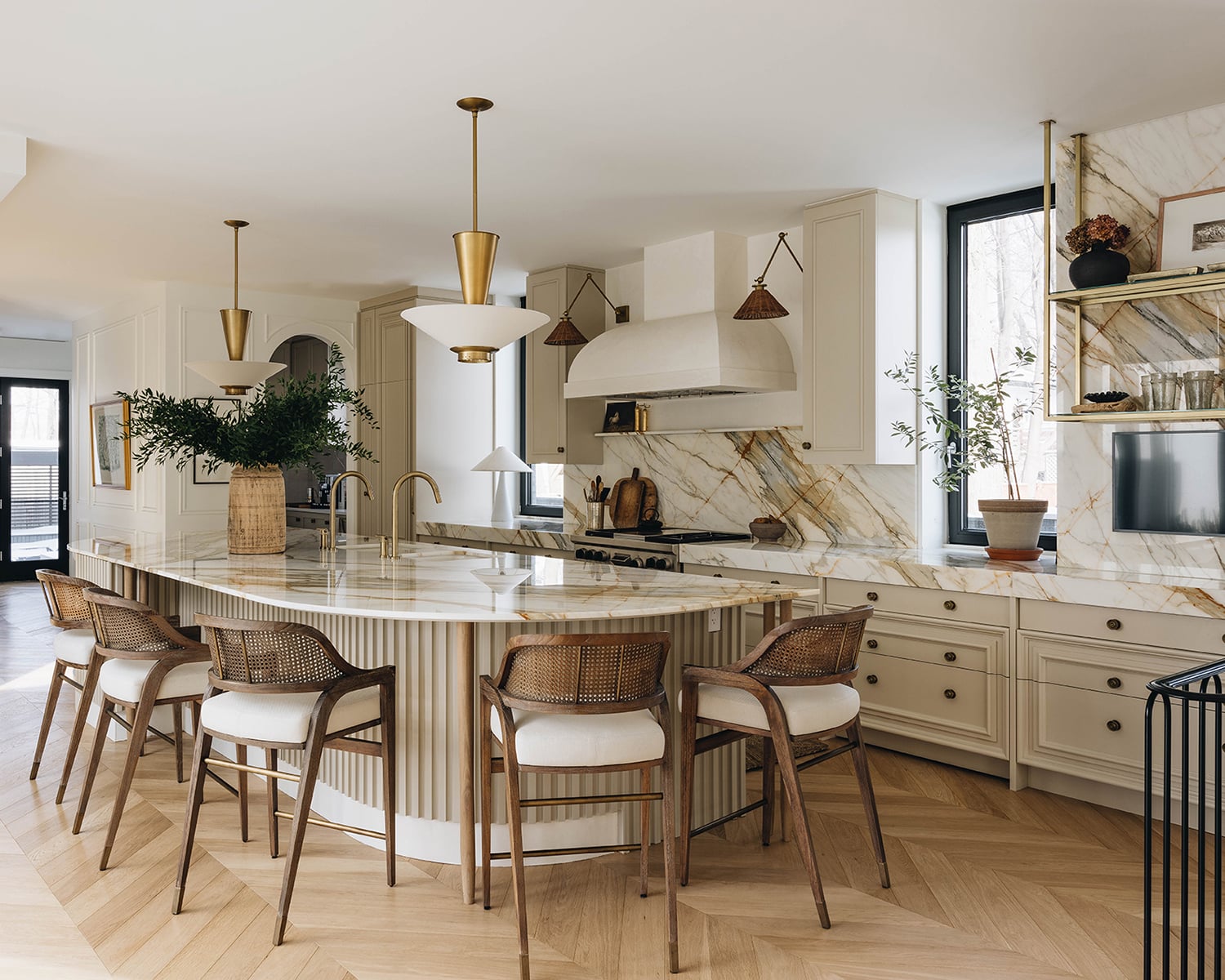
Modern Kitchen with Parisian Charm
Image courtesy of Eric Maille Design
19. A Plaster Arch Hood In a Handcrafted Log Home
A plaster arch hood is one of the most historically rooted range hood profiles — the arched opening references European farmhouse and old-world kitchen traditions in a way that connects naturally to the handcrafted log construction surrounding it.
This lake house kitchen in the Mauricie region by Blanc Marine shows the plaster arch hood at its most contextually appropriate. The cream plaster hood with its large arched opening framing the dark range surround sits against round handcrafted log walls and warm exposed ceiling beams — the pale plaster providing a deliberate light counterpoint to the warmth of the timber throughout. A dark charred wood island base with a light stone countertop anchors the kitchen center, flanked by rush seat bar stools with light wood frames that connect to the natural material palette of the logs above. A brass pot filler, black cone pendant lights suspended on chains, cream cabinetry with open shelving, and slate stone flooring complete the layered, deeply considered material palette. A white linen sofa visible in the foreground confirms the open-concept connection between kitchen and living space — the plaster hood visible and architecturally significant from every angle in the room.
Designer Tip: I recommend plaster hood profiles specifically in log home and rustic kitchens — the hand-applied plaster surface shares the same material authenticity as the log walls and stone flooring, creating a cohesion between the hood and the architecture that a manufactured metal or painted wood hood rarely achieves in this context.
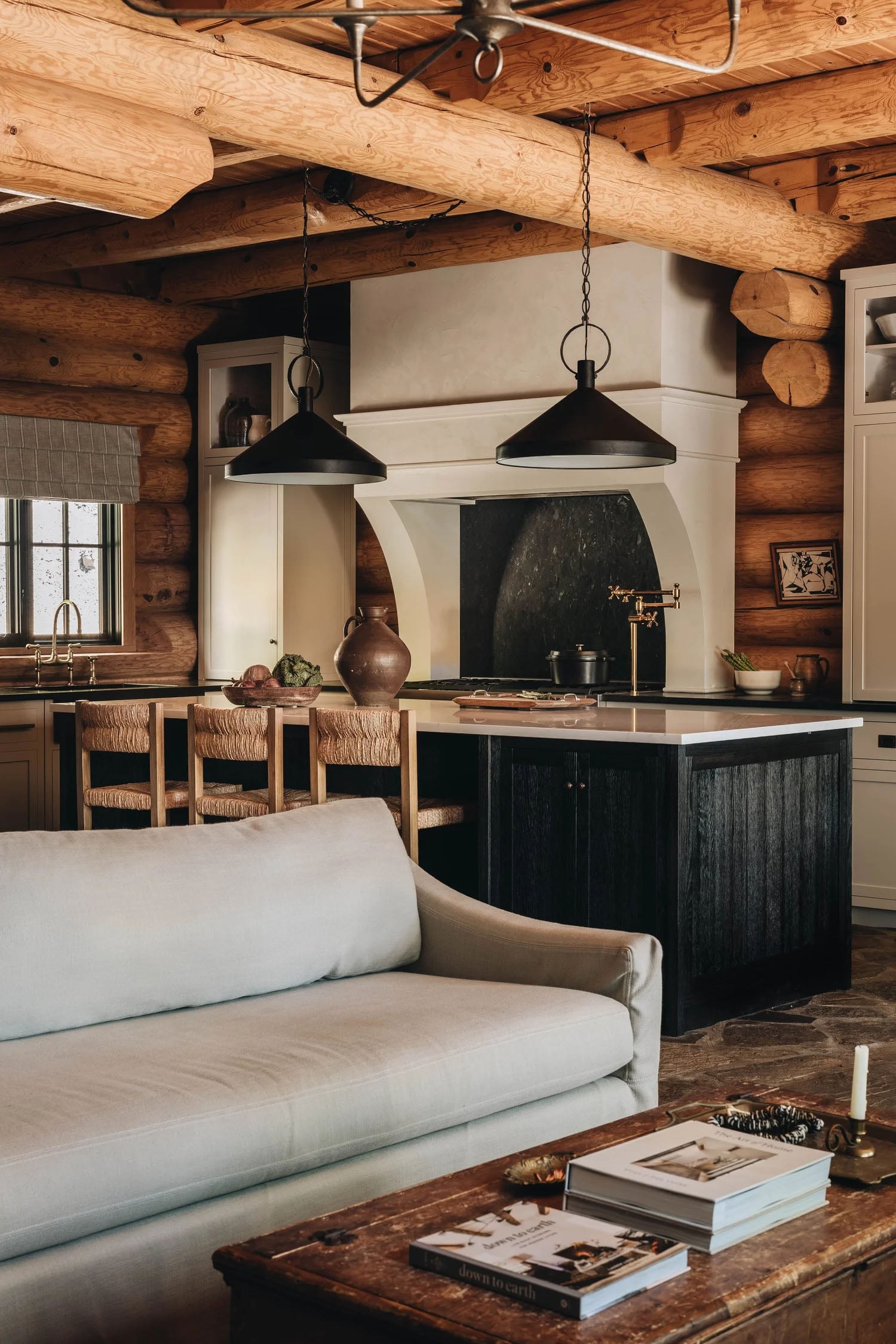
Vintage Hood in a Handcrafted Log Home
Image courtesy of Blanc Marine Design
20. A Zinc Hood with Brass Detailing in a Farmhouse Kitchen
A custom metal range hood in a zinc or pewter finish occupies a material category between the warmth of brass and the coolness of stainless steel — the matte gray-silver tone suits farmhouse and country kitchens precisely because it reads as aged and authentic rather than manufactured.
This farmhouse kitchen by Valerie Grant shows the zinc hood used as the room’s primary focal point alongside a Lacanche range — the two elements together establishing the cooking zone as the kitchen’s most architecturally considered moment. Vertical brass accent strips on either side of the hood connect directly to the brass cabinet hardware, pot filler, and warm brown pendant lights with brass hardware above the island — the metallic thread running consistently from ceiling to countertop. Off-white cabinetry with burnished metal accents pairs with light oak island base, light quartzite countertops, a Zellige-style square tile backsplash in warm cream tones, warm wood flooring, and a wood-paneled ceiling. Fresh herbs lining the windowsill and a generous arrangement of peaches on the island give the country kitchen its genuinely lived-in quality — a room that functions as well as it looks.
Designer Tip: I recommend matching pendant light finishes to the range hood material when the hood is a distinctive metal — the repetition of the same tone at ceiling level connects the hood to the broader kitchen composition rather than leaving it as an isolated focal point below.
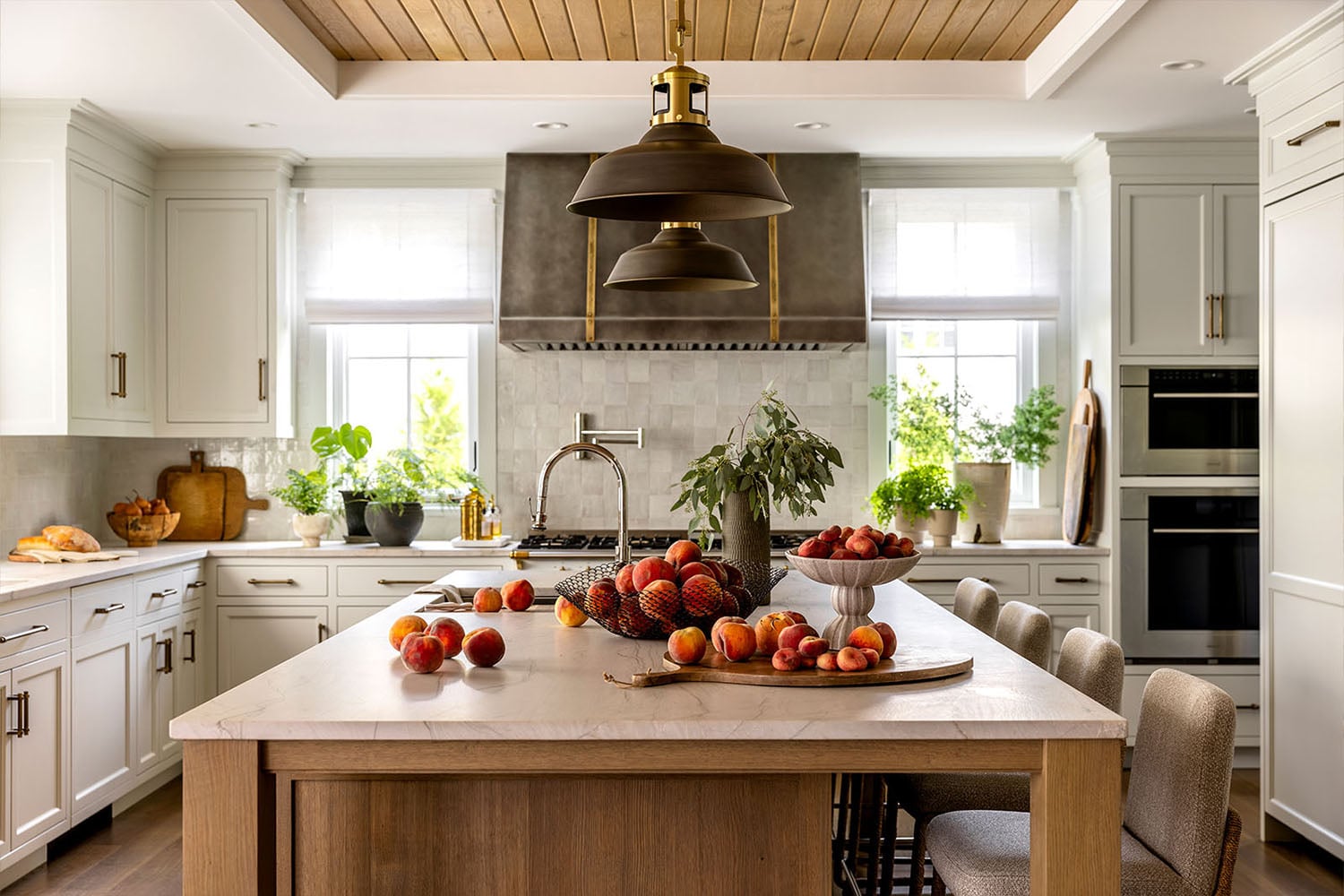
Modern Farmhouse Range Hood
Image courtesy of Vallerie Grant Design
21. A Hood That Reaches the Ceiling
A range hood that extends from above the cooking surface to the full ceiling height is one of the most architecturally assertive decisions available in kitchen design — the vertical form draws the eye upward and makes the ceiling height a feature rather than simply a spatial quality.
This kitchen by The Lifestyled Co. shows the approach with complete commitment. A matte black hood rises to the full height of the cathedral ceiling, commanding the cook’s wall with a scale and presence that makes it the room’s undisputed focal point. White cabinetry, a white marble backsplash with gray veining, and white-and-gray marble countertops with waterfall island edges create a high-contrast backdrop that allows the black hood to read at full intensity. Three black pendant lights above the fluted light wood island base connect the ceiling-height hood to the island below — the black tone repeated at a lower level anchoring the vertical composition. The backsplash slab marble runs to the ceiling alongside the hood, the continuous stone surface amplifying the vertical emphasis throughout.
Designer Tip: I recommend extending a hood to the full ceiling height specifically in kitchens with cathedral or unusually high ceilings — the vertical form justifies the ceiling height architecturally rather than leaving unused wall space above a conventionally proportioned hood.
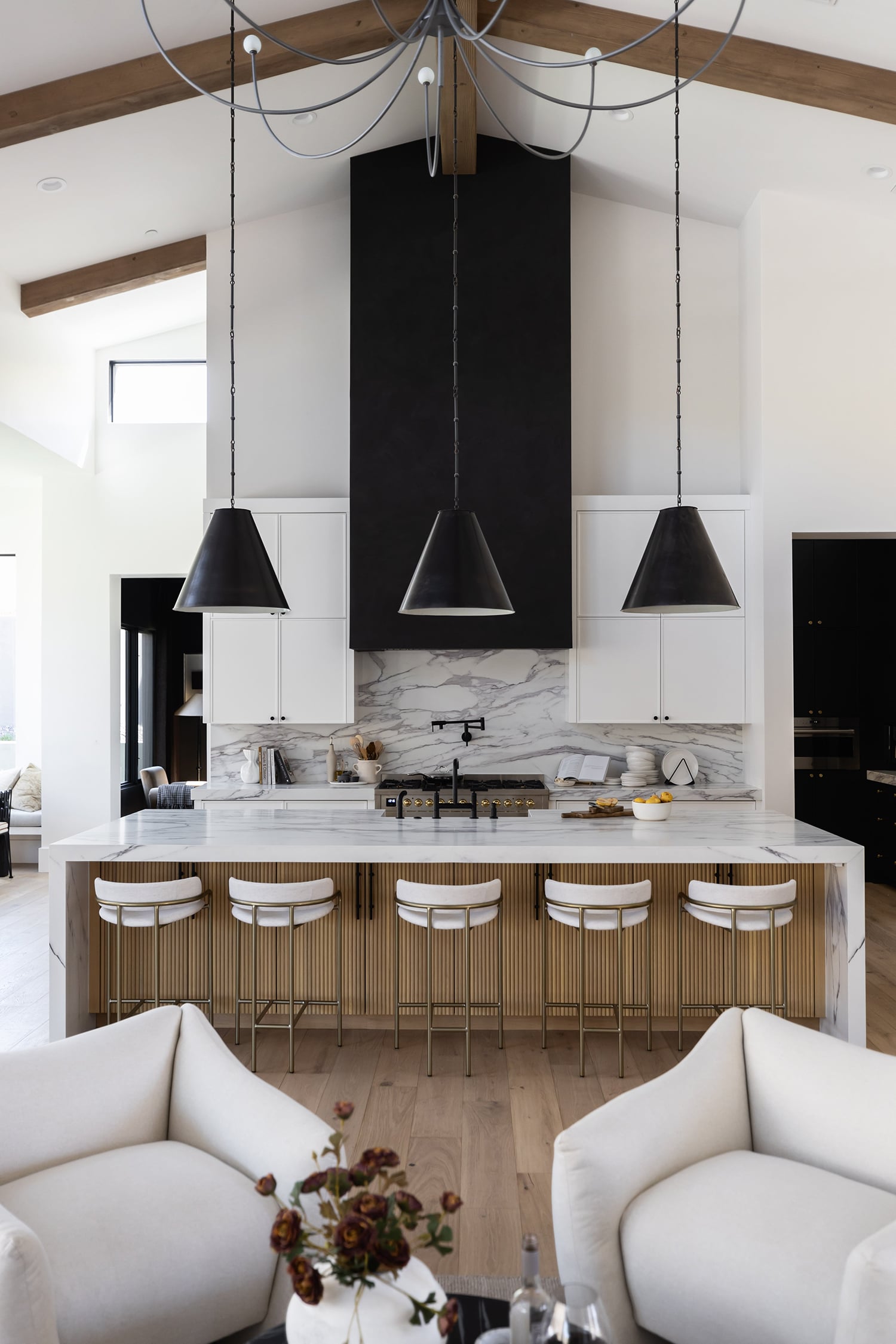
Long & Narrow Rectangular Vent Hood with High Ceilings
Image courtesy of The Lifestyled Co.
22. Let the Backsplash Take Center Stage
When the backsplash tile is the kitchen’s most distinctive material moment, the range hood should recede rather than compete — a simple, sculptural hood in a neutral finish allows the tile work to carry the visual weight it deserves.
This farmhouse family home by Honeycomb Design shows that principle applied with genuine material sophistication. A star-and-cross ceramic tile backsplash in a warm cardamom tone covers the wall and surrounds the sculptural warm-white range hood — the tile pattern doing the decorative work while the hood’s clean form provides the architectural anchor. Knotty alder cabinetry with a cashew stain introduces the warm, organic wood quality that connects naturally to the cardamom tile tones, while white Calacatta marble with gray and gold veining on the island waterfall edges adds the refined stone material counterpoint. A large arched black-framed window frames the composition — its dark frame providing the high-contrast element that prevents the warm neutral palette from feeling too uniform. The farmhouse material palette throughout — knotty wood, handmade tile, and natural stone — creates the lived-in, heritage quality that defines the style.
Designer Tip: I recommend a plain, simply profiled hood in a neutral finish when the backsplash tile is patterned or distinctive — the restraint of the hood allows the tile to read as the design statement rather than competing for attention.
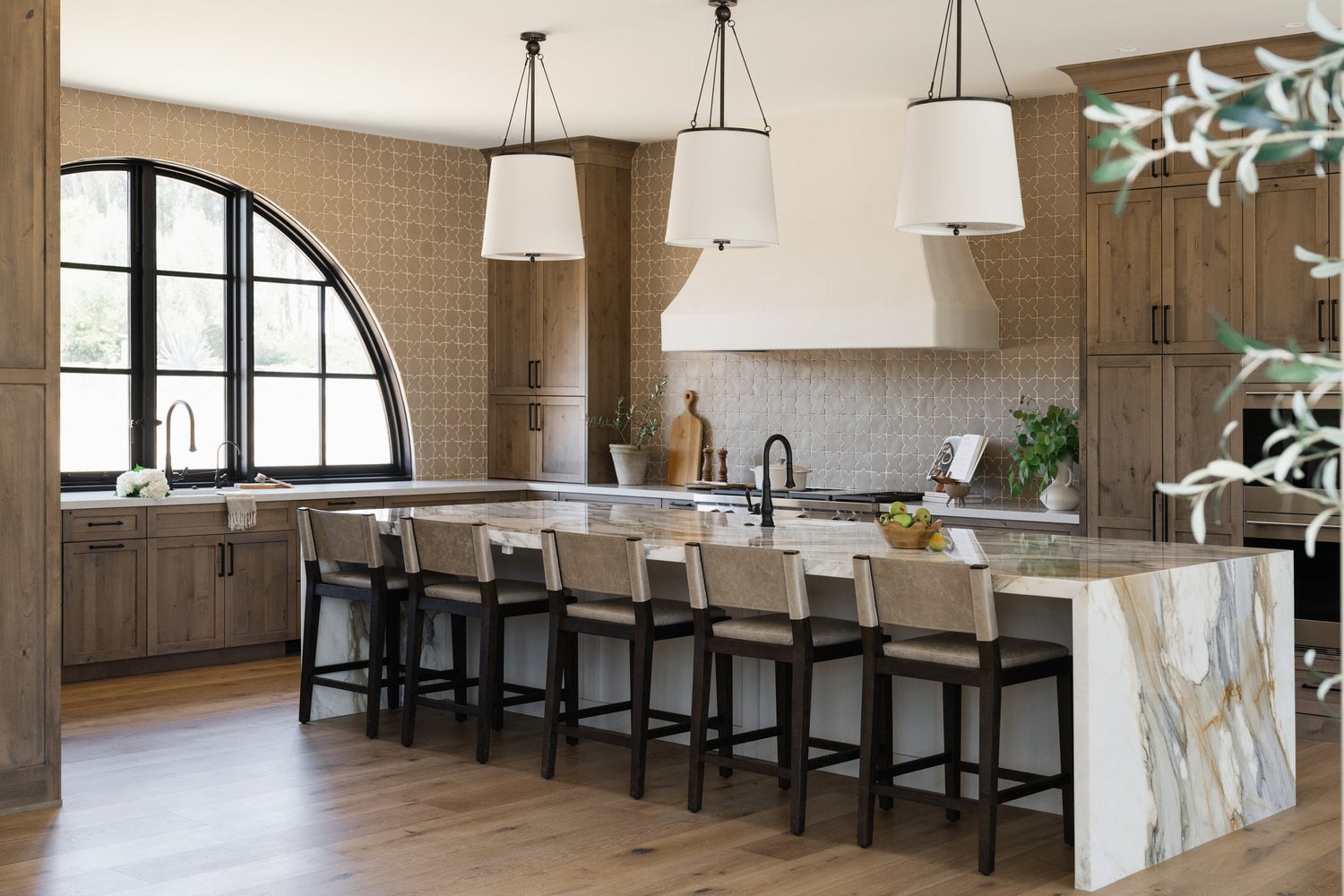
Let the Backsplash Stand Out
Image courtesy of Honeycomb Design
23. A White Hood with Fluted Trim
Adding a wood trim detail to a painted range hood bridges the gap between a fully integrated wood hood and a plain painted one — the wood introduces natural material warmth without committing the entire hood surface to a single material.
This kitchen by Parris McKenna in The Beaches shows the combination used with real material layering. A white hood with decorative fluted wood trim sits between solid light oak cabinets on either side and black-framed glass cabinets beyond — the white hood providing deliberate contrast within an otherwise warm, natural wood cabinet palette. A black-and-white backsplash introduces a high-contrast graphic element, while a fluted kitchen island connects the hood’s wood trim detail to the island base below. Well-dressed countertops with wood bowls, fresh herbs, and brass decor add the personal, lived-in quality that makes the kitchen feel genuinely inhabited rather than staged.
Designer Tip: I recommend a white or painted hood with wood trim in a kitchen with predominantly natural wood cabinetry — the white provides the light contrast that prevents the wood palette from feeling too heavy, while the wood trim detail connects the hood back to the cabinetry material rather than reading as a completely separate element.
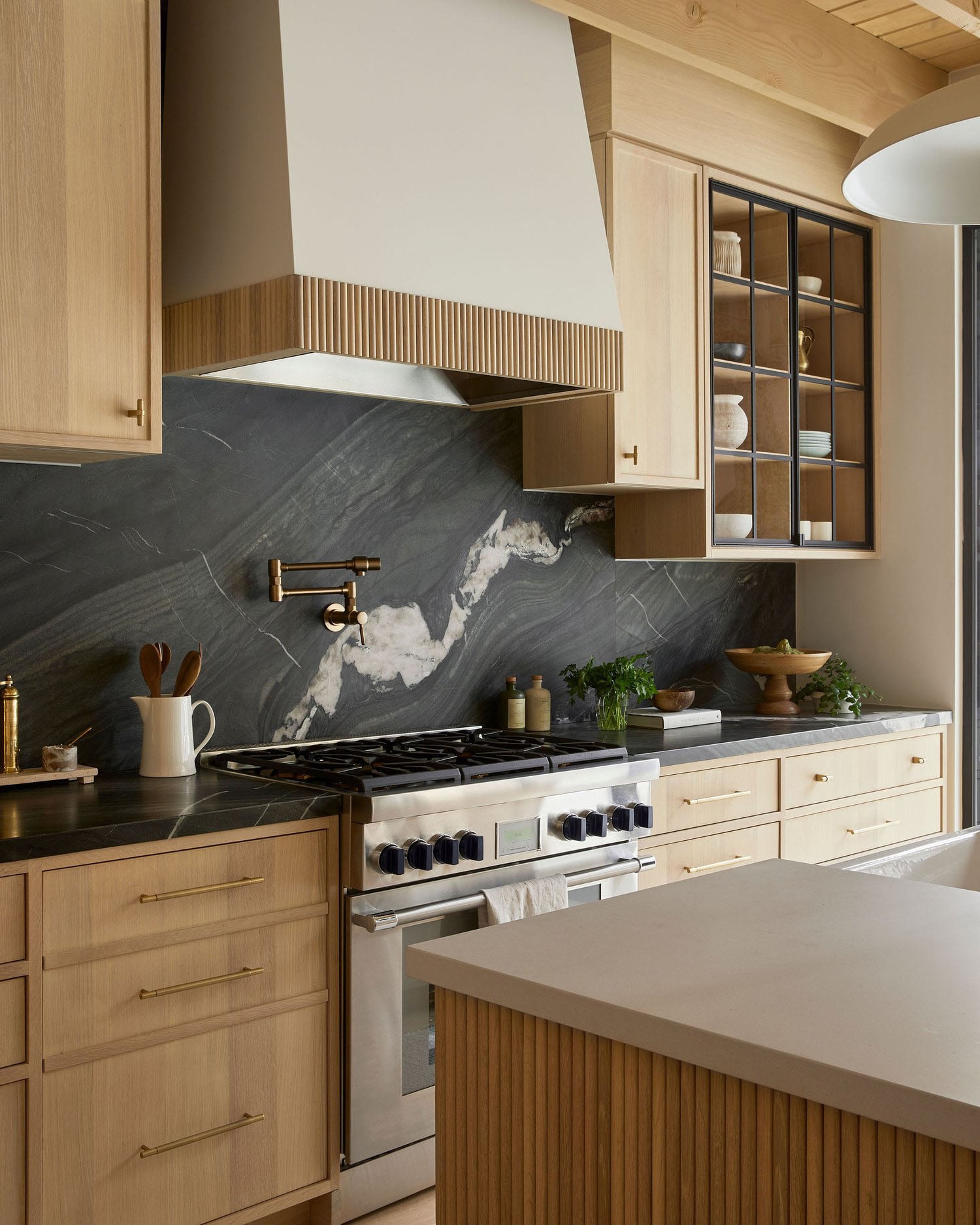
Range Hood with Stone Accent Wall
Image courtesy of Parris McKenna Design (Lauren Miller Photography)
24. Integrate the Vent Into a Stone Feature Wall
Integrating the ventilation into a natural stone feature wall rather than specifying a conventional range hood is one of the most architecturally resolved approaches in kitchen design — the cooking zone becomes part of the building’s structure rather than a furnished area within it.
This Muskoka cottage kitchen by Parris McKenna shows the approach at its most dramatic. A large irregular fieldstone wall in warm gray, tan, and brown tones runs across the entire upper kitchen, wrapping from the wood ceiling down to frame the cooking zone — the stainless vent insert recessed invisibly into the masonry rather than projecting from it. The stone wall’s warm tones are deliberately echoed throughout the kitchen: the light oak island base with open-end shelving styled with books, ceramics, and brass accents, the herringbone light oak flooring, and the wood ceiling all share the same warm material palette as the fieldstone above. A dark charcoal quartz island countertop and dark charcoal upholstered counter stools with curved backs provide the high-contrast element, while three white dome pendant lights with black cage detail on chains and a brass pot filler beside the range add the refined metallic accents that connect the stone accent wall to the broader kitchen composition.
Designer Tip: I recommend integrating the vent into a stone or brick feature wall wherever the architecture allows — the result reads as genuinely built rather than decorated, and it removes the hood as a separate design decision entirely. The stone wall becomes the cooking zone’s defining element without any additional fixture required.
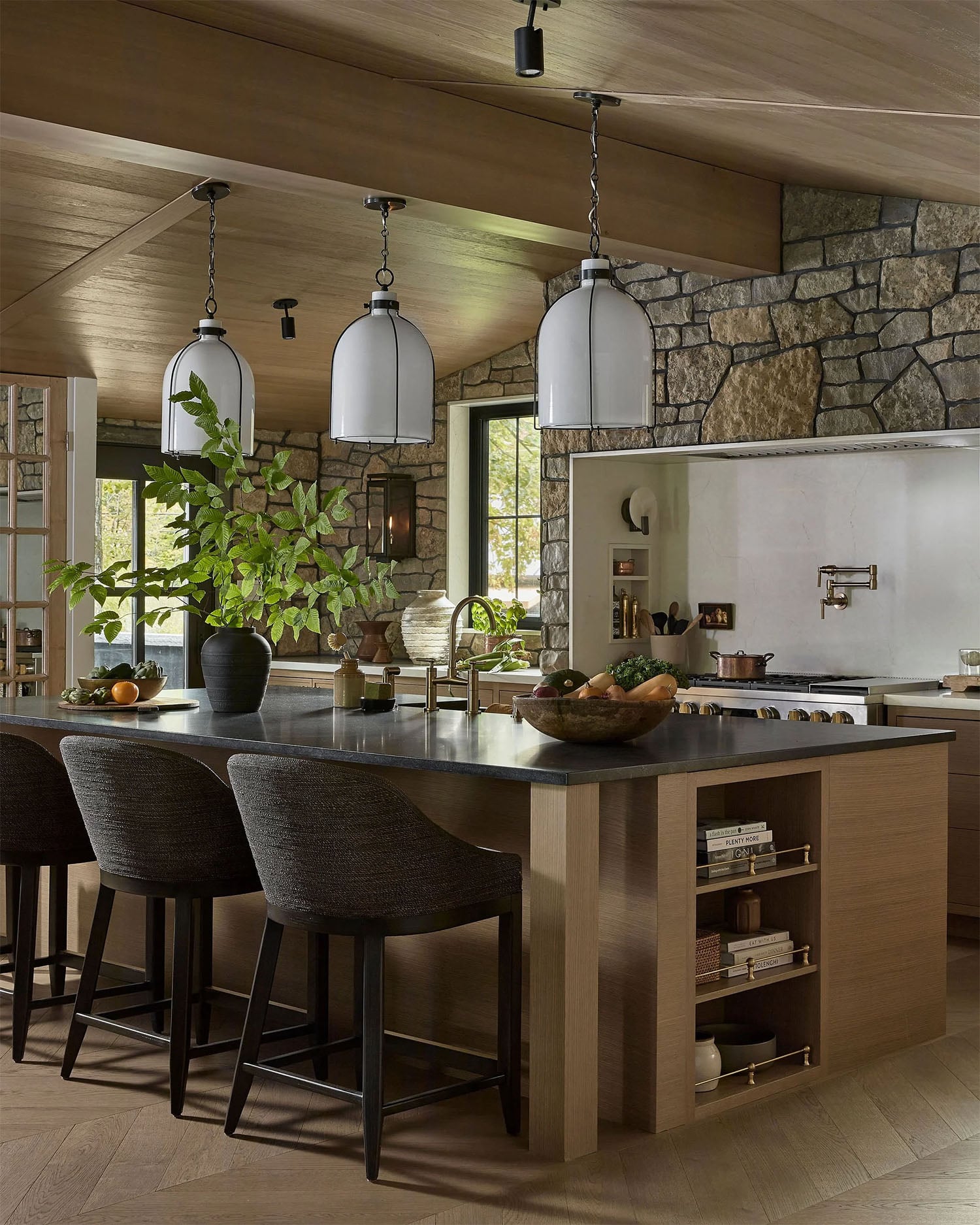
Stone Accent Wall
Image courtesy of Parris McKenna Design (Lauren Miller Photography)
25. Draw Inspiration from the Range
When a statement range is the kitchen’s primary investment — a La Cornue, an Aga, or a similarly distinctive professional appliance — the range hood should be designed in direct response to it, rather than independently. The hood and range together form the complete architectural composition of the cooking zone.
This kitchen by McCroskey Interiors shows that relationship working at the highest possible level. A large, angled stainless-steel hood with brass picture-frame trim spans the full width of the cooking zone above a 60-inch La Cornue range in gray, with extensive brass hardware and detailing — the angled profile of the hood echoing the forward presence of the La Cornue below it. Calacatta Oro marble runs dramatically from countertop to ceiling across the full backsplash, its bold gray veining visible through the cooking zone window and across every surface throughout the kitchen. Custom-stained white oak cabinetry and paneled doors in a warm honey tone introduce a natural wood counterpoint to the marble, while brass cup pulls, faucets, a pot filler, and open brass-and-glass shelving carry the warm metallic thread consistently from the hood trim to the smallest hardware detail.
Designer Tip: I recommend specifying the range hood finish and profile only after the range itself has been selected — the hood should respond to the range’s scale, finish, and character rather than being chosen independently. A La Cornue or similarly distinctive range has specific proportional and material qualities that the hood needs to acknowledge directly.
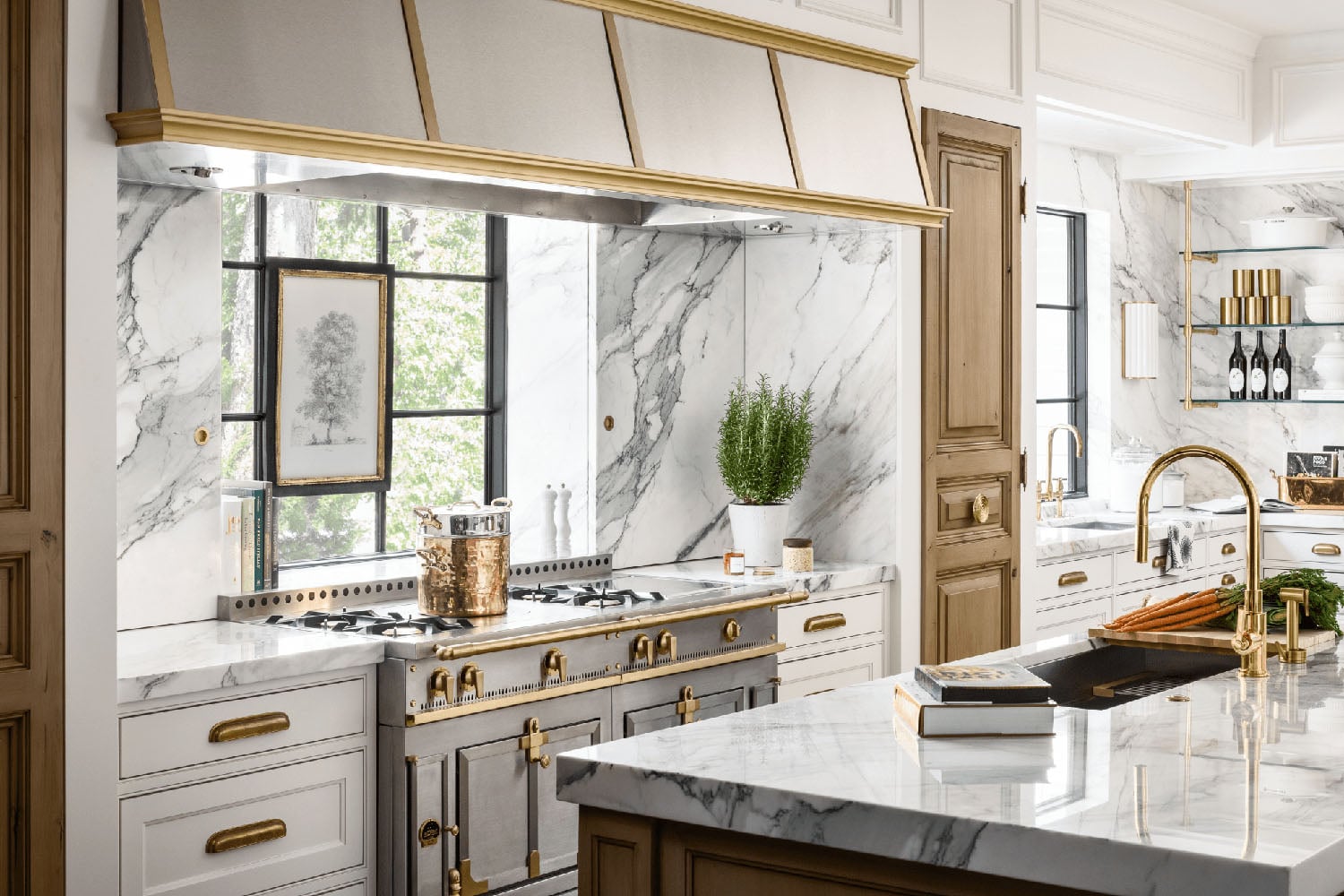
Matching the Design Aesthetic of the Range
Image courtesy of McCroskey Design
26. A Zellige Tile Hood in a Compact Kitchen
Zellige tile — traditional Moroccan handmade clay tile characterized by unique variations in color, shape, and texture — brings a level of material authenticity to a range hood that manufactured finishes can’t replicate. The inherent imperfections in each hand-molded and glazed tile are what give the surface its depth and handcrafted quality.
This 650 sq. ft. cottage kitchen by Parris McKenna shows Zellige used with genuine restraint. The warm neutral tile covers both the backsplash and the long, narrow rectangular hood — a continuous tile surface that connects the two elements into a single material composition above the range. Light oak cabinetry introduces warm natural wood that connects to the earthy, handcrafted quality of the Zellige, while black quartz countertops provide a high-contrast element that prevents the warm neutral palette from feeling too uniform. In a compact kitchen where every design decision carries more visual weight, the Zellige tile hood becomes the room’s defining material moment without requiring the scale that a larger kitchen would demand.
Designer Tip: I recommend Zellige tile for a range hood when the design intention is warmth and material authenticity — the handcrafted variation in each tile creates a surface depth that manufactured finishes can’t replicate, and it suits kitchens where the backsplash and hood are intended to be the primary material statement regardless of the kitchen’s scale.
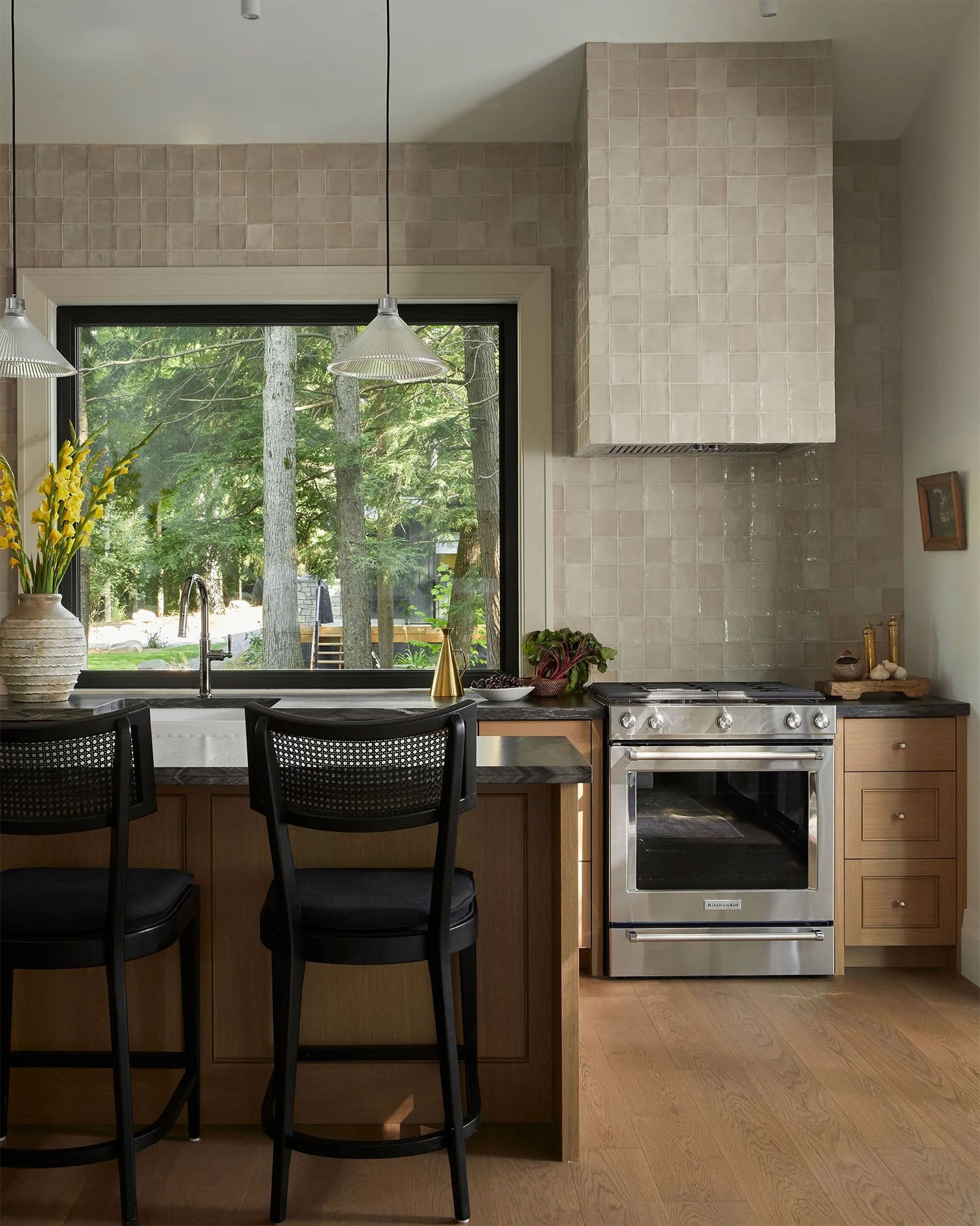
Zellige Tiles
Image courtesy of Parris McKenna Design (Lauren Miller Photography)
27. Suspend Over the Kitchen Island
A suspended island hood — dropped from the ceiling on structural rods rather than attached to a wall — is the most architecturally distinctive ventilation option available, transforming the extraction unit into a sculptural ceiling installation that defines the kitchen’s vertical space.
The Arclinea Proxima kitchen, designed by Antonio Citterio, showcases the Convivium island hood at its most resolved. A geometric black metal frame structure suspended on four vertical black rods descends from the white ceiling above the island, with an integrated extraction unit and LED light strip running horizontally beneath — the hood reading as much as a light fixture and architectural installation as a ventilation element. Matte black cabinetry throughout, Noir Saint Laurent marble on the island countertop, backsplash, and feature wall — its dramatic dark veining creating the bold material backdrop — and black-framed glass upper cabinets lit internally to display ceramics and serveware complete the dark, considered palette. A light oak wood panel wall on the left side provides the essential warm material counterpoint that prevents the black and dark marble composition from feeling oppressive. An open fireplace visible in the adjacent living area reinforces the connection between kitchen and living space throughout.
Designer Tip: I recommend suspended island hoods specifically in open-concept kitchens where the cooking zone sits on an island away from any wall — the suspended form defines the cooking zone from above in a way that no wall-mounted hood can achieve, and it maintains the open sightlines that an island kitchen depends on.
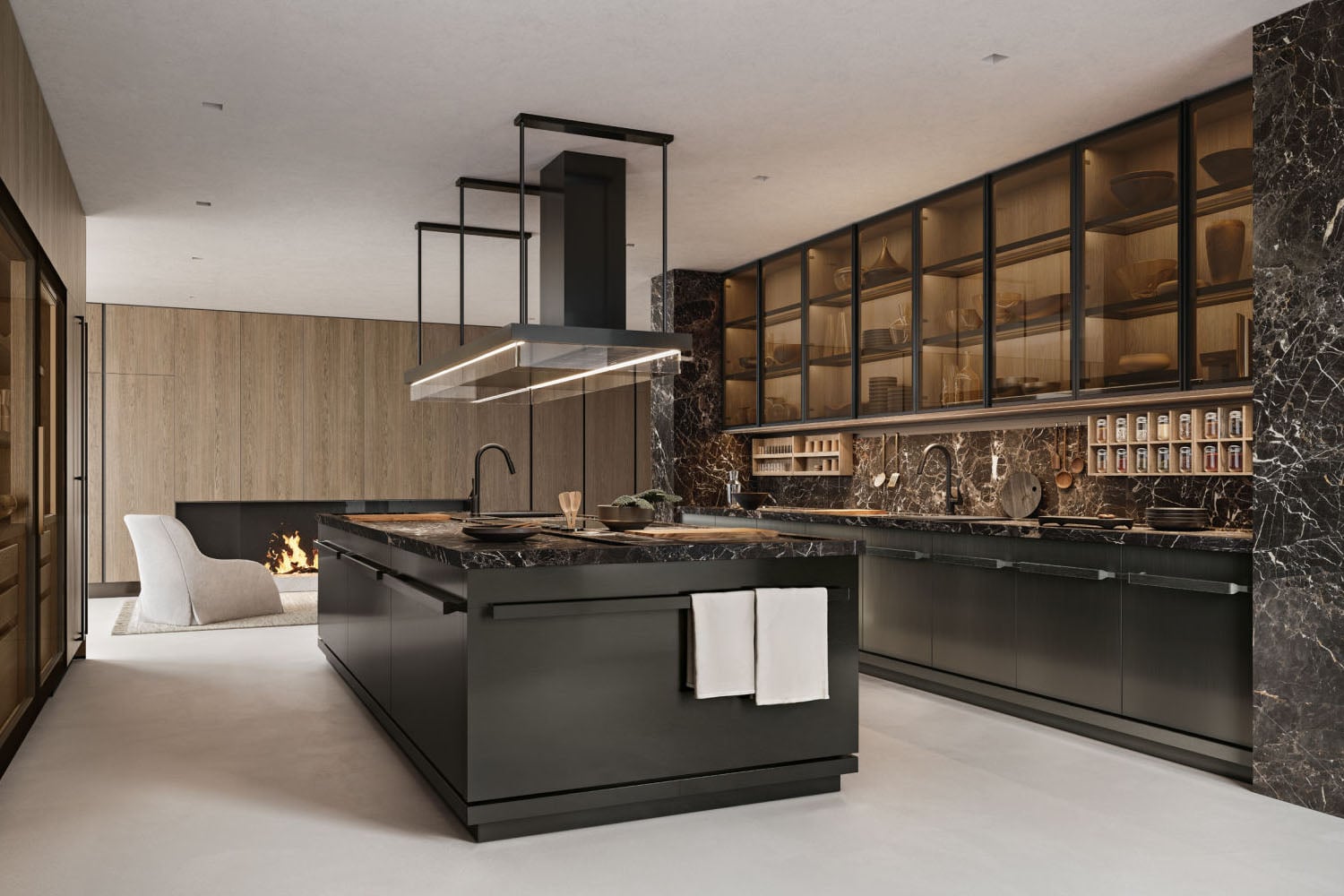
Vent Hood Over the Island
Image courtesy of Arclinea
28. Create Textural Contrast
The most compelling material contrast in a kitchen is often between a warm, consistent wood palette and a single dramatically veined stone surface — the contrast between the organic warmth of the wood and the bold graphic quality of the marble creates a tension that makes both materials read more powerfully than they would independently.
This kitchen by Allison Lind shows that contrast applied with complete material confidence. Light oak cabinetry, wide-plank flooring, and ceiling beams establish a warm, consistent wood foundation throughout — and then the dramatically veined white marble hood and continuous backsplash slab introduce the high-contrast stone element that defines the entire cooking wall. The marble’s gray, gold, and green veining reads as almost painterly against the calm warmth of the oak surrounding it — the two materials in genuine dialogue rather than simply coexisting. A fluted light oak island base with marble countertop, black hardware and pendant lights, glass-front upper cabinets, and upholstered island stools in warm linen complete the composition. An arched doorway leading to the dining room beyond frames the kitchen’s depth and confirms the open, connected quality of the floor plan.
Designer Tip: I recommend a dramatically veined marble hood and backsplash slab specifically in kitchens where the cabinetry is a consistent warm wood tone — the stone provides the visual contrast and material variation that a single-material kitchen needs, and the continuous slab from countertop through backsplash to hood creates the most architecturally resolved version of that contrast.
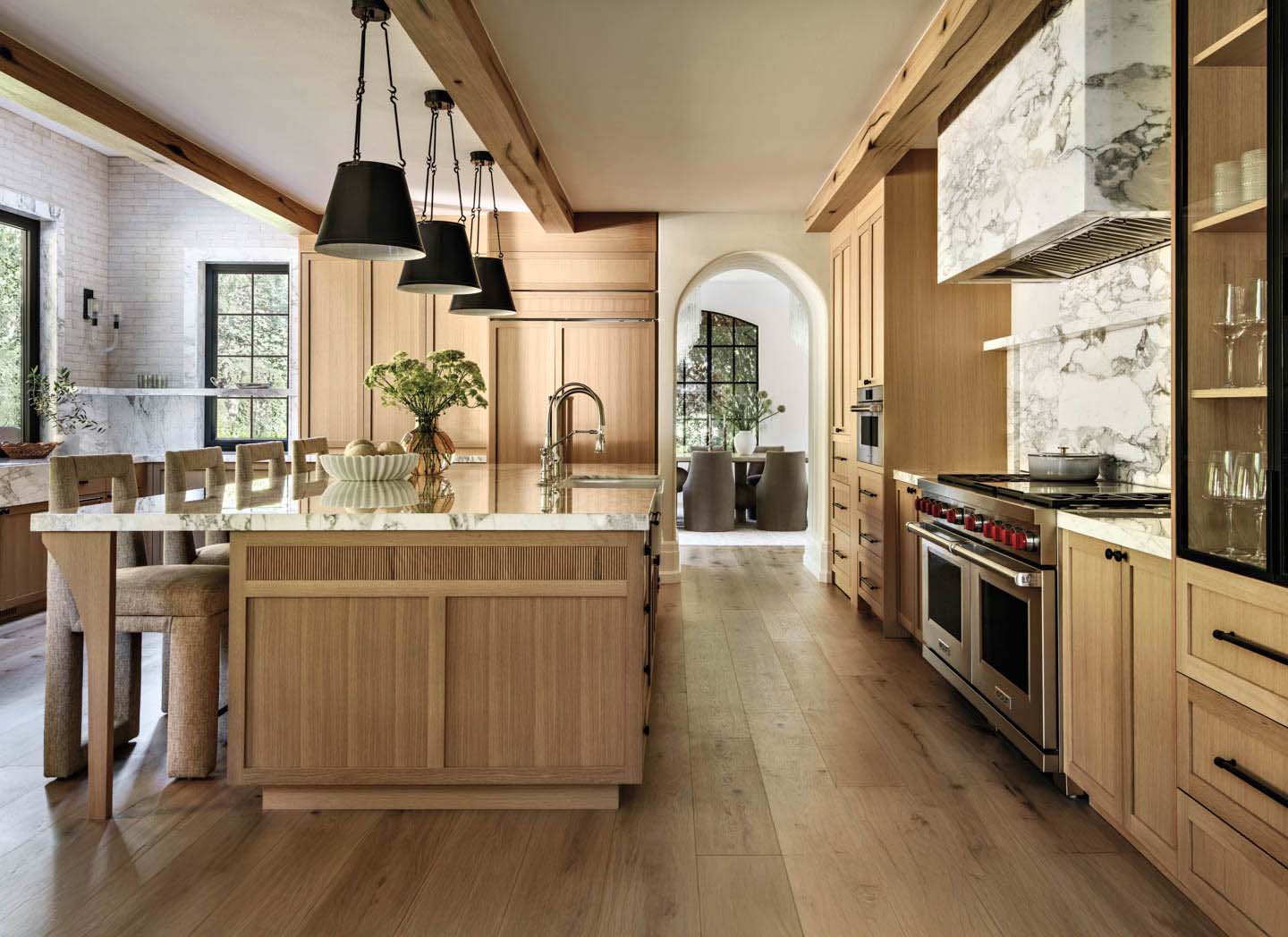
Use the Vent Hood to Create Contrast
Image courtesy of Allison Lind Design
29. Channel Bronze Cast Glass as a Hood Treatment
Architectural cast glass as a range hood treatment represents one of the most distinctive material choices available — the textured, bronze-tinted surface reads as simultaneously glass and metal, adding warmth, depth, and a quality of light transmission that no conventional hood finish achieves.
This kitchen by Atmosphere Interior Design uses Nathan Allan Channel Bronze Architectural Cast Glass for the upper cabinet and hood treatment above the range — the vertical channel pattern in the bronze-tinted glass catching light across its textured surface and creating the warm, reflective quality that defines the cooking wall. Light oak flat-front cabinetry runs the full perimeter, dramatically veined marble in white with gray, gold, and brown tones covers the backsplash, and a light marble island countertop anchors the center. Six taupe leather counter stools with black metal legs, light oak flooring, recessed ceiling lighting, and a large botanical branch arrangement on the island complete a kitchen where the Channel Bronze glass is the single most distinctive material decision — unexpected, refined, and impossible to replicate with a conventional hood specification.
Designer Tip: I recommend architectural cast glass as a hood treatment for kitchens where the goal is genuine material distinction — the textured surface adds the warmth and depth of metal with the light-transmitting quality of glass, creating a cooking zone that reads as genuinely bespoke rather than selected from a standard range of hood finishes.

Ribbed Glass Cabinetry
Image courtesy of Atmosphere Design
The Range Hood as a Design Decision
The range hood has shifted from a functional necessity to one of the most considered material decisions in contemporary kitchen design — and the 29 ideas in this guide reflect the full range of what’s now possible. Hand-carved stone, Venetian plaster, patinated brass, blackened steel, channel bronze cast glass, and fully integrated concealed panels are among the directions that have transformed a utilitarian appliance into a genuine architectural statement.
The most useful way to approach the decision is to start with the kitchen’s existing material palette and work outward — the hood should feel like a natural continuation of the design rather than a separately specified element. Whether that means matching the countertop material, drawing the color from the backsplash tile, or commissioning a custom profile that responds directly to the range below it, the result will always be more resolved than a hood chosen independently of its context.
For further kitchen design inspiration — cabinets, layouts, storage, and finishing touches — the Kitchen Design Ideas guide covers the full scope.
Frequently Asked Questions About Range Hood Design Ideas
What are the current trends in range hood design?
The strongest current directions are material specificity and integration. Hand-carved stone, Venetian plaster, patinated brass, and architectural cast glass are replacing standard painted or stainless finishes — each bringing a level of material authenticity that manufactured finishes can’t replicate. Concealment is equally prominent, with fully integrated paneled hoods, ribbed glass treatments, and vent inserts built into stone feature walls removing the hood as a visible element entirely. Fluting details on both the hood and surrounding cabinetry have become one of the most prevalent surface treatments in contemporary kitchen design, adding tactile depth without introducing color or pattern.
What features should you look for in a range hood?
Ventilation capacity is the primary functional consideration — CFM (cubic feet per minute) rating should match the BTU output of your range, with higher BTU ranges requiring higher CFM extraction. Noise level matters significantly in open-concept kitchens where the hood runs during entertaining. Ducting versus recirculating systems have different installation requirements and performance levels — ducted systems are more effective but require external venting. Beyond function, consider the hood’s proportional relationship to the range below it and the ceiling height above — a hood that’s too narrow for the range or too short for the ceiling height will always look undersized regardless of its finish.
How do you make a range hood look better?
The most effective improvements are material and contextual rather than decorative. Extending the hood to the ceiling rather than leaving wall space above it immediately reads as more considered and architectural. Matching the hood material to the countertop or backsplash creates a cohesion that a contrasting finish rarely achieves. Adding a trim detail — brass edging, wood surround, or a plaster finish — elevates a standard painted hood significantly. Designing the full cooking wall — hood, flanking cabinetry, and shelving — as a single composition rather than treating the hood in isolation produces the most resolved result.
What are the trends for range hoods in 2026?
In 2026 the range hood is being treated as the kitchen’s primary architectural statement rather than a functional afterthought. Stone hoods — hand-carved marble, travertine, and limestone — are gaining significant traction at the high end of the market. Plaster treatments, both Venetian and standard, continue to grow across modern organic and Mediterranean-influenced kitchens. Fluting on both hood and cabinetry surfaces is one of the most widely adopted details across all kitchen styles. Integration and concealment — particularly ribbed glass, mirrored panels, and architectural cast glass treatments — are increasingly specified in contemporary and minimalist kitchens where visual continuity is the primary design goal.
What are some unique and stylish range hood ideas?
Among the most distinctive approaches currently in use: hand-carved stone hoods in marble or travertine that treat the ventilation as a sculptural object; suspended island hoods dropped from the ceiling on structural rods that define the cooking zone from above; Nathan Allan Channel Bronze Architectural Cast Glass panels that combine the warmth of metal with the light-transmitting quality of glass; Zellige tile hoods that bring handcrafted Moroccan tile tradition to the cooking wall; and plaster arch hoods with curved openings that reference European farmhouse kitchen traditions. Integrating the vent invisibly into a natural stone feature wall is perhaps the most architecturally resolved approach of all.
What color should your range hood be?
The most reliable approach is to connect the hood color directly to an existing element in the kitchen rather than choosing it independently. Matching the hood to the countertop or backsplash material creates the most integrated result. Matching it to the cabinetry color — as in a fully integrated paneled hood — creates the most cohesive result. Contrasting it deliberately against the cabinetry — a black hood against white cabinets, or a dark green fluted hood against neutral surroundings — creates the most dramatic focal point. Neutral tones like warm white, cream, and plaster suit kitchens where the backsplash or countertop is the material statement. Bold metals — brass, copper, patinated zinc — suit kitchens with warm, earthy, or traditional palettes.
View Recent Posts
Stunning Range Hood Design Ideas
Range hood design ideas covering stone, wood, plaster, copper, and stainless steel — with designer tips on proportion, material selection, and installation.

Fireplace Design Ideas
45 fireplace design ideas, from ceiling-high stone and fluted plaster to wood paneling and black tile, with a designer’s tips on materials, scale and color.
Rustic Bedroom Ideas
Rustic bedroom ideas covering natural materials, layered textiles, color palettes, and professional design strategies for log cabin, modern rustic, Scandinavian, and luxury retreat styles.
Rustic Bathroom Ideas
Rustic bathroom ideas — natural materials, vintage fixtures, earthy palettes, and designer tips for log homes, cabins, and mountain retreats.
Cream Kitchen Cabinet Ideas
Cream kitchen cabinet ideas curated by interior designer Tracy Svendsen. Warmer than white and more versatile than beige, cream cabinets work beautifully across farmhouse, rustic, traditional, and modern kitchens.
Log Home Decorating Ideas
Log home decorating ideas covering color palettes, furniture selection, lighting, stone fireplaces, and modern approaches to handcrafted log home interiors.

