
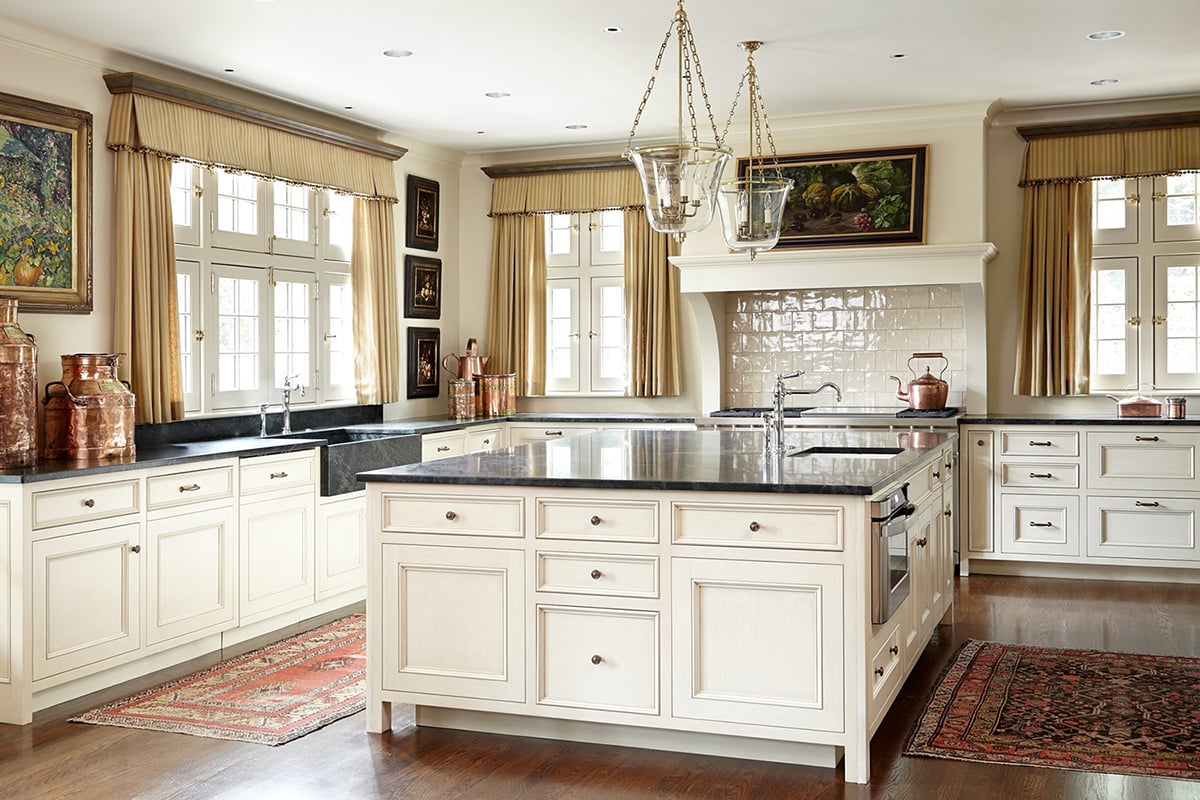
32 Cream Kitchen Cabinet Ideas: Paint Colors & Pairings
By Tracy Svendsen, Interior Designer | Published on August 02, 2022 | Updated on June 01, 2026 |
Cream kitchen cabinets remain a favorite among designers and homeowners alike, striking the perfect balance between the crispness of white and the softness of beige. From ivory to vanilla, champagne, ecru, and bone, these buttery shades work beautifully in modern, farmhouse, traditional, and rustic interiors. As an interior designer who has specified cream cabinetry for clients across hundreds of projects — including log homes where cream subtly complements natural wood tones — I’ve observed firsthand why this color endures while others fade.
Cream cabinets are also confirmed as a leading choice in the 2026 NKBA kitchen forecast, reflecting a broader shift away from white toward warmer, more inviting palettes.
In this guide, you’ll find kitchens with cream cabinets curated from top interior designers, covering everything from paint color selection to countertop pairings, hardware choices, and real-world examples across every kitchen style. Each idea is illustrated with photos of real designer kitchens, providing concrete visual references for every recommendation. Whether you’re drawn to cream cabinets with black countertops, warm wood accents, or bold contrasting islands, there’s an approach here for every home. Feature image courtesy of Morgan Creek Cabinets.
Kitchen with Cream Cabinets: Key Takeaways
-
Cream kitchen cabinets pair beautifully with warm neutrals, wood tones, and brass or matte black hardware for a timeless look.
-
Lighter cream shades open up smaller kitchens, while richer cream hues add depth in larger, naturally lit spaces.
-
Combining cream cabinets with contrasting island colors (e.g., gray or navy) boosts visual interest without feeling busy.
-
Choosing the right countertop and backsplash (marble veining, neutral tile, or soft quartz) ensures a cohesive design.
-
Cream cabinets work equally well in modern, farmhouse, traditional, and rustic log-home interiors.
- Cream cabinets with black countertops create one of the most striking and timeless kitchen contrasts — a combination that works in both traditional and modern spaces.
Browse 32 designer cream kitchen cabinet ideas below, featuring real kitchens styled by leading interior designers across modern, farmhouse, traditional, and rustic interiors.
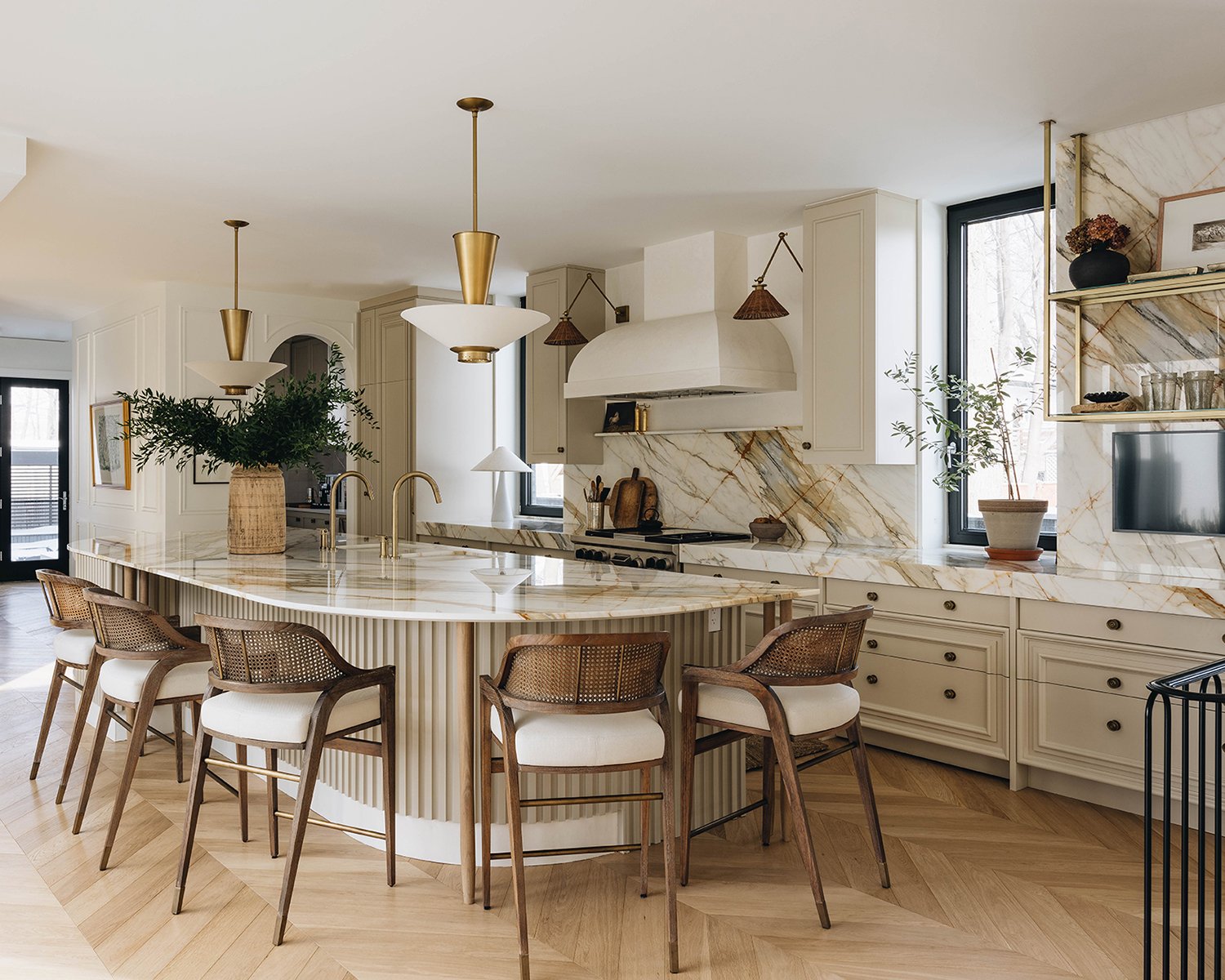
Cream Kitchen Cabinets in a Modern Parisian-Inspired Kitchen
Image courtesy of Erik Maille Design
Why Interior Designers Are Choosing Cream in 2026
Cream kitchen cabinets have become the defining choice among leading designers in 2026, and the reasoning goes deeper than aesthetics. After years of all-white kitchens dominating the market, homeowners and designers alike are gravitating toward palettes that feel warmer, more personal, and more livable. Cream sits at the center of that shift.
The 2026 trend toward cream isn’t isolated — it arrives alongside other humanizing design moves: minimal upper cabinetry to open up sightlines, rounded cabinet details that soften hard edges, and layered earth-tone palettes that blend mushroom, taupe, and warm cream with natural materials. In my own practice, I’ve noticed clients who once defaulted to white are now specifically requesting cream — particularly in homes with natural wood features, stone countertops, or warm-toned flooring, where pure white can read as cold by comparison.
The Studio McGee kitchen is a perfect example of this design choice. The perimeter cabinets are painted Benjamin Moore’s Baby Fawn — a soft, warm cream tone — while the dark pantry cabinets feature Sherwin-Williams’ Peppercorn, creating the kind of high-contrast, two-tone kitchen that defines 2026’s most sophisticated designs.

Elegant Farmhouse Kitchen With Cream Cabinets in Benjamin Moore Baby Fawn
Image courtesy of Studio McGee
How to Style Cream Kitchen Cabinets: A Designer Mood Board
One of the most common mistakes I see when incorporating cream cabinetry is treating it purely as a backdrop. Cream works beautifully when designers treat it as a bridge color: something that connects warm neutrals, natural materials, and subtle contrasts rather than recedes into the background. The result is an expertly layered and carefully curated kitchen design.
This Parisian-inspired kitchen by Erik Maille pairs cream cabinetry with taupe tones and richly veined Calacatta Macchia Vecchia marble — introducing movement through creamy whites, golds, and soft grays. Antique brass fixtures carry that warmth upward, while light oak chevron flooring grounds the space and reinforces a sense of craftsmanship. Every material is warm, but each adds a different texture and visual weight.
This principle of controlled variation is something I discuss with clients regularly. Cream cabinets paired with a single complementary material — say, white quartz countertops and white subway tile — can easily read flat. But introduce marble veining, warm brass, and a natural wood element, and the same cream cabinetry suddenly feels rich.
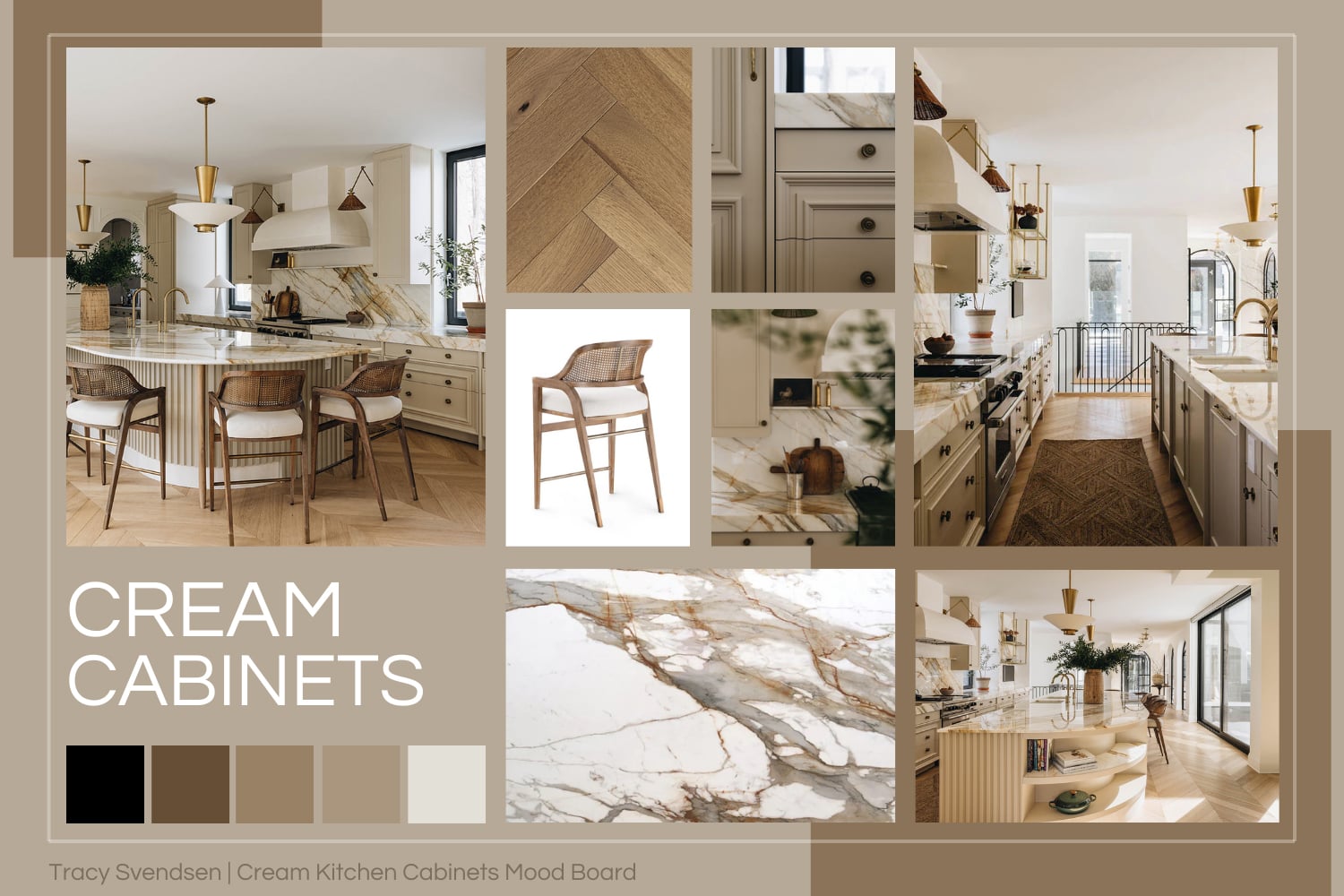
Designer mood board interpretation by interior designer Tracy Svendsen, showing how cream and taupe cabinetry can be layered with high-contrast materials for a refined kitchen.
Designer-Approved Cream Cabinet Paint Colors: Top Choices for 2026
Choosing the right cream paint color is one of the most nuanced decisions in kitchen design. Cream is not a single color — it spans a wide spectrum from barely-there warm whites to rich, golden beiges, and the undertones vary significantly between brands. The wrong shade can read yellow under certain lighting or clash with your countertop material, which is why designer guidance matters here more than in almost any other paint decision.
After years of specifying cream cabinetry for clients — including log homes where getting the undertone right is critical — these are the shades other leading designers and I return to consistently:
My top pick is Swiss Coffee (Benjamin Moore OC-45) — a warm, luminous white-cream that works with both warm and cool palettes and remains the most versatile option across kitchen styles. For a slightly softer look, White Dove (Benjamin Moore OC-17) is a perennial designer favorite with gentle cream undertones that pair beautifully with natural wood and stone. Natural Cream (Benjamin Moore OC-14) is the best choice for log homes and rustic interiors, as its warm, greige base harmonizes with amber wood tones without amplifying them.
On the Sherwin-Williams side, Accessible Beige (SW 7036) is Shea McGee’s go-to for kitchens that need to feel dynamic throughout the day — it shifts beautifully from soft and airy in morning light to warm and cozy in the evening. Creamy (SW 7012) remains Sherwin-Williams’ most recommended cream for kitchen cabinets, with soft yellow-beige undertones that suit farmhouse and traditional styles exceptionally well.
For detailed guidance on each of these shades — including how they read under different lighting conditions and which countertop materials they pair best with — see the full paint color section toward the end of this post.
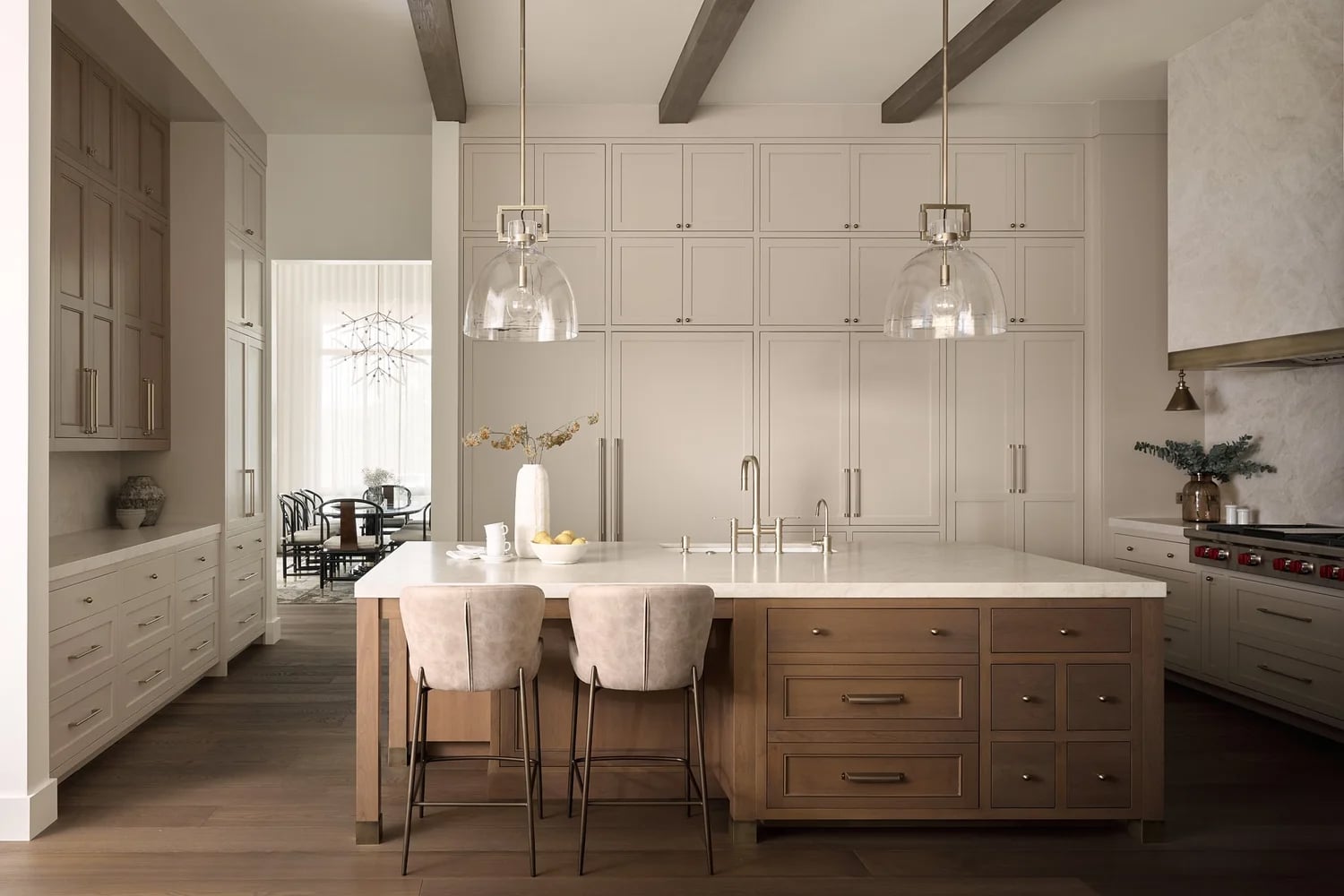
Cream Cabinets Paired with a Light Oak Island, Light Wood Flooring, and Wood Beams
Image courtesy of Go Studio
1. Cream Colored Kitchen Cabinets: Timeless Appeal Across Every Style
Of all the kitchen cabinet colors I’ve specified over the years, cream is the one clients never regret. Unlike bold color choices that can feel dated within a decade, cream colored kitchen cabinets age gracefully — deepening in character rather than falling out of step with evolving tastes.
The kitchen below, designed by Meghan Eisenberg, illustrates this perfectly. Rather than treating cream as a neutral placeholder, Eisenberg used it as an anchor for a richly layered palette inspired by the surrounding orchards of a country home. Rich cream cabinetry is paired with warm wood tones, deep rust accents, and gentle green hues that echo the landscape just outside the windows — a reminder that the best cream kitchens don’t exist in isolation from their surroundings.
The practical takeaway: cream cabinets give you the flexibility to shift your accent palette dramatically — from rust and green here to navy and brass elsewhere — without ever touching the cabinetry itself. That adaptability is a major reason cream remains a consistently strong choice for resale value and day-to-day livability.

Cream Kitchen Cabinets Paired with Rust Accents and Earth Tones
Image courtesy of Meghan Eisenberg Design (Harris Kenjar Photography)
2. Black Countertops with Cream Cabinets: A Striking, Timeless Contrast
If there’s one cream cabinet pairing I recommend without hesitation, it’s cream with black countertops. In fact, I have used this combination in a previous home of my own, and loved the dramatic contrast. The warmth of cream prevents the pairing from feeling cold.
This Palm Beach kitchen by Montreal firm Les Ensembliers demonstrates how this combination endures. Architect Maxime Vandal and designer Richard Ouelette were tasked with making a grand, formal home feel genuinely livable — and cream cabinetry paired with glossy black countertops was central to achieving that balance. The palette is anchored by crisp neutrals and softened with delicate shades of blue and gleaming brass tones. Large-scale black-and-white checkerboard tile flooring — one of 2026’s most notable kitchen revivals — adds pattern and energy without competing with the cabinetry above.
Additional details — glass-front cabinets and a long curved-edge kitchen island — layer warmth and sophistication into what could otherwise have been an intimidating space. The lesson here is that cream cabinets with black countertops work precisely because cream does the softening work that white cannot.


Striking Kitchen with Cream Cabinets, Black & White Flooring and Glossy Black Countertops
Image courtesy of Les Ensembliers (Lauren Miller Photography)
3. Cream Colored Cabinets as a Canvas for Bold Pattern
One of the most underrated qualities of cream colored cabinets is how confidently they support bold patterns elsewhere in the kitchen. Because cream is warm yet visually quiet, it lets decorative flooring, statement backsplashes, and colorful area rugs take center stage without making the space feel overdesigned.
Over the years, I’ve found that the combinations that work best pair cream cabinetry with patterns that share at least one of cream’s undertones — warm blues, soft greens, terracotta, and black-and-white all work beautifully for this reason. Patterns that lean toward cool gray or white as their dominant tone can create a disconnect with the inherent warmth of creamy tones. I’ve had clients bring me fabric or tile samples that looked beautiful in isolation but clashed the moment they went against their cream cabinetry — almost always because the pattern’s dominant tone was pulling cool while the cream was pulling warm.
Both kitchens below put this principle into practice in very different ways — one through striking decorative tile flooring, the other through a richly patterned area rug — demonstrating how similar cabinet colors can support different design personalities depending on the surrounding pattern choices.

Pairing Cream Cabinets with Blue Tiled Flooring
Image courtesy of Carpetright

Cream Cabinets with Soft Toned Area Rug
Image courtesy of Brown Interiors
4. Log Home Kitchens: Why Cream Works Where White Fails
Log home kitchens present a cabinet color challenge that most general design advice doesn’t address — and getting it wrong is an expensive mistake. Log and timber walls can have natural yellow, orange, or amber undertones, depending on the wood species and stain used. These undertones intensify over time as the wood ages and darkens.
White cabinets amplify those yellow tones, making the entire kitchen feel warmer and yellower than intended. Cream, with its own subtle yellow and red undertones, provides a soft, balanced contrast instead, working with the wood’s warmth rather than fighting it. Of all the design recommendations I make to log home clients, switching from white to cream cabinets yields the most visually pleasing results.
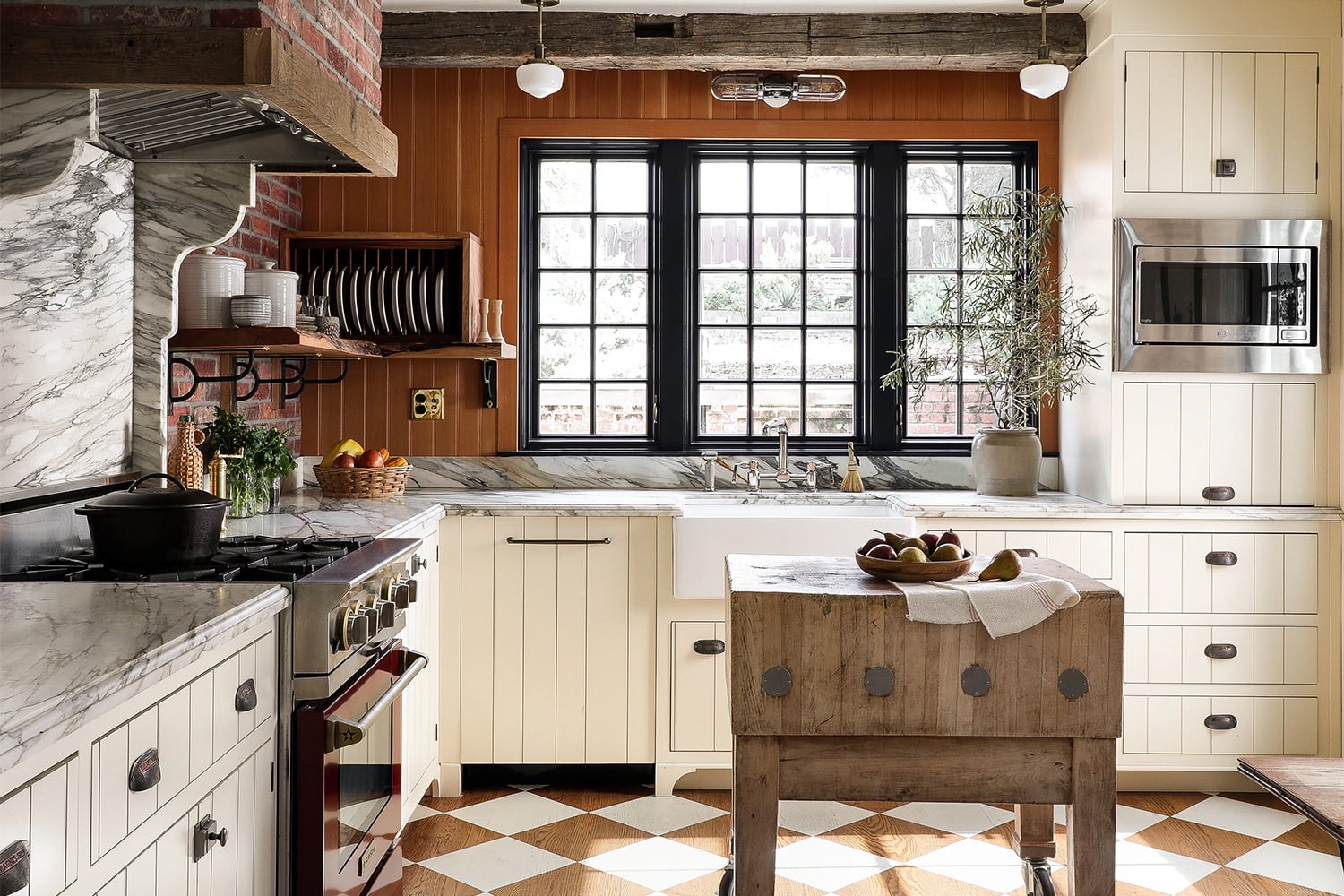
Rustic Kitchen with Cream Cabinets & Shiplap Walls
Image courtesy of Architectural Digest.
5. Choosing Cream Paint Colors for Log Home Kitchens
One dimension most homeowners don’t anticipate is lighting temperature. Because cream reflects light differently from white, bulb temperature becomes critical. Warm-toned lighting in the 2700K-3000K range keeps cream cabinets looking rich against wood walls.
Cool or daylight bulbs can push cream toward dingy or yellowed, especially in kitchens with limited natural light. This is one of the first things I discuss with clients during the design phase, long before cabinets are ordered.
For log home kitchens specifically, these are the Benjamin Moore cream paints I recommend most consistently:
| Color | Brand | Best For |
|---|---|---|
| Gentle Cream OC-96 | Benjamin Moore | Dark wood species |
| Ballet White OC-9 | Benjamin Moore | Lighter wood tones |
| Natural Cream OC-14 | Benjamin Moore | All log home styles |

Cream Cabinets in Rustic Cabin with Wood Paneled Walls and Butcher Block Countertops
Image courtesy of LogHome.Com (Hilgard Log Homes, Heidi Long Photography)
6. Complementing Cream Cabinets with Greenery
One of the quieter pleasures of cream kitchen cabinets is how naturally they welcome living elements into the space. Where white can make potted plants and fresh herbs feel like accessories, cream makes them feel like they belong — the warmth of the cabinet tone echoing the organic quality of the greenery itself.
In practice, I recommend this pairing to almost every client with cream cabinets, most notably in kitchens that lack a strong view or a natural connection to the outdoors. A cluster of fresh herbs on the countertop, a trailing potted plant on open shelving, or a simple floral arrangement on the island can do more to make a cream kitchen feel alive and personal than almost any other styling choice. In my own projects, I find myself returning to the same combination repeatedly — a simple olive or eucalyptus arrangement alongside fresh rosemary or thyme on the counter.
The kitchen below, designed by Shea McGee, incorporates cabinets painted in Swiss Coffee by Benjamin Moore — one of my personal go-to cream shades and a consistent favorite among leading designers for its ability to work equally well on walls and cabinetry. Calcutta marble countertops and backsplash add luminosity, while the greenery anchors the space with warmth and life.


Transitional Kitchen with Cream Cabinets & Brushed Oak Island
Image courtesy of Studio McGee
7. Wood Flooring with Cream Cabinets: Light, Dark and Everything in Between
The relationship between cream cabinets and wood flooring is one I think about carefully in almost every kitchen project I take on — most notably in log homes and rustic interiors where wood floors are the rule rather than the exception.
The dynamic works differently depending on the wood tone. With lighter wood floors — honey oak, blonde maple, or light ash — cream cabinets create a soft, luminous palette where neither element competes for attention. With darker wood floors — walnut, aged oak, or stained pine — cream cabinets provide a gentle lift, preventing the kitchen from feeling too heavy while maintaining the warmth that makes dark wood so appealing in the first place.
The modern farmhouse kitchen below, designed by Becca Interiors, beautifully highlights the lighter end of this spectrum. The cabinets are painted Silver Song by Benjamin Moore (BM 1557) — a shade Becca describes as “the perfect greige-green, although in some lights you may spot an undertone of blue peeking through.” Paired with light wood flooring, a white apron-front sink, white subway tiles, and a striped area rug, this kitchen is relaxed and layered without sacrificing brightness.
Silver Song is worth noting as a cream alternative for kitchens where a pure warm cream feels too yellow — its greige-green undertone helps stabilize it and works well in kitchens with abundant natural light.


Southampton Coastal Kitchen With Cream Cabinets, White Walls, and White Subway Tile Backsplash
Image courtesy of Becca Interiors
8. Farmhouse Cream Kitchen Cabinets: The Natural Choice for Rustic Charm
Farmhouse kitchens and cream cabinets have an almost self-evident compatibility. Cream is a wonderful option here for the same reason it works in log homes: farmhouse interiors rely heavily on natural wood accents, exposed ceiling beams, and hardwood floors, all of which carry warm undertones that white cabinets can inadvertently fight against.
What I find compelling about cream in a farmhouse context is how well it ages. Farmhouse design is built around materials that gain character over time — reclaimed wood, worn stone, and aged brass hardware. Cream cabinets participate in that narrative in a way that white simply cannot. White shows every mark and scuff as a flaw; cream absorbs the same wear and reads as patina.
The farmhouse kitchen below, designed by Dwell Wright Interiors, incorporates warm cream-colored cabinets paired with natural finishes throughout — a combination that feels hand-selected. It’s the kind of kitchen that looks better with a decade of use behind it than it did on installation day.
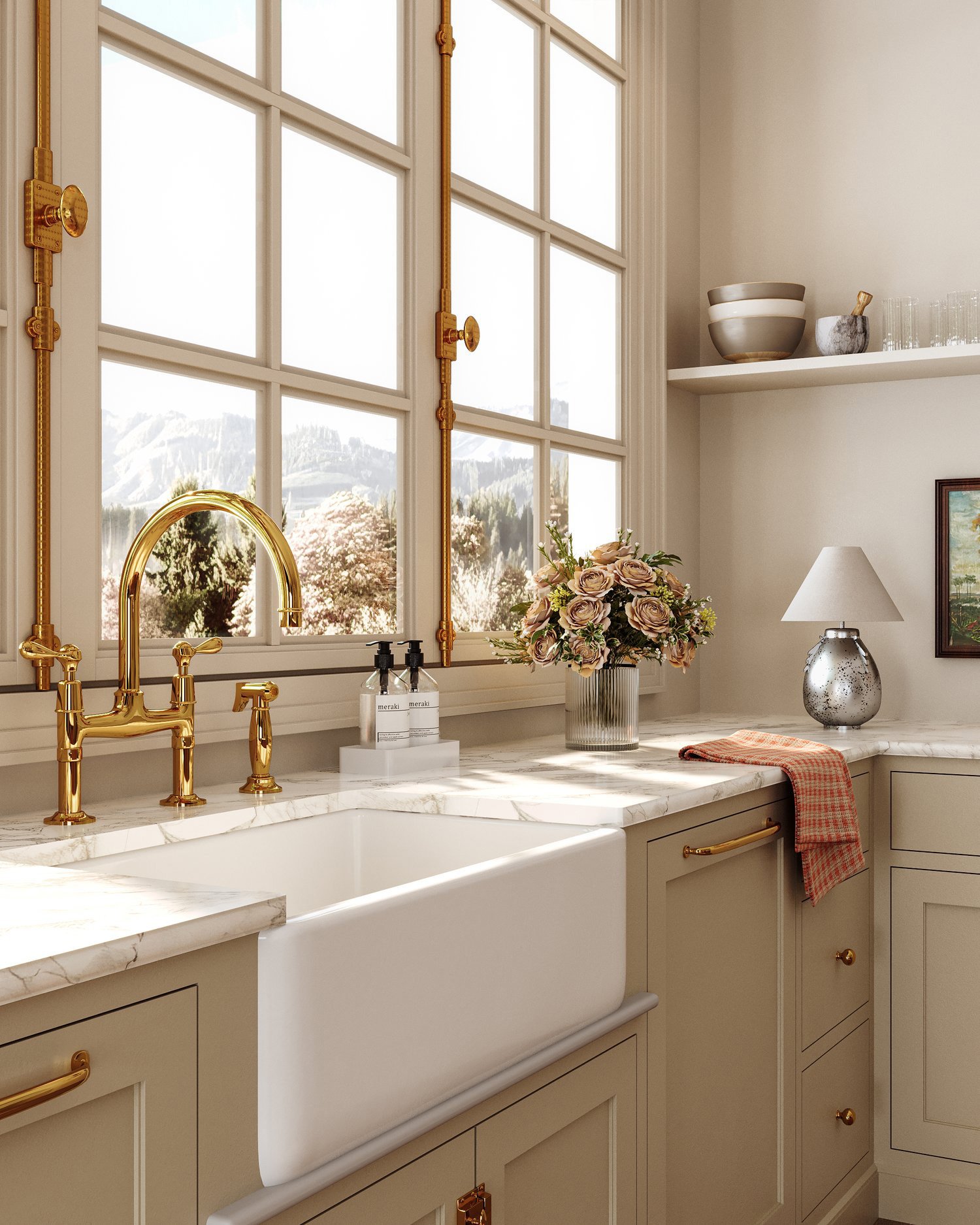
Farmhouse Kitchen with Cream Cabinets, Vintage Accessories, Brass Hardware and a White Farmhouse Sink
Image courtesy of Dwell Wright Interiors
9. Dark Countertops and Cream Cabinets: Old-World Charm Meets Modern Contrast
Old-world charm in kitchen design is harder to achieve than it looks. It requires layering of materials that feel simultaneously refined and lived-in — nothing too polished, nothing too raw. Cream kitchen cabinets paired with dark countertops are among the most reliable ways to strike that balance.
The contrast does the heavy lifting here. Cream brings the warmth and softness associated with traditional European kitchens — the kind of space that feels like it has always been there. Dark countertops, whether soapstone, dark granite, or honed black quartz, ground that softness with weight and sophistication.
The kitchen below, designed by Liza Bryan, boasts cream Shaker-style cabinetry — one of the most time-tested cabinet profiles in traditional design — paired with warm hardwood flooring, a glossy backsplash, and dark countertops. The large central island anchors the space and reinforces the high-contrast palette that makes this style so sought after.
If you’re drawn to this aesthetic, Shaker-style cabinetry in cream is my starting-point recommendation — it’s the profile that most naturally bridges traditional charm and contemporary livability without tipping into either extreme.

Cream Shaker Cabinets with Dark Countertops and Warm Hardwood Flooring
Image courtesy of Liza Bryan Interiors
10. What Colors Go With Cream Kitchen Cabinets: A Designer’s Color Guide
One of the most common questions I receive from clients with cream cabinets is how to build a cohesive color palette around them. The good news is that cream is genuinely one of the most versatile cabinet colors available—but that versatility can feel overwhelming without a clear framework for decision-making.
My approach is to think in terms of contrast level first, then color family second:
High Contrast Pairings — For Drama and Sophistication: Deep, saturated colors create the most striking results against cream cabinetry. Navy blue, charcoal gray, and shades of earth-toned greens all work beautifully as island bases, lower cabinet colors, or accent walls. Cream acts as a natural softener, preventing these deep tones from feeling oppressive, while the deep tones give the cream a sense of purpose and grounding.
The two kitchens below illustrate this well. In the first, Jean Stoffer paired deep olive-green cabinetry with a cream-toned wood kitchen island — the cream warming the olive and preventing it from reading too cool. In the second, aaNovo Design used upper cream cabinets paired with lower navy cabinetry in a two-toned pantry with shiplap walls — a combination that feels both traditional and fresh.
Medium Contrast Pairings — For Warmth and Cohesion: For a softer effect, warm wood tones, taupe, and greige create a layered tonal palette without high drama. This is my most frequent recommendation for log homes and rustic interiors where the goal is warmth rather than contrast.

Green Cabinets with Cream-Toned Wood Kitchen Island
Image courtesy of Jean Stoffer Designer

Two-Toned Pantry with Shiplap Walls
Image courtesy of aaNovo Design
Shea McGee’s kitchen below features upper cream cabinetry in Sherwin-Williams Natural Tan paired with lower cabinets and an island base in Sherwin-Williams Peppercorn. Light wood tones and warm metallics complete a palette that feels elegant and sophisticated.
A practical rule I share with clients: when building a color palette around cream cabinets, always pull your accent colors from the warm side of the color wheel. Cool grays, blues, and pure whites can create an uncomfortable disconnect with cream’s inherent warmth — the same undertone principle we discussed in the pattern section earlier.
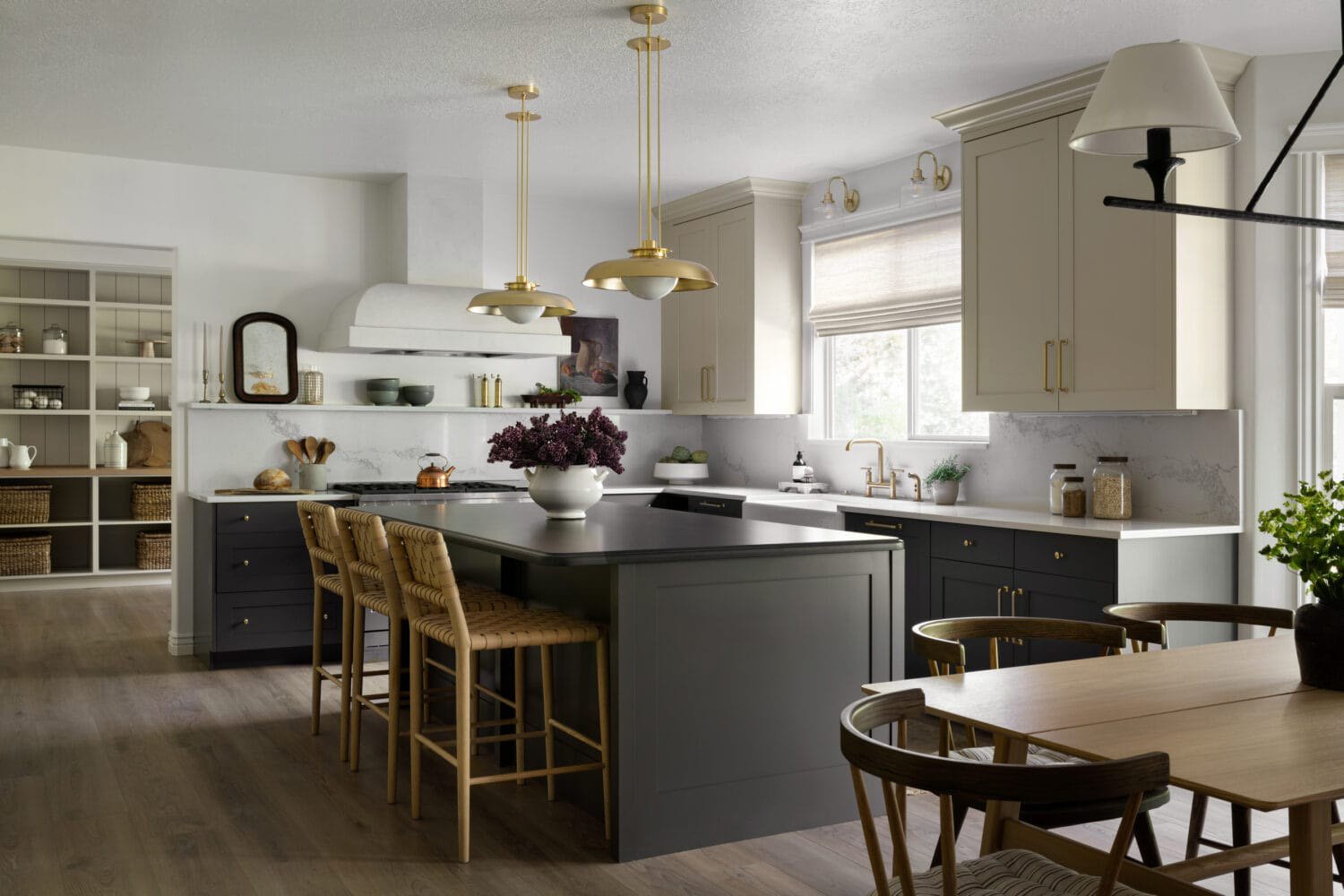
Modern Farmhouse Kitchen with Charcoal Gray Island Base, Cream Cabinets and White Walls
Image courtesy of Studio McGee
11. Brass and Gold Hardware: Warm Metallics Done Right
Hardware selection is one of the most underestimated decisions in a cream kitchen — and one of the most visible. The right metallic finish elevates cream cabinetry from pleasant to polished; the wrong one can make an otherwise beautiful kitchen feel disconnected or dated.
Warm metallics — brass, unlacquered brass, antique gold, and brushed gold — are my consistent first recommendation for cream cabinets, and for good reason. Cream and warm brass share the same underlying warmth, creating a harmony that feels effortless. From working with past clients, I’ve noticed that unlacquered brass is striking in cream kitchens because it develops a natural patina over time that deepens rather than diminishes the old-world quality cream cabinets naturally possess.
That said, the choice between brass finishes matters more than most clients expect:
| Finish | Best For | Avoid When |
|---|---|---|
| Polished Brass | Traditional, glamorous kitchens | Modern or minimalist spaces |
| Unlacquered Brass | Rustic, farmhouse, log home kitchens | High-traffic kitchens needing low maintenance |
| Brushed Gold | Modern farmhouse, transitional kitchens | Very traditional or period-style spaces |
| Antique Brass | Old-world, country, rustic kitchens | Contemporary or Scandinavian interiors |
The Studio McGee kitchen below features the polished brass approach at its most refined. Creamy Swiss Coffee by Benjamin Moore is paired with Calacatta marble countertops and backsplash — a luminous combination that gives the gleaming brass accents maximum impact. The result is simultaneously warm and glamorous without tipping into excess.
One note on matte black as an alternative: while warm metallics are my first recommendation for cream cabinets, matte black hardware creates a striking, increasingly popular contrast that fits beautifully with modern farmhouse and contemporary rustic kitchens. If your space leans cooler or more graphic in its overall aesthetic, matte black may serve you better than brass.


Cream Colored Cabinets, Soft Blue Range & Brass Hardware
Image courtesy of Studio McGee
12. Wood Accents That Work Beautifully with Cream: Beams, Shelving, and Countertops
While wood flooring is the most common wood pairing with cream cabinets, it’s the architectural wood accents — exposed beams, open shelving, corbels, and wood countertops — that truly define a cream kitchen’s character. These elements introduce warmth, texture, and craftsmanship in ways that flooring alone cannot, and cream cabinetry provides the ideal neutral backdrop for them to fully express themselves.
In my practice, exposed ceiling beams are the wood accent I recommend most enthusiastically, especially alongside cream cabinets — in log homes, farmhouse kitchens, and Tudor- or craftsman-style spaces. The combination works because cream cabinets visually recede, allowing the beams to carry the room’s architectural weight without competition. Paint the same cabinets white, and the beams can start to feel heavy; cream creates a softer transition, making the ceiling feel intentional rather than imposing.
The kitchen below, designed by Kat Lawton on Mercer Island, Washington, showcases this principle. Stained beams, corbels, and three-point arches pay homage to Tudor aesthetics — architectural details that could easily overwhelm a smaller or lighter space. Cream cabinetry in a neutral palette keeps the room unified while metallic touches add refinement without competing with the warmth of the wood. The result is a kitchen where every element feels as though it has always belonged there.
For clients considering wood countertops, especially butcher block, cream cabinets are an ideal pairing. The warmth of cream prevents the combination from feeling too raw or casual. Wood countertops also add a handcrafted quality that makes a kitchen feel personal rather than showroom-perfect.

Country Kitchen with Cream Cabinets, Brass Hardware and Vintage Accessories
Image courtesy of Kat Lawton Interiors (John Granen Photography)
13. Adding Black Accents: How to Ground a Light Cream Kitchen
We’ve already discussed cream cabinets with black countertops and matte black hardware — but black accents extend well beyond those two elements, and understanding how to deploy them throughout a cream kitchen is what separates a professionally designed space from one that feels unfinished.
The role of black accents in a cream kitchen is to ground. Cream is inherently warm and airy — qualities that are genuinely appealing but can occasionally make a kitchen feel lacking in definition. Strategically placed black elements — pendant lighting, window frames, faucets, range hoods, or appliance handles — provide visual anchors that give the eye places to rest and the space a sense of structure.
My general guideline for clients is to introduce black accents in at least three locations at varying heights — something low, like cabinet hardware or a faucet; something at mid-height, like a range hood or open shelving brackets; and something overhead, like pendant lighting or exposed ceiling beams stained dark. This vertical distribution prevents black accents from feeling concentrated or heavy in any one area.
The country kitchen below, designed by Whittney Parkinson, combines cream custom cabinetry, providing a warm, luminous backdrop, with unique black lighting fixtures. These design decisions, paired with carefully chosen black accents and richly textured materials, give the space weight and definition.

Renovated European-Inspired Kitchen with a Black Backsplash & Dark Island
Image courtesy of Whittney Parkinson Design
14. Layering Textures in a Cream Kitchen
Cream cabinets are uniquely suited to supporting layered textures — more so than white, which can flatten under the visual weight of too many competing materials, and more so than bold colors, which tend to dominate. Cream has the rare quality of receding just enough to let textures breathe while still contributing warmth and cohesion to the overall palette.
In practice, the textures I layer most consistently with cream cabinetry are natural stone, handcrafted tile, natural fiber textiles, and warm metals. The key is variation in surface quality — pairing a matte cabinet finish with a glossy backsplash tile, a rough-hewn wood element with a smooth marble countertop, or a woven textile with a polished metal fixture. Cream acts as the unifying thread, preventing these contrasts from feeling chaotic.
The farmhouse kitchen below, designed by Rosewood NB, is one of the best examples of this approach I’ve encountered. Subtle tones, warm textures, natural materials, handcrafted tiles, and mixed metals are layered with confidence, creating a space that feels curated and natural. The foundation for all of it is the custom cabinetry by interior designer Jean Stoffer in her signature Oxford Cream. This beautifully calibrated shade sits at the intersection of warm white and soft greige.
Jean Stoffer’s custom cabinetry line is worth noting specifically for readers in the planning stages of a kitchen renovation. Her Oxford Cream is available with 5″ x 5″ samples online — an important step given how significantly cream shades can shift under different lighting conditions. Seeing a physical sample in your own kitchen before committing to a full cabinet order is something I recommend without exception.

Kitchen with Cream Cabinets, Organic Textures, and Wood Island
Image courtesy of Rosewood NB Design (Stacy Zarin Goldberg Photography)
15. Choosing Hardware for Cream Cabinets: Style, Profile and Finish
We covered hardware finishes in detail earlier — brass, unlacquered brass, brushed gold, and matte black — but finish is only half of the hardware decision. Profile and style are equally important, and in my experience, they’re where clients feel most uncertain.
The hardware profile you choose sends a strong signal about the overall design direction of your cream kitchen. Here’s how I guide clients through that decision:
| Hardware Profile | Best Style Match | Avoid With |
|---|---|---|
| Shaker cup pulls | Farmhouse, country, traditional | Sleek modern or minimalist kitchens |
| Bar pulls | Modern farmhouse, transitional | Period-style or ornate traditional |
| Bin pulls | Traditional, old-world, rustic | Contemporary or Scandinavian spaces |
| Knobs only | Cottage, country, vintage | Large drawers where pulls are more practical |
| Mixed knobs and pulls | Most styles | Spaces where consistency is the priority |
My personal preference for cream cabinets in most contexts is a combination of knobs on doors and pulls on drawers — it’s the most traditional approach and the one that most naturally suits cream’s inherently classic character. The exception is modern farmhouse kitchens, where a simple bar pull in brushed gold or matte black creates a cleaner, more contemporary result.
One piece of guidance I share with every client at the hardware selection stage: order samples before committing. Hardware photographs very differently from how it reads in person, especially brass finishes, which can range from warm and golden to almost orange depending on the light. Most hardware companies offer sample programs — it’s an investment of twenty to thirty dollars that can save thousands in regret.
For traditional and rustic kitchens specifically, antique brass and oil-rubbed bronze remain my top recommendations — their aged finishes develop character over time, much like cream cabinets, creating a kitchen that feels collected with each passing year.

Kitchen with Cream Cabinets, White Walls, Light Wood Flooring, and Brass Accents
Image courtesy of Whittney Parkinson Design
16. How Cream Reflects Light: Maximizing Brightness in Any Kitchen
Light behavior is one of the most underappreciated aspects of cabinet color selection — and one where cream has a genuine and measurable advantage over both white and darker neutrals.
White cabinets reflect light at full intensity, which may sound appealing but can create harsh, flat illumination that eliminates shadows and depth. Darker cabinets absorb light, creating drama but potentially making smaller kitchens feel cave-like. Cream sits in a uniquely beneficial middle position — it reflects light warmly, softening harsh direct sunlight while amplifying the golden quality of morning and evening light, making the entire kitchen feel more inviting throughout the day.
In my practice, I’ve noticed this quality is valuable in mountain homes and log cabins, where natural light shifts dramatically with the seasons and the surrounding landscape. A kitchen that is bright and airy in summer needs to feel warm and cozy in winter — cream cabinets achieve both in a way that white simply cannot.
The Studio McGee kitchen below is a great example of cream cabinetry done well. Set in a modern mountain home in Utah, light cream cabinets in Benjamin Moore’s Natural Cream — my top recommended shade for log homes and mountain interiors — are paired with black metal accents and Calacatta marble countertops. The contrast is deliberate: the cream maximizes the sense of light and openness, while the black metal accents prevent the space from feeling washed out or ill-defined.
A practical note on maximizing light reflection with cream cabinets: the sheen level of your paint finish matters significantly. Satin finishes reflect more light than matte while remaining practical for kitchen use — my consistent recommendation for cabinet paint in any kitchen where light optimization is a priority.
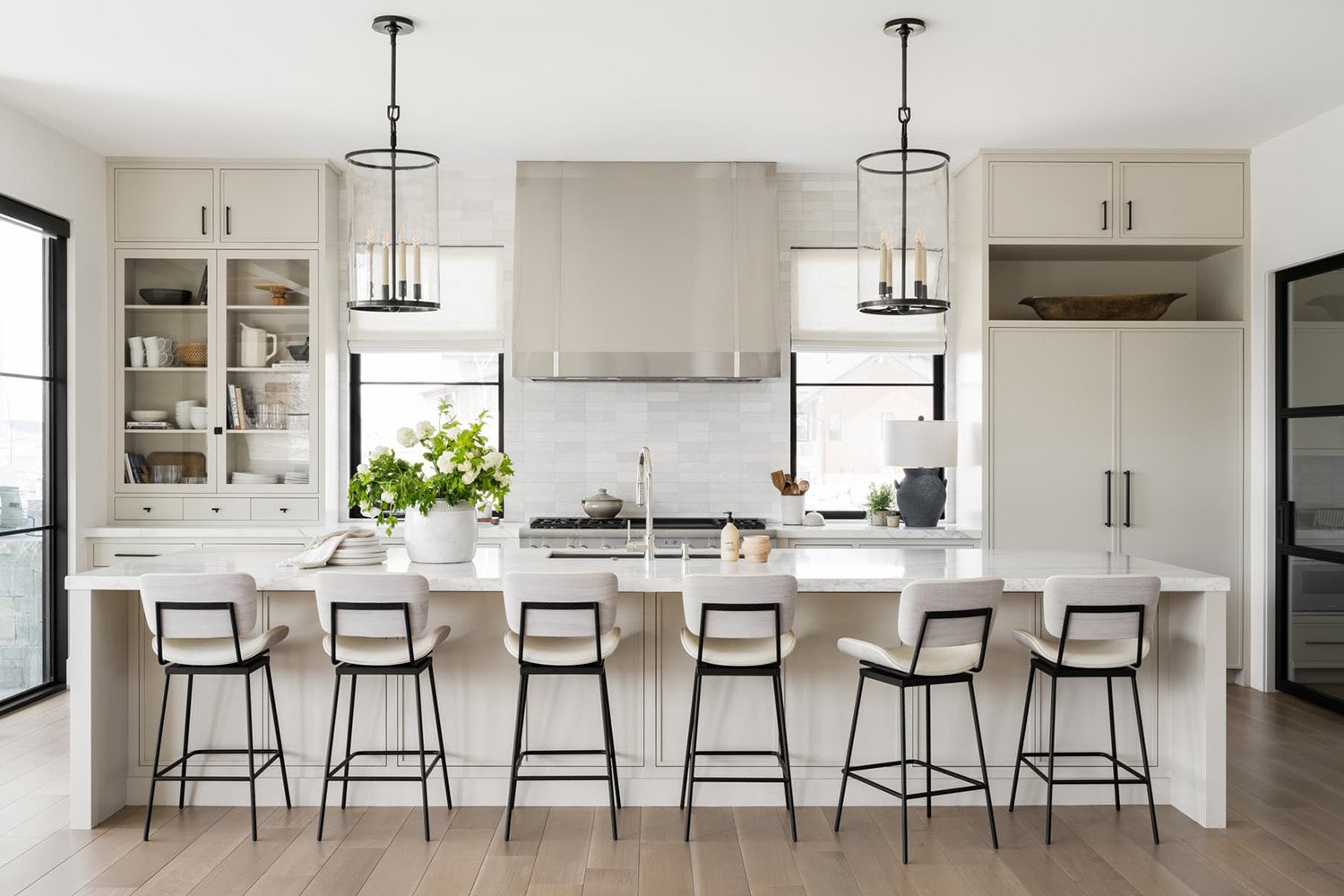
Airy & Open Kitchen with Plenty of Natural Sunlight
Image courtesy of Studio McGee
17. Cream Cabinets in Modern Kitchens: Warmth Without Compromising Clean Lines
Modern kitchen design and cream cabinets might seem like an unlikely pairing — modern interiors typically favor cooler, more restrained palettes, and cream’s inherent warmth can feel at odds with the clean, unadorned aesthetic that defines contemporary spaces. In practice, however, cream in a modern kitchen works precisely because of that tension. It prevents the coldness that all-white or gray modern kitchens can produce while maintaining the visual simplicity that makes modern design appealing.
The key to making cream work in a modern context is restraint everywhere else. Where a farmhouse cream kitchen might layer in wood accents, mixed metals, and textural materials, a modern cream kitchen benefits from a more disciplined approach — streamlined cabinet profiles, minimal hardware, and a limited material palette of two or three carefully chosen elements.
Modern materials that pair well with cream in a contemporary context include:
- Marble — the veining introduces movement and warmth that complements cream without competing with it. Dramatic, large-format slabs work especially well.
- Concrete — the matte, industrial quality of concrete creates an interesting tension with cream’s softness, resulting in a kitchen that is warm and architectural.
- Stainless steel — used selectively on appliances and fixtures rather than as a dominant surface material, stainless steel adds a professional quality that grounds cream in a modern context.
- Glass — glass-front cabinet doors or a glass backsplash introduce lightness and transparency that amplify cream’s light-reflecting qualities.
In the kitchen below, Whittney Parkinson paired cream cabinetry with dramatic marble surfaces and white walls — a deliberately limited palette that allows each element maximum impact. The result is a warm, inviting kitchen without sacrificing the clean aesthetic that defines modern design at its best.
A note for readers whose homes skew more rustic or farmhouse in character — cream cabinets can bridge traditional and modern elements more naturally than almost any other cabinet color. If you’re drawn to a cleaner, more contemporary look but love the warmth of your existing log or wood elements, cream cabinetry is often the most natural starting point for that transition.


Neutral Kitchen with Warm Cream Cabinets, Modern Backsplash and White Walls
Image courtesy of Whittney Parkinson Design
18. Cream Cabinets in Traditional Kitchens: A Timeless Design Partnership
If modern kitchens benefit from cream’s ability to add warmth without sacrificing clean lines, traditional kitchens benefit from something different — the ability to honor architectural heritage without feeling heavy or dated. It’s the same cabinet color doing two very different jobs, which speaks to why cream remains one of the most enduringly versatile choices in kitchen design.
Traditional kitchen design is built around a specific set of values — craftsmanship, permanence, and the sense that a space has been thoughtfully accumulated over time rather than installed all at once. Cream-colored cabinets naturally fit into that narrative. Their warmth suggests age and character; their softness prevents the formality of traditional design from tipping into stuffiness. Whether the context is a stately colonial home, a charming English cottage, or an elegant farmhouse manor, cream cabinetry feels as though it belongs.
In my practice, the traditional kitchen details I pair most consistently with cream cabinets are inset cabinet doors, furniture-style cabinet feet, and substantial crown molding. These architectural details amplify cream’s inherent sense of craftsmanship and permanence — and they look considerably more authentic in cream than in white, which can make traditional millwork feel clinical rather than classic.
The kitchen below, again designed by Whittney Parkinson, features a traditional, refined cream palette. Cream cabinetry is paired with shiplap walls, a soapstone backsplash, vintage lighting, and dark wood flooring — a combination of materials that each carry their own sense of history and character. Together, they create a kitchen that feels genuinely traditional rather than merely traditionally inspired—a subtle but important distinction that separates the best examples of this style from the merely competent.


Kitchen with Warm Cream Cabinets, Shiplap Walls and Brass Lighting Fixtures
Image courtesy of Whittney Parkinson Design
19. Contemporary and Urban Spaces: Why Cream Works in Compact Spaces
One context where cream cabinets consistently surprise people is in contemporary urban kitchens — apartments, lofts, and city homes where the assumption is that sleek, cool neutrals are the natural choice. In practice, cream works exceptionally well in these spaces precisely because urban kitchens tend to have less natural light and smaller footprints than suburban or rural counterparts. Cream’s light-reflecting warmth compensates for both.
There’s also a psychological dimension worth noting. City kitchens are often the most heavily used rooms in an apartment — cooking, working, socializing, and eating frequently happen in the same compact space. Cream cabinets make that space feel more welcoming and residential rather than functional and transactional, which matters considerably when your kitchen is also your living room.
The Tribeca kitchen below, designed by Jamie Baird, incorporates this urban cream approach with particular confidence. A large kitchen island with a dramatically veined marble countertop and brass-paneled base makes a striking focal point — the brass is warm enough to complement the cream cabinetry. In contrast, the marble introduces the kind of visual drama that compact urban kitchens need to feel considered rather than cramped. Contemporary bar stools keep the overall aesthetic current without compromising the warmth that cream brings to the space.
The lesson here is that cream cabinets aren’t exclusively a suburban or rural choice — in the right hands, they’re as at home in a Manhattan loft as they are in a Vermont farmhouse or a British Columbia log home.

Modern Kitchen with Cream Cabinets, Marble Backsplash and Herringbone Wood Flooring
Image courtesy of Jamie Baird Design
20. Pairing Cream Cabinets with Natural Materials: Wood, Stone, and Brick
Of all the material pairings available to cream cabinetry, the combination with natural wood, stone, and brick is the one I find most consistently successful — and arguably the most relevant to the log home, ranch, and mountain home clients I work with most frequently.
The reason this pairing works so well comes down to a shared quality: all of these materials carry inherent warmth that manufactured surfaces cannot replicate. Cream cabinets don’t fight that quality — they amplify it. Where a cooler cabinet color might create tension with the irregularity of natural stone or the grain variation in wood, cream absorbs those qualities. It reflects them back as a cohesive whole.
Specific pairings I recommend:
- Cream with exposed brick — effective in older homes and urban kitchens where brick walls are an architectural given rather than a design choice. Cream prevents the brick’s orange-red tones from overwhelming the space while honoring their warmth.
- Cream with natural stone countertops — soapstone, honed marble, and leathered granite all pair beautifully with cream, each bringing a different texture quality that cream’s softness complements rather than competes with.
- Cream with reclaimed wood — reclaimed wood’s natural aging and color variation find a natural partner in cream, which shares the same sense of accumulated character over time.
The Montecito ranch home below, designed by Formm Design, integrates a natural approach to materials in a distinctive setting. Nestled beneath a grove of protected oaks with vaulted interiors that open to the surrounding landscape, this modern rustic kitchen uses custom cream cabinetry as the anchor for a palette of natural woods and warm textures. The sight lines from the kitchen deliberately frame the outdoor views, making the natural materials inside feel continuous with the surrounding landscape rather than separate from it.
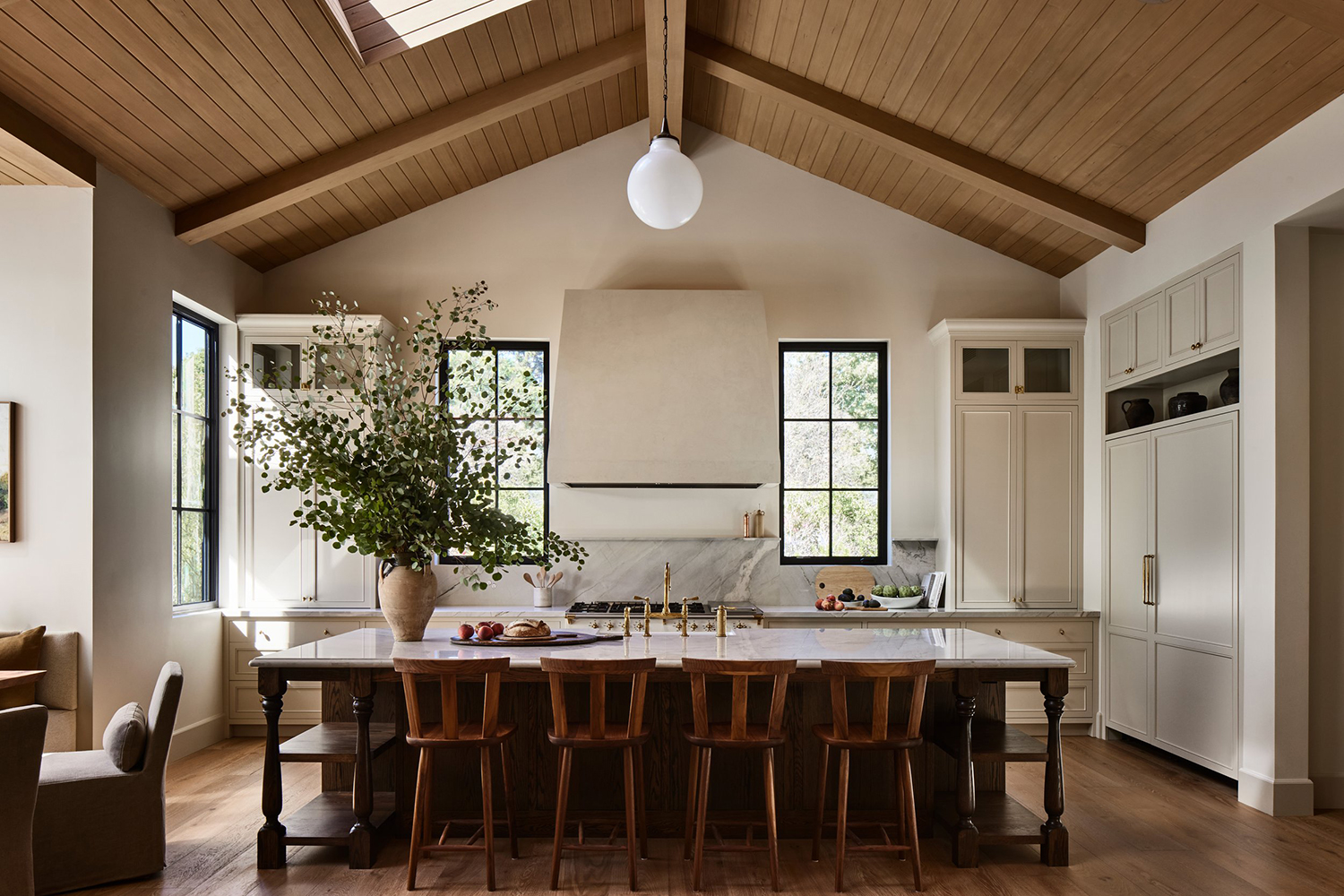
Cream Cabinets in a Modern Rustic Home Featuring a Wood Ceiling and Beams
Image courtesy of Formm Studio (Sam Frost Photography)
21. Do Cream Kitchen Cabinets Add Resale Value? A Designer’s Perspective
This is a question I get asked regularly — usually by clients who love the idea of cream cabinets but want reassurance that the investment makes sense beyond their own enjoyment of the space. My answer is consistently yes, and for reasons that go beyond the standard “it’s a neutral color” argument.
The resale value case for cream cabinets rests on three specific advantages:
First, cream occupies a unique position in the neutral spectrum that neither white nor gray does. White kitchens have been so ubiquitous over the past decade that they’ve lost their premium appeal in many markets — buyers increasingly see them as the default rather than a deliberate design choice. Gray has followed a similar trajectory. Cream, by contrast, still reads as a considered, intentional selection that suggests the kitchen was designed rather than simply furnished.
Second, cream cabinets age more gracefully than white in the context of a home sale. A white kitchen installed five years ago shows its age through yellowing, visible wear, and an aesthetic that feels dated relative to current trends. Cream absorbs those same years differently — what reads as wear on white reads as character on cream. This means a cream kitchen typically presents better at resale without requiring the repainting or refacing that white kitchens often need.
Third, cream has a broad demographic appeal across age groups and design preferences in a way that bolder cabinet colors simply don’t. Shea McGee’s consistent recommendation of Sherwin-Williams Accessible Beige for kitchen cabinetry reflects this — it photographs beautifully for listing photos, reads warmly in person, and appeals to the widest possible range of potential buyers.
My practical recommendation for clients renovating specifically with resale in mind: choose a cream shade with greige undertones rather than yellow ones. Greige-leaning creams — Accessible Beige, Natural Cream, Swiss Coffee — photograph more neutrally and appeal to a broader buyer pool than warmer, more yellow-leaning creams, which can divide opinion.

Cream Cabinets in a Farmhouse Kitchen with a Stone Accent Wall
Image courtesy of Studio McGee
22. What Countertops Go With Cream Kitchen Cabinets: A Complete Pairing Guide
Countertop selection is one of the highest-stakes decisions in a cream kitchen — get it right and the entire space feels cohesive and considered; get it wrong and even the most beautiful cream cabinetry can feel disconnected or flat. After specifying countertops for cream kitchens across hundreds of projects, these are the pairings I return to most consistently.
| Countertop Material | How It Works With Cream | Best Cream Shade Match | |
|---|---|---|---|
| Calacatta Marble | Dramatic veining adds movement; cream softens marble’s coolness | Swiss Coffee, White Dove | |
| Carrara Marble | Softer veining creates an elegant, understated pairing | Natural Cream, Ballet White | |
| Soapstone | Dark, matte surface creates striking contrast; ages beautifully alongside cream | Accessible Beige, Creamy | |
| Honed Black Granite |
|
Swiss Coffee, Gentle Cream | |
| Butcher Block | Shared warmth creates a natural pairing ideal for farmhouse kitchens | Natural Cream, Ballet White | |
| White Quartz |
|
White Dove, Swiss Coffee | |
| Leathered Granite | Textural quality pairs beautifully with cream’s softness | Accessible Beige, Natural Cream | |
| Quartzite | Similar to marble in appearance but more durable, warm-veined varieties work best | Swiss Coffee, Gentle Cream |
A few guidance points I share with every client at the countertop selection stage:
Undertone matching matters more than overall color. A cream cabinet with yellow undertones can clash with a cool gray quartz, even if both are technically neutral. Always bring your cabinet door sample to the countertop showroom — never select countertops from a photo or a small chip alone.
Finish matters as much as material. A matte or honed countertop finish paired with cream cabinetry creates a softer, more organic look — ideal for farmhouse, rustic, and log-home kitchens. A polished finish adds glamour and reflectivity that work better in both traditional and contemporary spaces.
Veining direction is worth considering in larger kitchens. Horizontal veining in marble or quartzite visually widens a kitchen; vertical veining draws the eye upward. In a cream kitchen where the cabinetry is already providing warmth and cohesion, the countertop veining becomes one of the primary sources of visual movement — worth thinking about deliberately rather than leaving to chance.

Stunning Kitchen Design with Wood-Topped Kitchen Island & Cream Cabinets
Image courtesy of Veranda Homes
23. Paint Colors Beyond Benjamin Moore and Sherwin-Williams: Farrow & Ball
Throughout this post, we’ve focused primarily on Benjamin Moore and Sherwin-Williams cream shades — the brands I recommend most consistently for their availability, reliability, and the breadth of designer endorsement behind them. But the cream cabinet conversation doesn’t end there, and for clients drawn to more distinctive, characterful shades, Farrow & Ball and other independent paint houses offer options worth serious consideration.
The most important distinction with Farrow & Ball creams is their depth of pigment. While Benjamin Moore and Sherwin-Williams cream shades tend toward clean, bright neutrals, Farrow & Ball’s cream palette leans toward what the British paint house describes as “historic” tones — shades with greater complexity, subtle muddiness, and an aged character that can be difficult to replicate with standard paint lines.
Interior designer Becca Casey of Becca Interiors captured this quality perfectly when describing her choice of Old White by Farrow & Ball for the Colonial-style kitchen below — noting that while it “lends more toward a putty color, it has a beautiful old-world hue that applies beautifully to cabinetry and moldings.” That description — putty-leaning, old-world — is precisely what distinguishes Farrow & Ball’s approach to cream from the cleaner American paint-house alternatives.
Old White is well suited to Colonial, Georgian, and period-style kitchens where a historically accurate cream tone matters more than a bright, photogenic neutral. It’s also worth considering for log homes and rustic interiors where the added depth and complexity of the pigment harmonizes with the natural variation in wood grain and stone.
One practical consideration with Farrow & Ball: their paint is significantly more expensive than Benjamin Moore or Sherwin-Williams and requires more careful application. For clients drawn to the aesthetic but sensitive to cost, both Benjamin Moore and Sherwin-Williams offer color-matching services that can approximate Farrow & Ball shades at a lower price point — though paint professionals will tell you the depth of pigment is rarely perfectly replicated.

An Abstract, Artful and Cozy Kitchen & Nook Design
Images courtesy of Becca Interiors

24. Bold Accent Colors That Work With Cream: The Blue Cabinet Moment
One of the most sophisticated moves in a cream kitchen is the strategic introduction of a bold accent color — and nothing illustrates this better than the increasingly popular combination of cream cabinetry with blue accents. Whether in the form of a contrasting island, a pantry cabinet, open shelving, or a statement range, blue and cream share a natural, fresh complementary relationship.
The reason this pairing works comes down to undertones. Most cream shades carry subtle warm undertones — yellow, red, or greige — that sit naturally opposite the cool quality of blue on the color wheel. Rather than clashing, the two colors balance each other: cream warms the blue and prevents it from feeling cold or corporate; blue cools the cream and prevents it from feeling too sweet or country.
In my practice, the blue shades I recommend most consistently alongside cream cabinets are navy, slate blue, and soft French blue — each creating a different mood against the same cream backdrop:
- Navy — the highest contrast option, creating a dramatic and sophisticated result that complements traditional and colonial kitchens
- Slate blue — a softer, more muted option that feels collected, ideal for farmhouse and rustic interiors
- French blue — the most romantic option, evoking a European country kitchen quality that pairs beautifully with unlacquered brass hardware and natural stone
The kitchen below, designed by Suzanne Kasler, demonstrates the accent blue approach with particular restraint and sophistication. An all-ivory cream palette — nickel range hood and wood flooring creates a warm-neutral foundation that is punctuated by a strong pop of blue cabinetry in the adjoining pantry. By confining the blue to the pantry rather than the main kitchen, Kasler creates visual intrigue and a sense of destination without disrupting the warmth and cohesion of the primary space. It’s a move I recommend regularly to clients who love blue but are hesitant to commit to it throughout an entire kitchen.
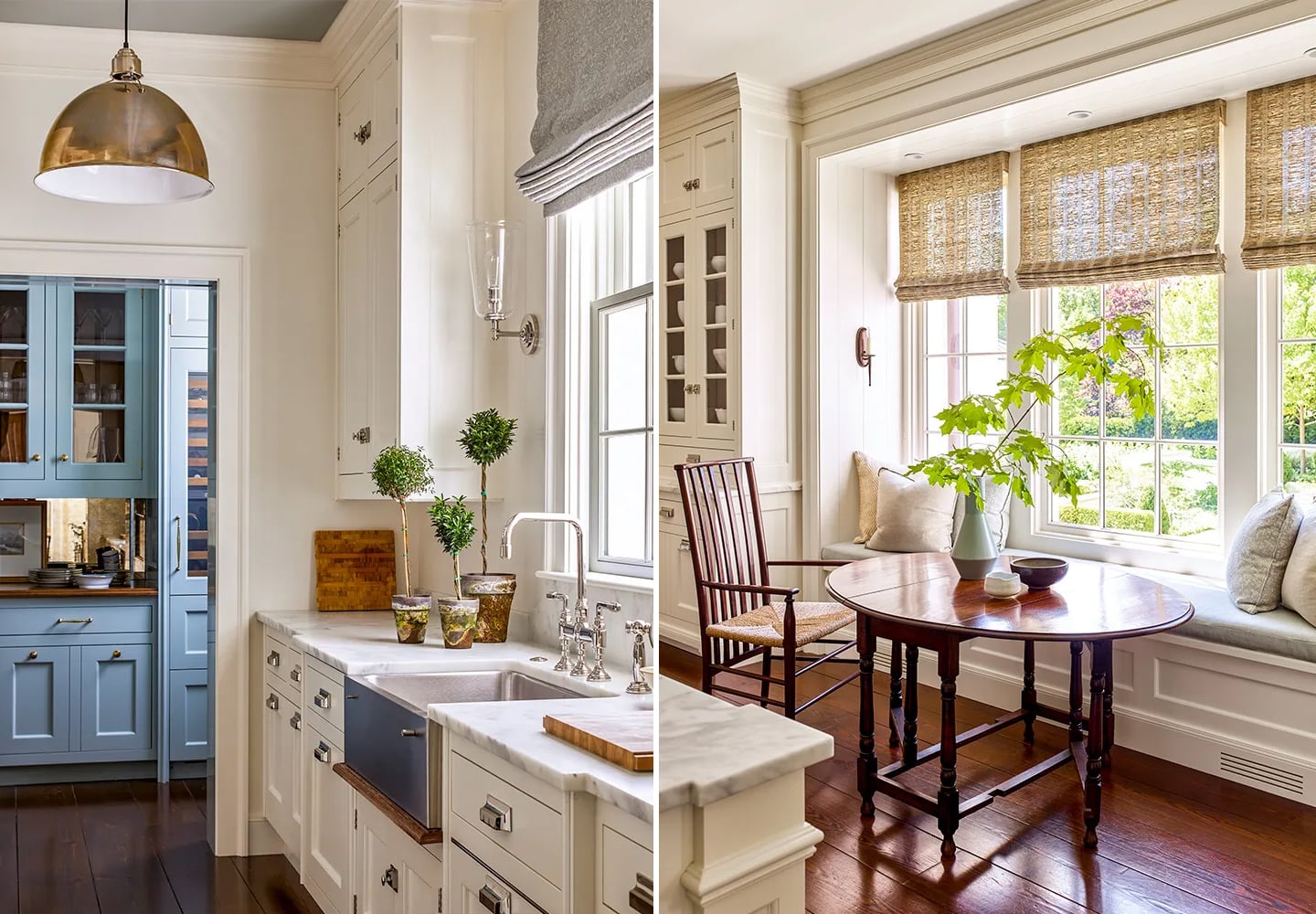
A Warm & Inviting Kitchen with Natural Accents
Image courtesy of Suzanne Kasler Design
25. The Most Adaptable Kitchen Color: Why Cream Stands the Test of Time
One argument I make regularly to clients planning a long-term home is the adaptability of cream cabinets. Unlike bold cabinet colors that lock you into a specific design direction, cream cabinets let you completely transform the feel of your kitchen — with a new backsplash, countertops, island color, or hardware — without touching the cabinetry itself. It’s the closest thing to a permanent foundation in kitchen design.
In this heritage remodel of a Maryland home, interior designer Shea McGee chose Steamed Milk by Sherwin-Williams — a cream shade with a soft peachy undertone that adds warmth and complexity. It’s a less obvious choice than Swiss Coffee or Natural Cream and is worth considering for kitchens where a standard cream reads too flat or too cool.
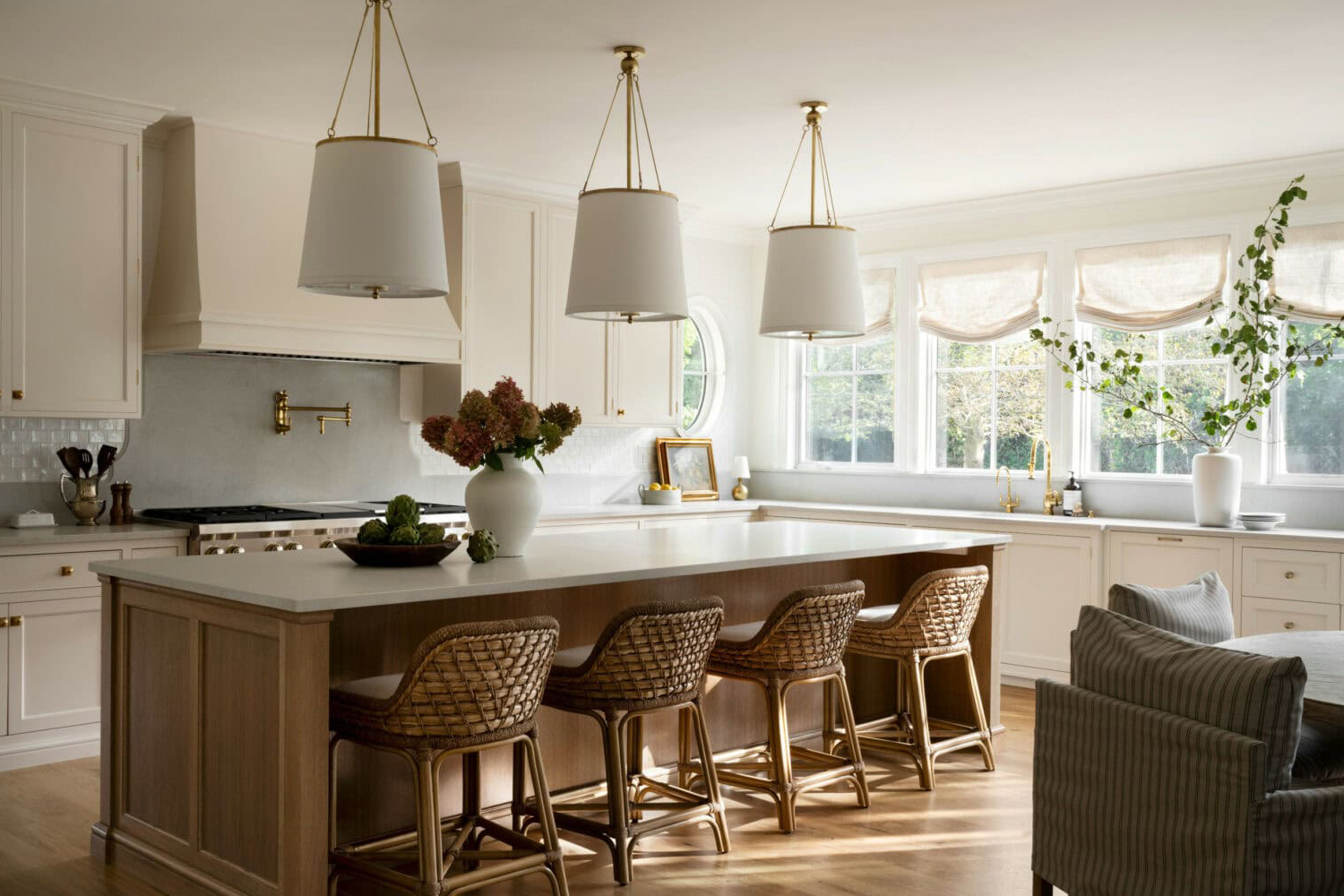
Contemporary Kitchen Design with Cream Cabinets and Wood Island
Image courtesy of Tyler Karu Design
26. Cream Kitchen Decor Ideas: Decorative Accents That Take Center Stage
Cream cabinets have a quality that bolder colors don’t — they make decorative accents feel complementary rather than competing. Statement lighting, open-shelving displays, unique dishware, and artwork all read more clearly against cream than against a cabinet color that’s competing for the same visual attention. In my own projects, I use this quality deliberately, in kitchens where the client wants personality without pattern.
Interior designer Mindy Gayer’s cottage kitchen features creamy cabinets in Pewter Patter by Dunn-Edwards — a distinctive warm putty-cream with subtle gray undertones that reads differently from standard Benjamin Moore or Sherwin-Williams options — providing the backdrop for open shelving, shiplap walls, and dramatically veined marble. The result is a kitchen where every decorative element earns its place precisely because the cabinetry doesn’t compete with it.
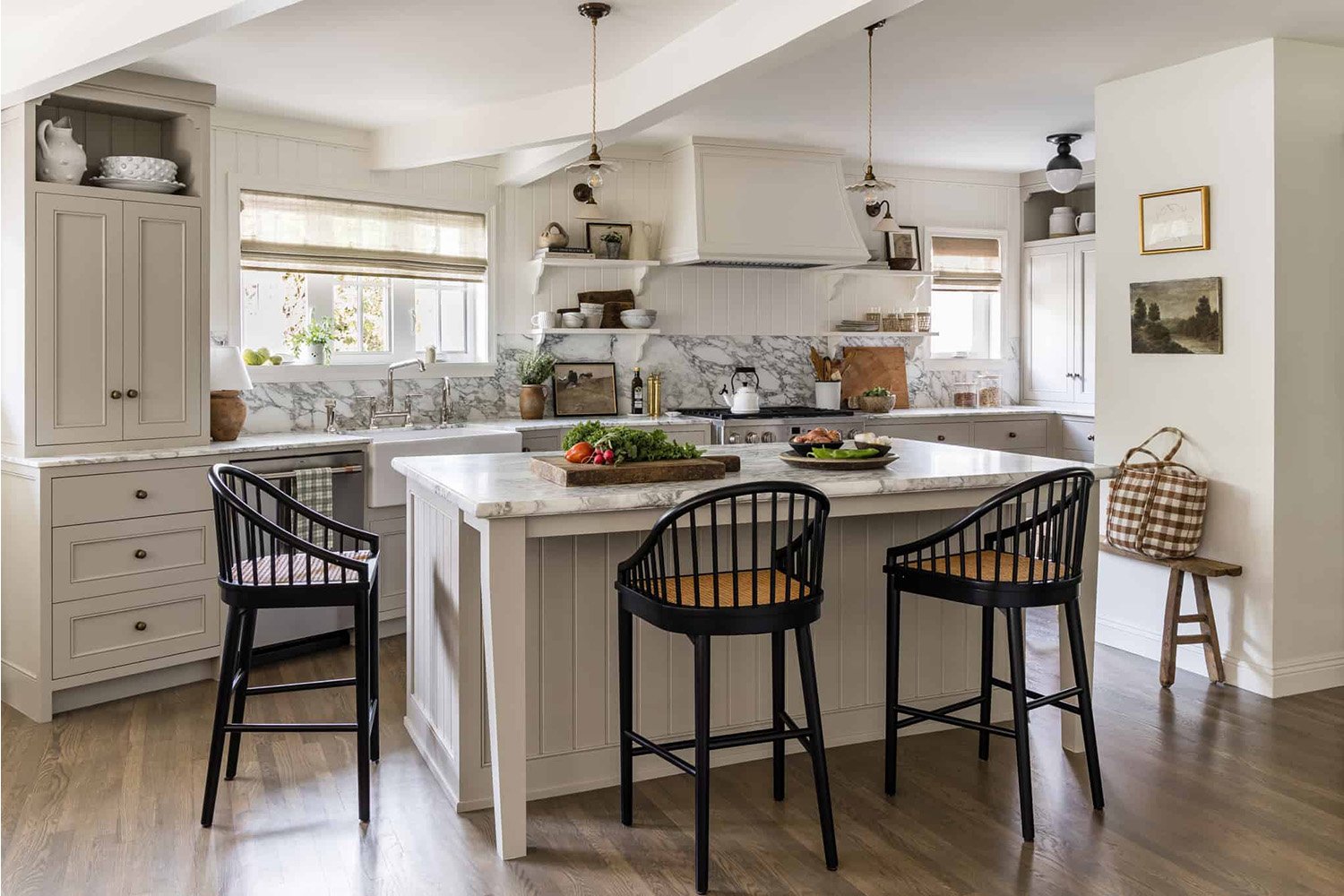
Country Kitchen with Cream Cabinets, Vertical Shiplap Walls, and a Marble Backsplash
Image courtesy of Mindy Gayer
27. Vintage Cream Cabinets: Glamour and Old-World Character
Vintage cream kitchen cabinets occupy a specific design territory that standard cream doesn’t — they lean into aged character, subtle patina, and old-world glamour rather than clean contemporary warmth. The distinction lies primarily in the undertone: vintage cream shades tend toward cool beige, putty, or greige rather than the warmer yellow-based creams that dominate farmhouse and rustic applications.
The kitchen below, by Blushing Boho Design, demonstrates this beautifully with a sophisticated two-tone approach. Perimeter cabinets are painted Sherwin-Williams Realist Beige — a light, cool-brown cream that reads as refined and understated — while the island is painted Sherwin-Williams Utterly Beige, a slightly deeper version of the same cool-brown family. The tonal variation between perimeter and island is subtle enough to feel considered rather than contrasting, while glossy subway tiles, gleaming white countertops, and brass accents complete a palette that feels simultaneously vintage and current.

Lovely Cream Cabinets Paired With Gold Hardware and Glossy White Subway Tiles
Image courtesy of Blushing Boho
28. Cream Cabinets with White Walls – and Other Wall Color Pairings
Wall color is one of the most common questions I receive from clients with cream cabinets — and one where the answer is more nuanced than most design resources suggest. The right wall color depends entirely on your cream shade’s undertone, your kitchen’s natural light, and the overall mood you’re trying to achieve.
My guidance by wall color category:
| Wall Color | Works Best When | Avoid When |
|---|---|---|
| White | Maximizing light in smaller kitchens; cream has warm undertones | Your cream shade already reads very light — walls and cabinets will blend together |
| Warm greige | Creating a cohesive tonal palette, rustic or farmhouse kitchens | You want contrast or visual definition between walls and cabinets |
| Soft sage green | Adding natural color without drama; cream has yellow undertones | Your kitchen has limited natural light — green can read dull |
| Warm gray | Modern or transitional kitchens; cream has cool undertones | Traditional or rustic spaces where gray feels too contemporary |
| Deep navy or forest green | Creating a dramatic, moody kitchen; large kitchens with good light | Small kitchens or spaces with limited natural light |
The kitchen below, designed by interior designer Chelsey Hale, effectively incorporates white walls. Cream cabinets are paired with white walls and a white shiplap ceiling — a combination that maximizes the sense of light and space without feeling cold, thanks to the warmth that cream brings to what would otherwise be an entirely white palette. Gold accessories and a warm wood kitchen island add the contrast and grounding that prevent the space from feeling washed out.

Farmhouse Kitchen with White Walls, Cream Cabinets, Gold Hardware and Light Wood Flooring
Image courtesy of Chelsey Hale Design
29. Dark Wood Kitchen Island with Cream Cabinets: High Contrast Done Right
A dark wood island paired with cream perimeter cabinets is one of the most effective high-contrast combinations in kitchen design — and one I recommend regularly to clients who want visual drama without committing to dark cabinetry throughout. The contrast works because cream and dark wood share the same warmth while sitting at opposite ends of the value scale. The result feels intentional and grounded rather than jarring.
The country kitchen below, by West of Main, showcases this combination with confidence. Cream kitchen cabinets are paired with a dark wood island base and a white quartz countertop — the quartz serving as a visual bridge between the light cabinets and the dark island. Medium-toned wide-plank wood flooring sits comfortably between the two extremes, preventing the contrast from feeling too abrupt. Woven counter stools and a colorful area rug add the layered texture that keeps a high-contrast palette from feeling flat.
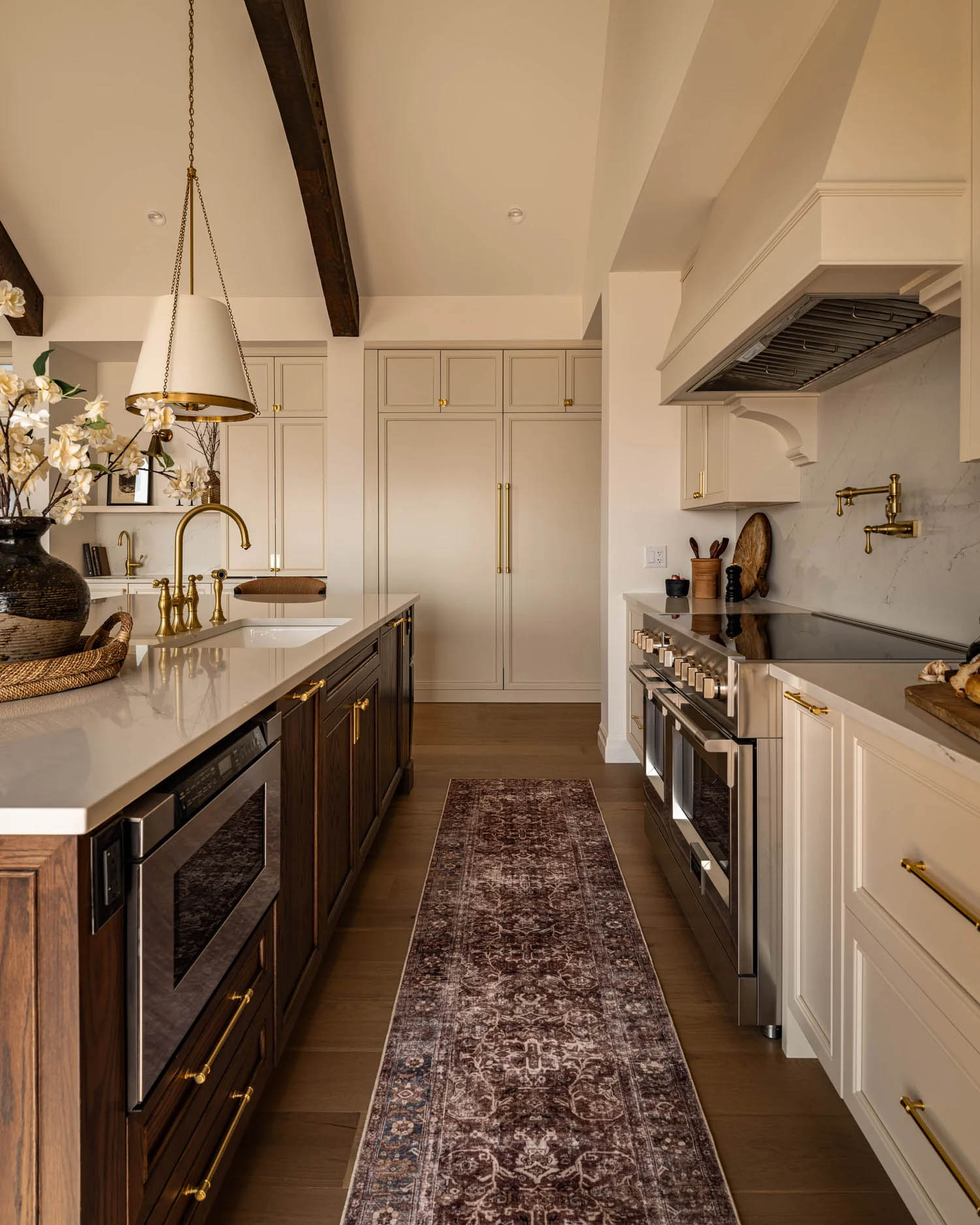

Kitchen with Warm Cream Cabinets, High Ceilings, Wood Beams and a Dark Wood Island
Image courtesy of West of Main
30. Backsplash Ideas for Cream Kitchen Cabinets: What Works Best
The backsplash is arguably the most impactful single decision in a cream kitchen after the cabinet color itself — it sits at eye level, covers significant visual real estate, and directly influences whether the cream reads warm, cool, vintage, or contemporary. After specifying backsplashes for cream kitchens across hundreds of projects, these are the combinations I return to most consistently:
| Backsplash Material | Effect With Cream Cabinets | Best Style Match |
|---|---|---|
| White and gray marble | Adds movement and luminosity; cream softens marble’s coolness | Traditional, transitional, contemporary |
| Zellige tile | Handcrafted texture and warm variation that complements cream naturally | Farmhouse, rustic, Mediterranean |
| Subway tile — white | Clean and classic; choose a warm white to avoid a clash with cream | Farmhouse, cottage, traditional |
| Soapstone or slate | Dark matte surface creates dramatic contrast | Rustic, log home, old-world |
| Terracotta tile | Shared warm undertones create a cohesive, natural palette | Southwestern, Mediterranean, rustic |
| Shiplap | Architectural texture that reinforces farmhouse character | Farmhouse, country, cottage |
| Unlacquered brass tile | Glamorous and distinctive; works with cream’s warmth | Traditional, maximalist, old-world |
The kitchen below, by Brittany Hakimfar, features the white-and-gray marble approach at its most dramatic. Cream cabinetry is paired with richly veined marble — the movement in the stone providing all the visual interest the backsplash needs while the cream cabinets keep the palette warm and grounded. Two vibrant green pendant lights and fresh greenery add unexpected color that the cream backdrop handles effortlessly — a reminder that cream’s neutrality extends to bold accent colors as well as natural materials.

Light and Airy Country Kitchen with Cream Cabinets, White Marble Backsplash & Countertops
Image courtesy of Brittany Hakimfar
31. Butler’s Pantry Ideas with Cream Cabinets
Butler’s pantries present a unique design opportunity — because they’re secondary spaces that connect to but sit apart from the main kitchen, they can take a slightly different design direction without disrupting overall cohesion. In my experience, cream cabinets are the ideal choice for butler’s pantries for exactly this reason. They maintain continuity with a cream or neutral main kitchen while allowing the pantry to feel like its own considered space rather than an afterthought.
The butler’s pantry below, designed by Cedar & Oak Homes, demonstrates this beautifully. Cream cabinetry anchors a space layered with carefully chosen details — neutral checkerboard tile flooring, glass-front cabinet doors, black-framed windows, a farmhouse sink, brass hardware, and fresh greenery. Each element contributes to a country charm that feels collected rather than decorated. The pottery display on open shelving is effective — cream cabinets provide exactly the kind of quiet backdrop that makes the displayed objects read as intentional rather than cluttered.

Butler’s Pantry With Cream Cabinets Paired With Glass Cabinet Doors
Image courtesy of Cedar & Oak Homes
32. Cream Cabinets in a Country Kitchen
Of all the kitchen styles that cream cabinets suit, country and rustic interiors are where they may feel most at home. There’s a natural alignment between cream’s inherent warmth and aged character and the country kitchen’s emphasis on handcrafted materials, lived-in comfort, and organic imperfection. Where modern kitchens require restraint from cream cabinets and traditional kitchens require formality, country kitchens simply ask cream to be itself.
The kitchen below by Anja Michals captures this quality perfectly. Cream cabinets are paired with warm tile flooring, wood accents, brass hardware, and a zellige tile backsplash — an inspired choice. Zellige’s handcrafted irregularity and subtle color variation share the same organic, imperfect quality that defines country kitchen design at its best, and cream cabinetry is the ideal foil — warm enough to complement the zellige’s earth tones without competing with its texture and movement.
For more country kitchen inspiration, including layout ideas, color palettes, and styling guidance, visit my complete guide to country kitchen ideas.


Cream Cabinets in a Country Kitchen
Image courtesy of Anja Michals Design
Designer-Approved Cream Cabinet Paint Colors: The Definitive Guide
Choosing the right cream paint color is the single most consequential decision in a cream kitchen — get the undertone wrong and even the most beautiful design can feel off. After years of specifying cream cabinetry for clients across log homes, farmhouse interiors, and rustic mountain retreats, these are the shades other leading designers and I return to consistently:
| Color | Brand | Undertone | Best For | Designer Endorsement |
|---|---|---|---|---|
| Swiss Coffee OC-45 | Benjamin Moore | Warm yellow-cream | All styles — most versatile option | Industry-wide favorite |
| White Dove OC-17 | Benjamin Moore | Soft cream-white | Spaces with abundant natural light | Amber Lewis |
| Natural Cream OC-14 | Benjamin Moore | Warm greige | Log homes, rustic interiors | Tracy Svendsen |
| Accessible Beige SW-7036 | Sherwin-Williams | Warm gray-beige | Kitchens needing dynamic light response | Shea McGee |
| Creamy SW-7012 | Sherwin-Williams | Soft yellow-beige | Farmhouse and traditional kitchens | Most recommended SW cream |
| Dover White SW-6385 | Sherwin-Williams | Warm sun-white | Any room needing warmth and crispness | Erin Napier |
| White Heat | Dunn-Edwards | Warm vanilla-cream | Bright spaces with abundant natural light | Amber Lewis |
| Pewter Patter | Dunn-Edwards | Warm putty-gray | Cottage and country kitchens | Mindy Gayer |
| Old White | Farrow & Ball | Cool putty-cream | Colonial, Georgian, period-style kitchens | Becca Casey |
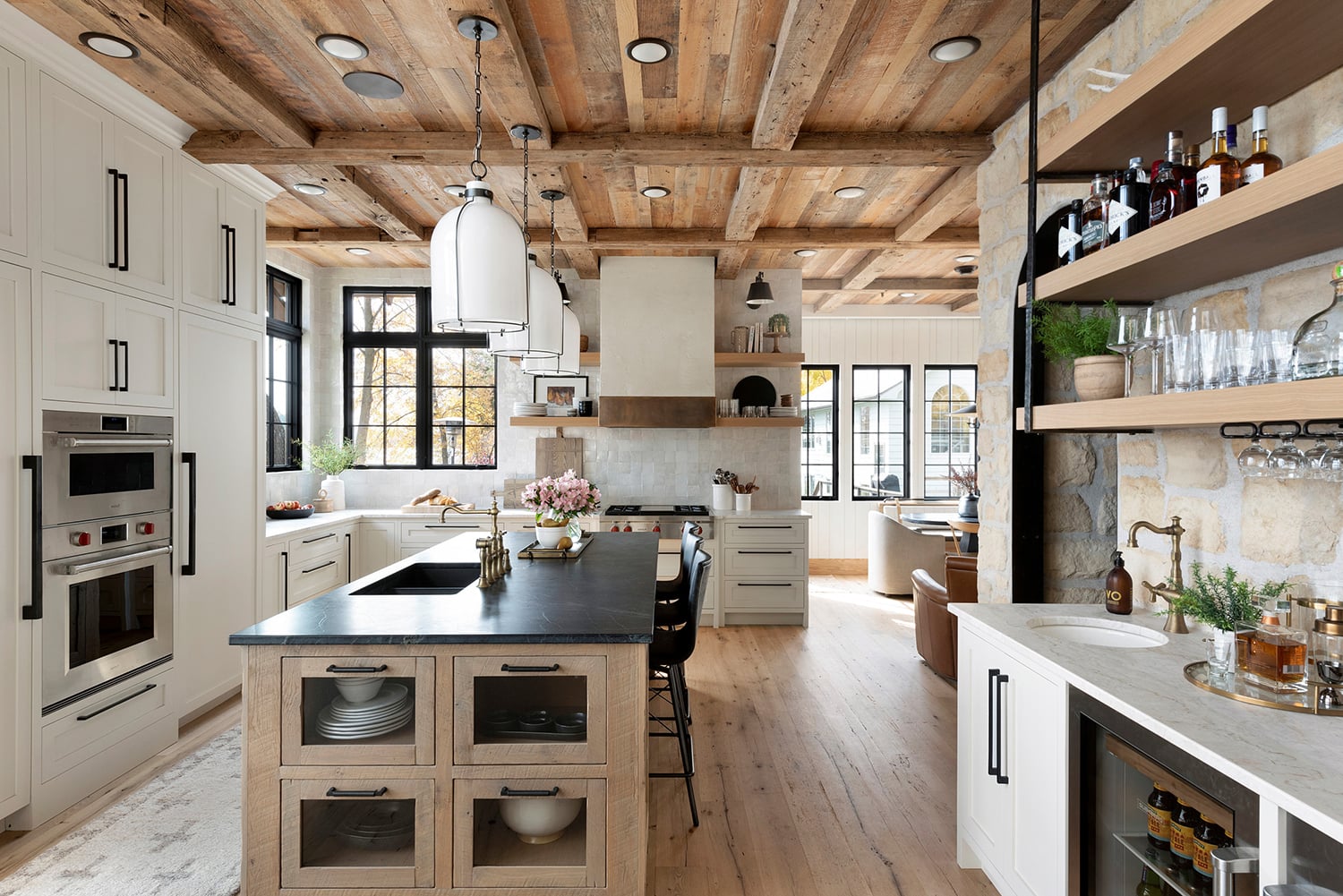
Modern Farmhouse Kitchen with Cream Cabinets, Wood Beam Ceiling, and Stone Accent Wall
Image courtesy of Tays and Co.
Choosing the Right Sheen
Sheen matters as much as color in a kitchen environment. Satin and semi-gloss are the only finishes I recommend for kitchen cabinet paint — matte finishes show wear quickly and are genuinely difficult to keep clean. My personal preference is satin: it provides a soft, barely-there sheen that photographs beautifully and holds up exceptionally well to daily use.
Potential Drawbacks to Know Before You Commit
Cream is not a foolproof color — it requires more careful selection than white precisely because its undertones are more complex. Yellow, beige, and subtle green undertones all exist within the cream family and can read very differently depending on your kitchen’s light exposure, flooring tone, and surrounding materials.
My non-negotiable advice: always place a physical sample on your actual cabinet door and observe it at multiple times of day before ordering. I place a swatch of Benjamin Moore Simply White alongside every cream sample I evaluate — comparing against a true white immediately reveals the undertone and prevents costly mistakes. Never rely on online color swatches alone — screen calibration varies significantly, and cream is one of the colors most affected by digital rendering.
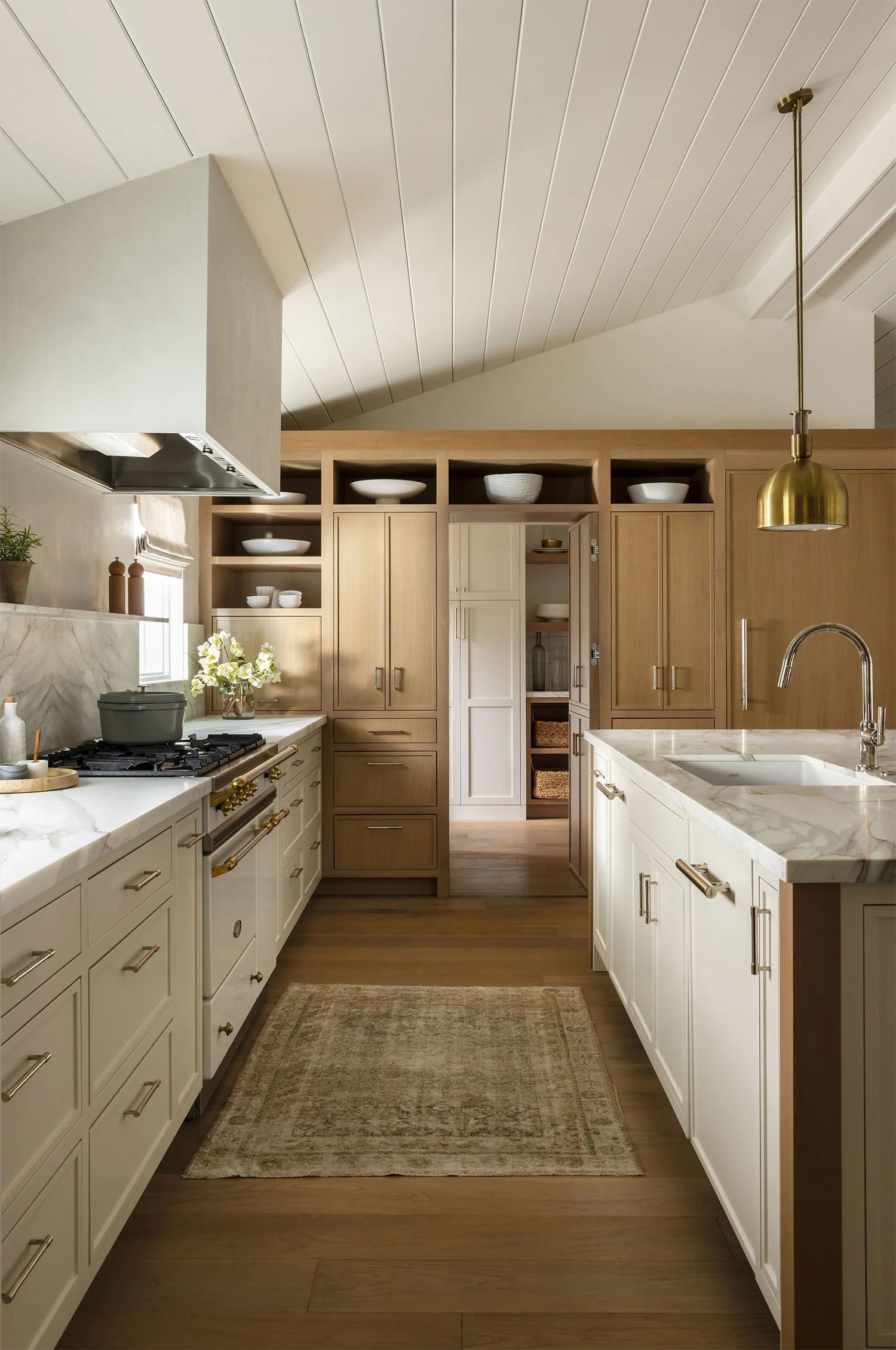
Two-tone cream and wood kitchen cabinets with light oak flooring
Image courtesy of Katie Monkhouse Design
Frequently Asked Questions About Cream Kitchen Cabinets
Are cream kitchen cabinets still in style?
Yes — and arguably more so than ever. Cream kitchen cabinets are confirmed as a leading choice in the 2026 NKBA kitchen forecast, reflecting a broader shift away from the all-white kitchens that dominated the past decade. Leading designers including Shea McGee, Amber Lewis, and Studio McGee are actively specifying cream over white for its warmth, versatility, and ability to work across modern, farmhouse, traditional, and rustic interiors. Unlike trend-driven colors that cycle in and out, cream has an enduring quality that makes it a sound long-term investment for any kitchen.
What color goes best with cream kitchen cabinets?
Cream pairs beautifully with a wide range of colors, but the most successful combinations share cream’s underlying warmth. For high contrast, navy blue, charcoal gray, forest green, and matte black all work exceptionally well — cream softens these deep tones while they give the overall palette definition and depth. For a softer result, warm wood tones, taupe, greige, and sage green create a layered palette that feels harmonious without drama. The key rule: always pull accent colors from the warm side of the color wheel — cool grays and pure blues can create an uncomfortable disconnect with cream’s inherent warmth.
What countertop looks best with cream cabinets?
The best countertop for cream cabinets depends on your kitchen style and the mood you want to achieve. For elegance and movement, Calacatta or Carrara marble is the top designer choice — the veining adds visual interest while cream softens marble’s coolness. For maximum contrast, honed black granite or soapstone creates a striking, timeless combination. For farmhouse and rustic kitchens, butcher block is a natural pairing — the shared warmth between cream and wood creates an organic, inviting result. The most important rule regardless of material: always bring your cabinet door sample to the countertop showroom — undertone matching matters more than overall color.
What is the difference between cream and white kitchen cabinets?
The difference goes beyond color. White cabinets reflect light at full intensity, which can create harsh, flat illumination and make natural wood tones appear more yellow by contrast. Cream cabinets reflect light warmly, amplifying the golden quality of natural light and creating a softer, more inviting atmosphere throughout the day. In practical terms, cream works more harmoniously with natural wood, stone, and brick — particularly in log homes and rustic interiors, where white can inadvertently clash with the warmth of surrounding materials. Cream also ages more gracefully — what reads as wear and yellowing on white reads as character and patina on cream.
Are cream cabinets a good choice for log homes?
Cream cabinets are my top recommendation for log home kitchens — and the single design decision that generates the most positive feedback from clients after completion. Log and timber walls carry natural yellow, orange, or amber undertones that intensify as the wood ages. White cabinets amplify those yellow tones, making the kitchen feel warmer and more yellow than intended. Cream, with its own subtle warm undertones, provides a soft harmonious contrast that works with the wood rather than against it. For log homes specifically, Benjamin Moore Natural Cream OC-14 is my most consistent recommendation — its warm greige base harmonizes with amber wood tones without amplifying them.
View Recent Posts
Modern Rustic Decorating Ideas
Transform your home into a warm, welcoming retreat with these modern rustic decorating ideas. Combining the best of both worlds, this design style effortlessly blends contemporary elements with the charm of rustic aesthetics.
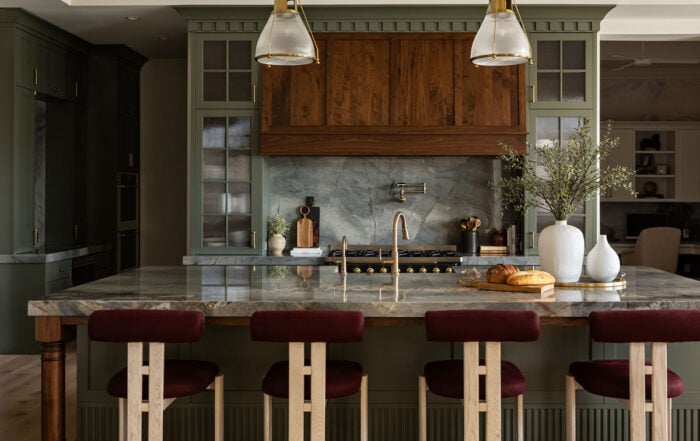
Stunning Range Hood Design Ideas
Range hood design ideas covering stone, wood, plaster, copper, and stainless steel — with designer tips on proportion, material selection, and installation.

Fireplace Design Ideas
45 fireplace design ideas, from ceiling-high stone and fluted plaster to wood paneling and black tile, with a designer’s tips on materials, scale and color.
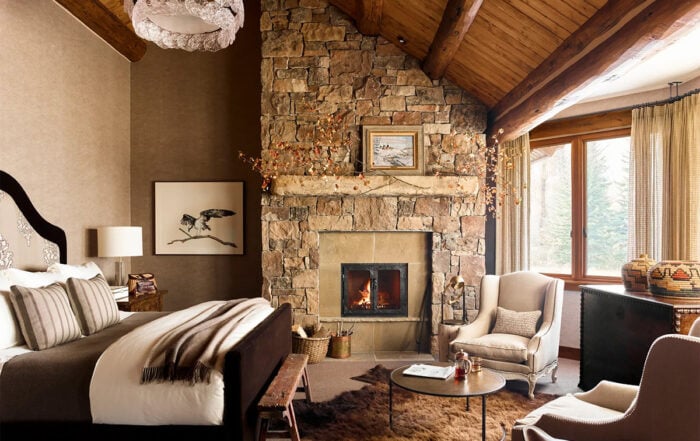
Rustic Bedroom Ideas
Rustic bedroom ideas covering natural materials, layered textiles, color palettes, and professional design strategies for log cabin, modern rustic, Scandinavian, and luxury retreat styles.
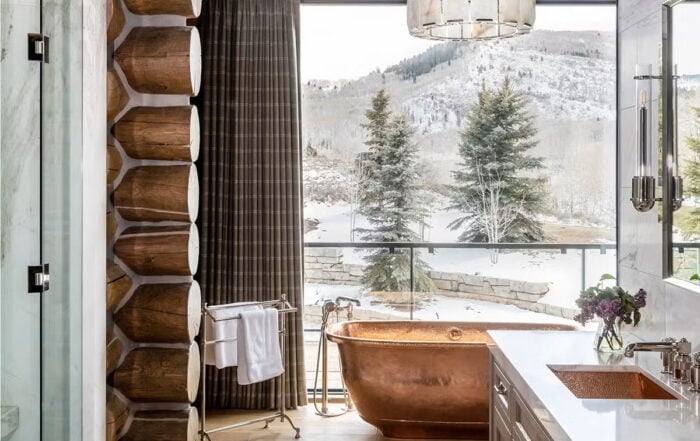
Rustic Bathroom Ideas
Rustic bathroom ideas — natural materials, vintage fixtures, earthy palettes, and designer tips for log homes, cabins, and mountain retreats.
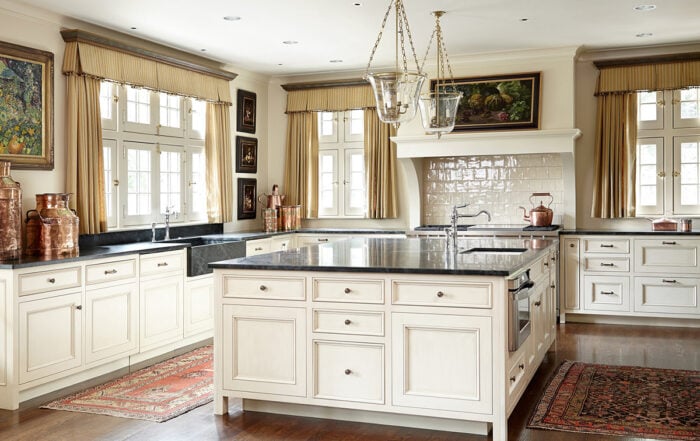
Cream Kitchen Cabinet Ideas
Cream kitchen cabinet ideas curated by interior designer Tracy Svendsen. Warmer than white and more versatile than beige, cream cabinets work beautifully across farmhouse, rustic, traditional, and modern kitchens.

