
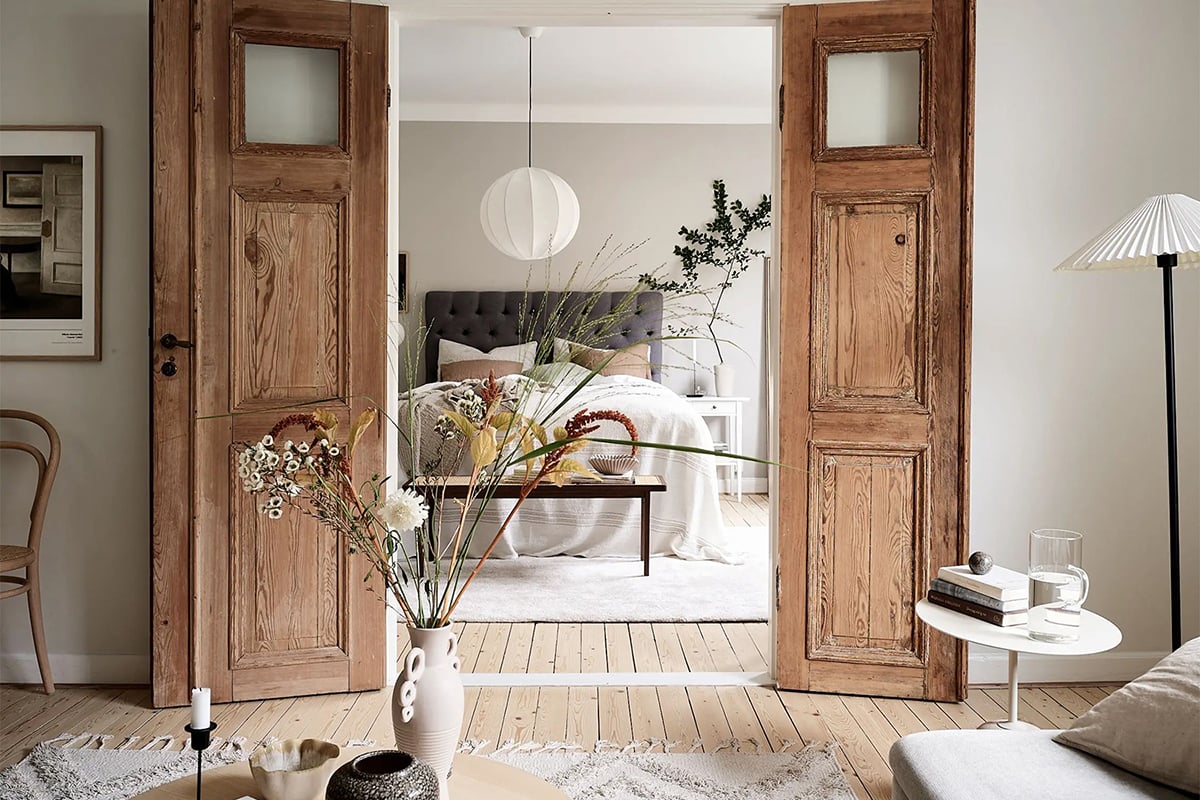
15 Scandinavian Decorating Ideas for Every Room
By Interior Designer TRACY SVENDSEN | Published on Aug 6, 2023 | Updated on September 10, 2026 |
Scandinavian design gets reduced to a formula so often — white walls, wood floors, a few plants — that its actual discipline gets lost. The style works because every material choice is deliberate: warmth and restraint held in constant balance, nothing added without a reason for being there.
Being of Danish descent — my father was Danish — I’ve been drawn to this style long before it became a design trend. It was the dominant language of both interiors and furniture design throughout my design education, and it shaped how I think about a room long before I ever specialized in log home and rustic interiors. My own home carries that influence today: a strong balance of white and black, paired with organic, earthy materials that keep the palette grounded rather than overly minimal.
The 15 rooms in this guide show that same balance solved differently across real projects — how much warmth to bring in, where black anchors a space instead of softening it, and when natural materials should lead instead of support. Feature image courtesy of Planete-Deco.

Scandinavian-Style Living Room
Image courtesy of Emily Henderson Design.
1. Understanding Scandinavian Style: A Case Study in Restraint
Lisa Staton designed this home around a brief with real discipline: a limited number of finishes and design concepts, repeated deliberately throughout rather than introduced room by room. The owners — originally from Sweden — wanted to balance contemporary design with the antique pieces they’d collected back home, set into a new build tucked into a hillside above Bellingham Bay, Washington.
Staton holds that balance with a tight palette of oatmeal, cinnamon, and olive green, carried across wide-plank oak floors and a striking concrete fireplace. A light-wood Karl Springer coffee table keeps the furniture simple in shape, while an antique Oushak rug layered over a large wool flatweave gives the open-plan space real warmth without introducing new colors or patterns. The result reads more cabin than showroom — textures doing the work color usually does, all filtered through a neutral scheme that echoes the forest and lake outside.
Designer Tip: I recommend Staton’s approach for any home blending inherited or antique pieces with a contemporary build: limit your palette and materials first, then let the antiques carry the history within that restraint. A tight, repeated material palette lets a 100-year-old rug and a Karl Springer table sit in the same room without either looking out of place.

A Layered Antique Rug Grounds an Open-Plan Scandinavian Retreat
Image courtesy of Luxe Interiors
2. Curved Forms Within a Restrained Palette
Two views of Louise Liljencrantz’s own showroom show how far a tight material palette can stretch when the forms inside it get more expressive. Dark wood flooring and furniture repeat across both spaces, but the geometry does the real work: a white curving sofa and matching accent chair play off a dark wood coffee table paired with a square end table, keeping the curves from tipping into formlessness. A wood cube sits against the black diagonal graphic wall — the room’s one sharp, linear gesture — while a fluted wood ledge runs the length of the window, adding a third texture without introducing a new color.
The second view pushes the same language further with a custom freeform wood coffee table, its natural grain left fully exposed, alongside a low-profile cream sofa and a curving white bench. Nothing here is upholstered in a hard edge — every piece is sculptural first, functional second, unified by the same dark wood and white base that Staton’s project in the previous section also relied on.
Designer Tip: I recommend mixing curved and angular forms deliberately rather than choosing one language exclusively — here, the square end table and wood cube ground the room’s curving sofa and chair, giving the eye a place to rest. The mix works because everything shares the same dark wood and white palette; it’s the material consistency, not the shape, that keeps the room from feeling disjointed.


Curving Furniture Softens a Dark Wood and White Palette
Image courtesy of Louise Liljencrantz
3. Layering Textures in Neutral Spaces
Jenn Pablo Studio builds this beachside retreat around one architectural gesture: a large arched window, dressed in sheer white linen, that floods the room with light beneath a high vaulted ceiling. Bright white walls do nothing to compete with it, leaving the arch itself as the room’s clear focal point — modern rustic in structure, with the Scandinavian restraint carried through in how little else is asked to compete with that light.
Texture does the work color usually would. A low-profile sofa in creamy white sits alongside accent chairs with light oak frames, all resting on two layered rugs — a woven sisal base topped with a high-pile flokati wool. Throw pillows mix solids with subtle earth-tone stripes, and the light oak coffee table is styled with circular wood trays that echo the arch’s curve, breaking up the table’s square geometry in a small, deliberate way. Large plants in rustic pots and woven baskets round out the room’s natural materials without introducing anything ornamental.
Designer Tip: I recommend layering two rugs with different textures — a flat woven base under a higher-pile top layer — whenever a room’s palette is otherwise all-neutral. It’s one of the fastest ways to add real depth underfoot without introducing a single new color.

A Layered Sisal and Flokati Rug Grounds the Room’s Textures
Image courtesy of Jenn Pablo Studio
4. Two Ways to Bring Natural Materials Indoors
Photographer Laura Muthesius and stylist Nora Eisermann gutted a former schoolhouse near Berlin to create this German countryside retreat, and the kitchen shows their commitment to material honesty: deVOL’s Real Shaker cabinets and Crackle metro tiles, a Bertazzoni range, and an island topped in warm copper against Arabescato marble countertops. New oak parquet flooring and an informal limewash finish from Bauwerk keep the room from feeling too polished for a converted schoolhouse, while a rustic wood dining table and loose displays of florals and branches soften the kitchen’s harder surfaces.
At Lon Retreat — a home-hotel on Victoria, Australia’s Bellarine Peninsula, opened by owners Claire and Rob Gemes in 2018 after two decades of planning — the same instinct for natural materials takes a different form. Light gray concrete covers both the floor and walls, paired with a wood ceiling and black woven pendant lights overhead. A curving concrete bench wraps around a wood stove, with firewood stacked beneath it as both fuel and texture, while a woven earth-tone rug and a light gray sofa keep the room from reading as purely industrial.
Designer Tip: I recommend choosing one or two “hero” materials per space rather than scattering natural elements evenly — the schoolhouse kitchen leans on copper and marble, Lon Retreat leans on concrete and wood. Both work because the material choice is concentrated, not spread thin across dozens of small decorative touches.


Incorporating Natural Materials in Scandinavian Design
Images courtesy of The Style Files
5. A Warmer, More Luxurious Take on Scandinavian Design
Louise Liljencrantz’s work is known for its elegance across showrooms, private interiors, and furniture design alike — “every project has to be just right,” as she’s put it. These two Stockholm apartments show a more contemporary, richer register than the earlier rooms in this guide: warm woods and black accents replacing the all-white restraint of Sections 1 through 4.
In the first apartment — renovated with a 360-degree terrace view of the Stockholm skyline — Liljencrantz grounds the space in mahogany downstairs, then lets the palette evolve outward from that warm anchor into cooler greyish-blue tones, curved lines set against hard ones. The dining room shows the formula directly: dark and light hardwood flooring combined underfoot, a warm wood table, caramel leather chairs with dark wood frames, and built-in cabinetry that repeats the same warm wood throughout.
The second apartment pushes the palette further into rich, moody territory—a curving, fluted wall in warm wood tones, black accents, and sculptural objects that give the space a distinctly mid-century, contemporary European character.
Designer Tip: I recommend starting with one warm, grounding material — mahogany, in this case — before introducing any cooler accent tones. Liljencrantz builds outward from that anchor rather than mixing warm and cool elements from the start, which is why the palette reads as intentional rather than assembled piecemeal.


Contemporary Scandinavian Design in the Dining Room
Image courtesy of Louise Liljencrantz
6. An Old-World European Bedroom, Styled Scandinavian
This Swedish apartment, styled by Grey Deco, sits inside an older European building — ornate crown molding against the white ceiling gives away the structure’s age, a detail Scandinavian styling here doesn’t fight against but simply lets be. Walls in a warm, muted olive green anchor the room, paired with light wood flooring and white-painted doors and window frames that keep the older architecture from feeling heavy.
With the bedroom door open, the adjacent living room is clearly visible, painted a pale gray that adds visual depth to the sightline while keeping the two spaces feeling connected rather than competing with the olive bedroom walls. A paper pendant light and Scandinavian-style modern artwork add a more contemporary layer, while a quilted taupe bedspread and floor-to-ceiling pale gray curtains keep the bedding and window treatments in the same soft, neutral register as the walls. A dark leather butterfly chair in the corner is the room’s only sharp material contrast—its curved black leather frame against all that pale, warm color.
Designer Tip: I recommend considering the view through an open doorway as part of a room’s design, not just the room itself — pairing this olive bedroom with a paler gray living room, visible in the same sightline, keeps two different wall colors from feeling disconnected when both rooms are seen together.

Ornate Crown Molding Meets Modern Scandinavian Styling
Image courtesy of Planete-Deco
7. Hygge in Practice: The Adjacent Living Room
Through the same open doorway as the previous bedroom, this living room picks up the apartment’s warm copper tones and carries them into a paler, quieter register: pale gray walls, light wood flooring, and a low-slung off-white sofa layered with textural pillows and a knit throw. A large, textured off-white rug anchors the space, while sheer floor-to-ceiling linen drapes let light move through the room the way the bedroom’s own curtains did.
Sculptural vases and a scattering of plants bring in the room’s only organic color note, and a round coffee table on slim wood legs keeps the space feeling light rather than heavy — what the designer clearly intended as quiet elegance, not visual noise. It’s a fitting home for hygge, the Danish concept of contentment this style is often built around: nothing here demands attention, which is exactly the point.
Designer Tip: I recommend choosing furniture with visibly slim, light legs — like this coffee table — when a room already carries a lot of texture through rugs, pillows, and throws. A heavier piece would compete with all that softness; a light one lets the textures stay the visual focus. My own home leans into hygge the same way — layered pillows and throws, candles, and a rotating collection of sculptural vases do most of the work, long before any single piece of furniture does.

A Round Coffee Table Adds Quiet Elegance to a Layered Living Room
Image courtesy of Planete-Deco
8. Lagom in Practice: Just the Right Amount
Lagom — the Swedish concept of “just the right amount,” neither too much nor too little — guides every decision in this narrow living room. A charcoal gray ceiling anchors the space against white walls and parquet flooring, while floor-to-ceiling sheer white curtains and a circular white fabric pendant keep the room feeling open despite its width. A pale gray geometric rug and a sofa in the same pale gray tone hold the palette steady, with color introduced in exactly one place: artwork above the sofa, echoed in the throw pillows below it, and nowhere else.
Two Harry Bertoia Diamond Chairs — American mid-century design, not Scandinavian, but a natural pairing with this restraint — sit as the room’s one textural departure, their wire mesh frames reading as sculpture as much as seating. An abundance of plants throughout softens all that gray and white with real, living green — the one element in the room that isn’t strictly controlled by the lagom discipline governing everything else.
Designer Tip: I recommend applying lagom as a real constraint, not just a mood — pick exactly one place for color (here, the artwork and pillows) and exactly one place for a contrasting material or texture (the wire mesh chairs), then stop. The discipline of choosing “just enough” is harder than it sounds, but it’s what keeps a narrow room like this one from feeling either bare or cluttered.

Bertoia Diamond Chairs Add Texture to a Lagom-Inspired Living Room
Image courtesy of Planete-Deco
9. Old-World Architecture, Scandinavian Restraint
This turn-of-the-century Swedish apartment, styled by Grey Deco, pairs its original architecture with a deliberately restrained approach to furnishing. A traditional tiled Swedish stove, painted with faded floral detail, anchors one corner as a genuine architectural feature rather than a styling prop, its ornate pattern left fully visible against otherwise plain gray walls.
An abstract woven wall hanging — circles and geometric forms in black, tan, and cream — is the room’s real focal point, hung at scale above a rattan-front storage cabinet. A white canvas butterfly chair and a round wood coffee table with slim black hairpin legs keep the furniture light, while a wire magazine rack and a monstera in a sculptural black planter add the room’s only sharp, dark accents. A wool throw draped over the sofa and a pale wool rug underfoot round out the textures without introducing any new color.
Designer Tip: I recommend hanging a single large-scale art piece — like this woven textile — rather than a gallery wall of smaller pieces, when a room’s fireplace or stove is already a strong architectural focal point. One statement piece on the opposite wall balances the room without competing with the stove for attention.

An Abstract Woven Wall Hanging Anchors the Living Room
Image courtesy of Planete-Deco
10. A Kitchen Built to Age Well
Leanne Ford designed this kitchen around a philosophy most Scandinavian kitchens don’t state outright: imperfection as a feature, not a flaw. The white cabinets are alder wood, left with visible imperfections rather than sanded to a flawless finish — as the paint naturally wears over time, the cabinets are designed to look better, not worse. Glossy white subway tile keeps that same informal, lived-in character against a slightly more polished surface.
Overhead, the wood ceiling was built from reclaimed hardwood flooring pulled from elsewhere in the home, paired with exposed wood beams that give the room real mid-century weight. There’s no island — instead, a massive wood table anchors the space, lit by two glass chandeliers hung side by side. Open wood shelving and a brick fireplace round out the room’s material honesty; every surface here is chosen to show its age rather than hide it.
Designer Tip: I recommend deciding early whether you want your kitchen to age visibly, like this one, or stay closer to a flawless modern Scandinavian finish — both are legitimate directions, but the material choices differ. Alder wood and worn paint suit the first; a sealed matte lacquer or quartz surface suits the second. Choosing one early keeps the rest of the room’s finishes consistent with that decision.

Alder Wood Cabinets Are Designed to Wear Beautifully Over Time
Image courtesy of Leanne Ford Design
11. Teak and Cane: A Softer Material Mix
Louise Liljencrantz brings white walls, light wood parquet flooring, and floor-to-ceiling sheer linen curtains into this dining room, letting daylight fill the space without a single hard edge. A wood dining table is surrounded by teak and cane chairs—genuinely Scandinavian in construction, with woven cane seats that add texture and warmth.
A black cupboard on slim wood legs sits in the corner, and a black contemporary chandelier hangs above the table — two dark notes repeated at different heights, anchoring the room without letting either piece dominate on its own. A large white area rug underneath keeps the whole space feeling light despite the dark furniture pieces working against it.
Designer Tip: I recommend repeating a single dark material — here, black, used in both the cupboard and the chandelier — at two different heights in a room rather than confining it to one piece. It reads as an intentional anchor rather than a single dark object competing with an otherwise light palette.

Teak and Cane Chairs Bring Warmth and Texture to the Table
Image courtesy of Louise Liljencrantz
12. A Sage Green Bedroom Built on Texture
Soft sage green walls set a quiet, natural tone against a woven headboard and white ceiling in this bedroom. Floor-to-ceiling linen curtains layer two tones — soft gray on the outer panels, white on the inner — filtering light without blocking it entirely.
The bedding does the real work here: white and tan linens in a deliberately rumpled, lived-in layer, joined by an assortment of textured accent pillows. Three woven trays hung above the bed repeat that same textural language at a different scale, while a vase holding a single leafy branch on the windowsill brings in the room’s one organic, living note. A round black bedside table topped with sculptural vases adds a small, deliberate dark accent against all that softness.
Designer Tip: I recommend a full-length mirror beside the bed in any smaller bedroom — placed here specifically to make the room read larger, it’s a practical trick disguised as a styling choice, doing real functional work rather than just adding to the room’s decor.

Layered Linen Bedding Anchors a Sage Green Bedroom
Image courtesy of Coco Lapine Design
13. A Vaulted Ceiling and a Sculptural Chandelier
Elizabeth Metcalfe Design lets the architecture do the talking here: a steep, white A-frame ceiling rises to a peak, met by a black branching chandelier whose angular arms and warm glass orbs echo the roofline’s own geometry. A white plaster fireplace column runs the same vertical line straight up the center of the room, flanked by tall, twisted black sculptural totems that add height on either side without ever matching each other exactly.
Below all that architectural drama, the furniture deliberately mixes eras: a dusty rose velvet chaise and a bouclé bentwood chair in the foreground sit alongside a contemporary white sectional and a long black table on angled legs. Wide-plank white oak floors run throughout, and near the entry, a fringed textile draped over an arched mirror adds one soft, tactile note against all the black and white.
Designer Tip: I recommend choosing a statement light fixture whose actual geometry matches your ceiling’s shape, not just its scale — here, the chandelier’s angular branches directly repeat the A-frame’s own lines, which is why it reads as built for the space rather than simply large enough to fill it.

A Branching Black Chandelier Echoes the Vaulted Roofline
Image courtesy of Elizabeth Metcalfe Design
14. Hygge, Reimagined for a Manhattan High-Rise
Featured in Architectural Digest, this apartment shows how far hygge — the Danish concept of simple comfort — can travel from its usual cabin-in-the-woods association. Designer David Scott built the look after his clients, Sullivan and Stacy, returned from trips through Copenhagen, Stockholm, Oslo, and Helsinki, captivated by Scandinavian design — drawn especially to its clean lines, exacting craftsmanship, and strong tradition of women designers and artists.
Lighting designer Nathan Orsman helped source the room’s fixtures, including a pair of Pelle bubble chandeliers over the combined living and dining space. Scott uses lighting as “real source of light, and as sculpture in the space” — essential, he notes, for animating the volume left by a high ceiling. The custom sofa curves in the opposite direction from the apartment’s own curved glass windows, a deliberate architectural counter-move, while a pair of shearling armchairs softens the room’s more tailored pieces. The clients’ love of tactile art shows in a crinkled copper wall piece by Mareo Rodriguez and a heavily textured painting by Larry Poons — both pieces meant to be felt as much as seen.
Designer Tip: I recommend echoing a room’s architecture in its furniture silhouette—here, the sofa’s curve directly counters the window wall’s curve rather than matching it, which keeps the shape deliberate rather than arbitrary. A straight sofa in this room would have fought the windows instead of responding to them.

A Contemporary Sky-High Apartment that Celebrates Scandinavian Design
Image courtesy of Architectural Digest
15. A Traditional Scandinavian Apartment, All in White
This apartment leans fully into the palette Scandinavian design is best known for: light wood flooring, whitewashed or painted to read almost fully white, against soft tonal white walls. A flokati-style area rug joins a genuinely textured room — a bouclé accent chair, a knit throw, and heavily textured white artwork above the sofa all layer texture, with throw pillows in warm earth tones adding the room’s one real note of color against all that white.
A round coffee table in white with black metal legs is the room’s single sharp material contrast, styled with a plant in a rustic pot. Layered curtains — warm brown linen on the outside, sheer white on the inside — soften the windows without darkening the room, and a monstera plant rounds out the space’s few departures from an otherwise all-white, texture-heavy palette.
Designer Tip: I recommend a single dark material accent — like this coffee table’s black legs — as the minimum needed to keep an all-white, texture-heavy room from reading as flat. Without it, even well-layered white-on-white design can lose definition; one small contrast is often enough to hold the whole space together.
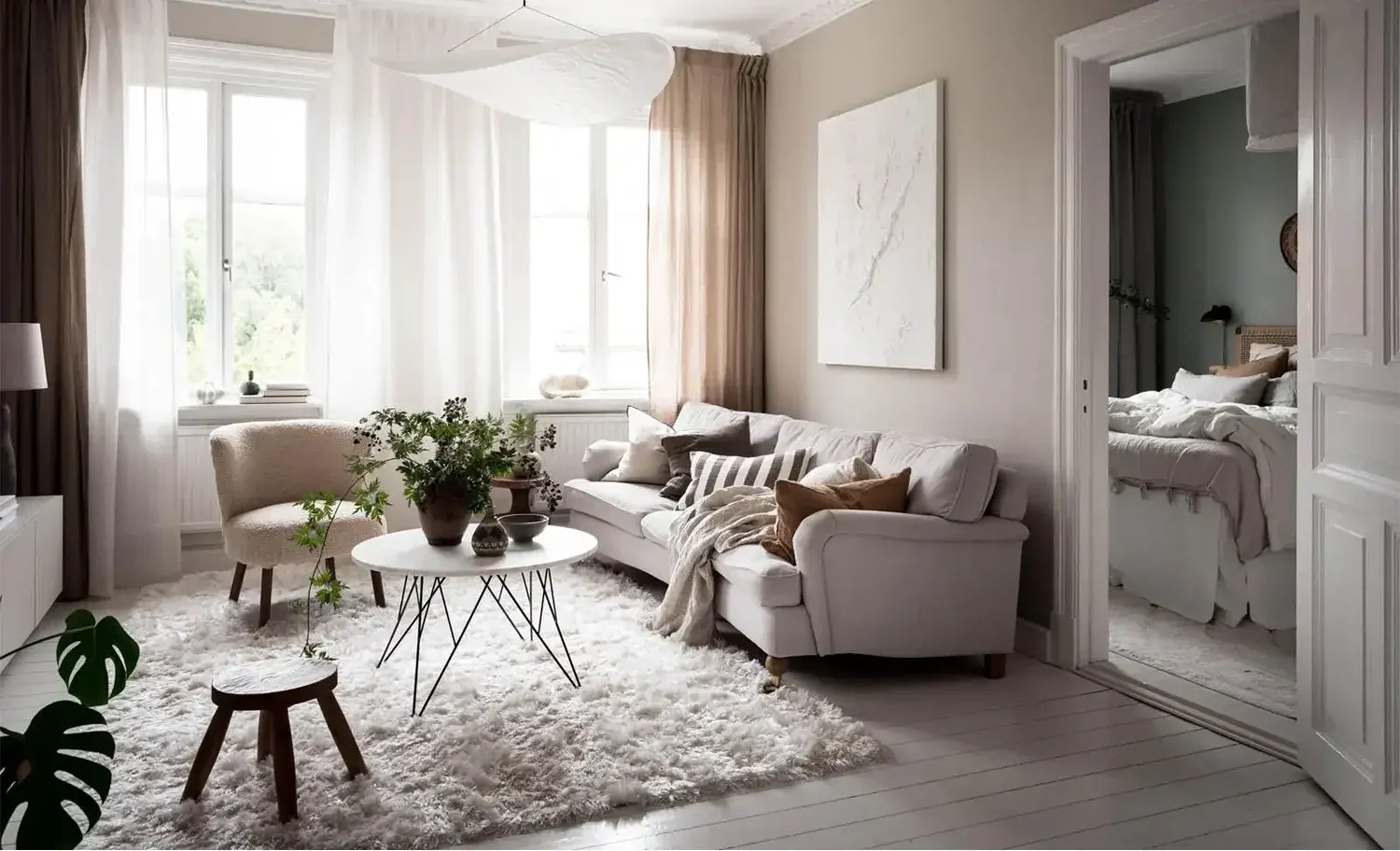
Earth-Tone Pillows Warm an Otherwise All-White Room
Image courtesy of Coco Lapine Design
Scandinavian Decorating Ideas Conclusion:
The 15 rooms in this guide don’t share a single formula — some strip the palette down to white and black, others bring in mahogany, terracotta, or a full curving furniture language. What holds them together is the discipline behind each choice: restraint as a starting point, then a deliberate decision about where to break it — a black chandelier against a vaulted ceiling, a single antique rug layered over new construction, teak and cane against an otherwise minimal dining room.
That’s the real throughline of Scandinavian design, and of hygge specifically: comfort built through intention, not accumulation. Every room here adds exactly as much warmth, color, or texture as it needs, and stops there.
Frequently Asked Questions About Scandinavian Decorating Ideas
How do Scandinavians decorate their homes?
Scandinavian homes are built around restraint rather than a fixed color palette — light woods, whites, and a limited number of natural materials repeated throughout, with warmth added through texture (linen, wool, leather) rather than pattern or color. Comfort is treated as a design requirement, not an afterthought.
What are the Scandinavian design trends for 2026?
Contemporary Scandinavian interiors are moving toward richer, warmer palettes — mahogany and other dark woods, curving furniture silhouettes, and black metal accents — layered over the traditional white-and-light-wood foundation rather than replacing it entirely.
What are some ideas for Scandinavian interior design?
Start with one or two natural materials as a foundation — wood flooring, a stone or plaster fireplace — then build warmth through layered textiles: a flokati rug over a flat woven base, linen curtains, and a mix of solid and textured throw pillows. Add exactly one contrasting material, like black metal or a single dark furniture piece, to keep an all-neutral room from feeling flat.
What colors are typically used in Scandinavian interior design?
White, light gray, and natural wood tones form the base palette, with earth tones like olive, rust, and warm brown used sparingly as accents. More contemporary interpretations introduce deeper colors — charcoal, mahogany, black — but always against a still-neutral foundation.
What is hygge, and how does it relate to Scandinavian design?
Hygge is a Danish concept describing a feeling of comfort and contentment, not a specific decorating style. In practice, it shows up as layered textiles, soft lighting, and rooms built for slowing down rather than displaying — the emotional goal Scandinavian design’s material choices are working toward.
View Recent Posts
Stunning Range Hood Design Ideas
Range hood design ideas covering stone, wood, plaster, copper, and stainless steel — with designer tips on proportion, material selection, and installation.

Fireplace Design Ideas
Discover fireplace design ideas that range from rustic to modern, country, traditional, Scandinavian and farmhouse with stunning photos.
Rustic Bedroom Ideas
Rustic bedroom ideas covering natural materials, layered textiles, color palettes, and professional design strategies for log cabin, modern rustic, Scandinavian, and luxury retreat styles.
Rustic Bathroom Ideas
Rustic bathroom ideas — natural materials, vintage fixtures, earthy palettes, and designer tips for log homes, cabins, and mountain retreats.
Cream Kitchen Cabinet Ideas
Cream kitchen cabinet ideas curated by interior designer Tracy Svendsen. Warmer than white and more versatile than beige, cream cabinets work beautifully across farmhouse, rustic, traditional, and modern kitchens.
Log Home Decorating Ideas
Log home decorating ideas covering color palettes, furniture selection, lighting, stone fireplaces, and modern approaches to handcrafted log home interiors.
Key Takeaways: Scandinavian Decorating Ideas
- Scandinavian design works through deliberate restraint, not simplicity for its own sake — most strong rooms pair a neutral palette with exactly one contrasting element.
- Texture carries the visual interest that color usually provides, especially in all-white rooms — layered rugs, bouclé, and linen do real design work.
- Hygge and lagom are genuine Danish and Swedish concepts, not buzzwords — comfort and “just enough,” respectively.
- Contemporary Scandinavian design increasingly borrows richer materials — mahogany, curved silhouettes, deeper color — layered over the classic white-and-wood base.
- Strong architectural features, like vaulted ceilings or original crown molding, should stay visible rather than be designed around.

