
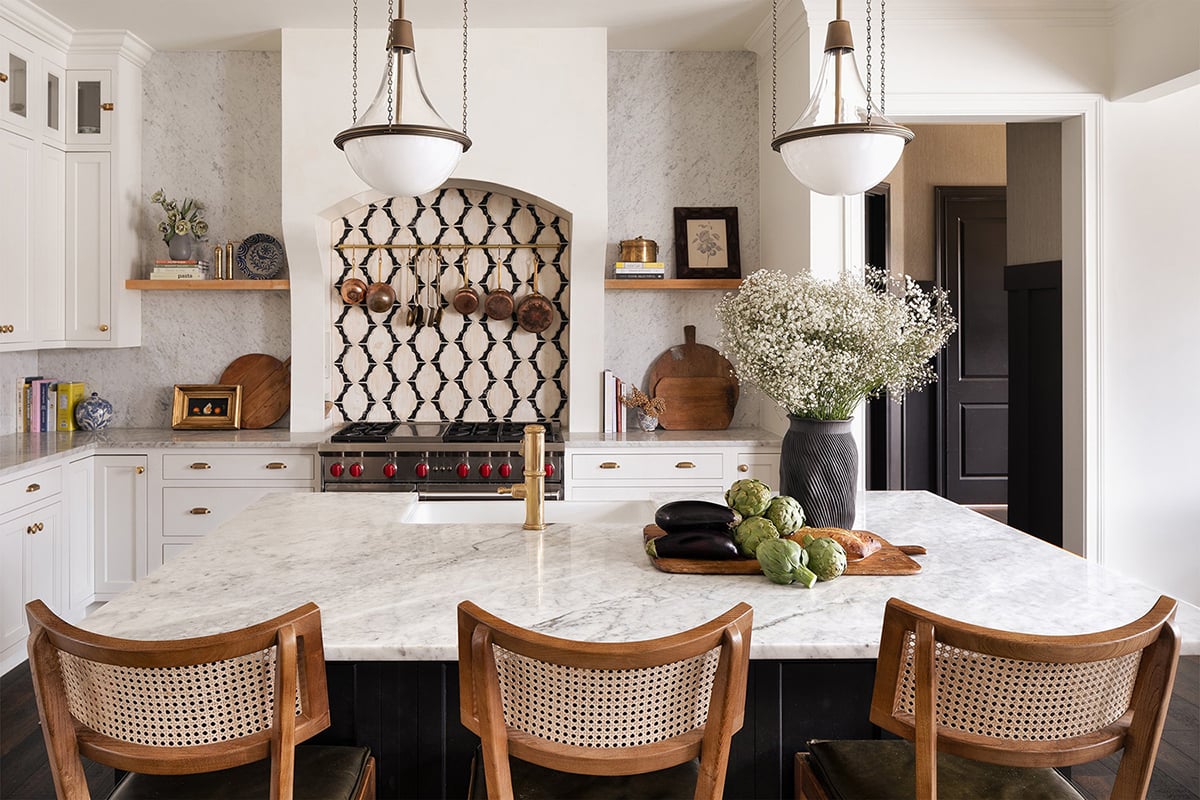
Country Kitchen Ideas: Designer Inspiration for 2026
By Interior Designer, TRACY SVENDSEN | Published on January 22, 2024 | Updated on July 11, 2026 |
Country kitchens occupy a unique space in interior design — warmer and richer in character than farmhouse style, more relaxed than traditional, and more deeply rooted in natural materials than either. As an interior designer who has worked with clients drawn to this aesthetic for over three decades, I’ve come to understand why the country kitchen endures while trends around it come and go.
This collection of country kitchen ideas covers the full breadth of the style — from English country and French country to modern country and classic rustic. You’ll find guidance on cabinet colors, natural materials, vintage accents, flooring, and lighting, with each idea photographed in a real designer kitchen so you can see how every element comes together in practice.
Whether you’re drawn to the quiet elegance of an English country kitchen, the warmth of exposed beams and reclaimed wood, or a cleaner contemporary take on the style — there’s an approach here that suits your home. Feature image courtesy of Heidi Woodman Interiors
Key Takeaways
- Country kitchens are defined by natural materials, warm earth tones, and a quality that feels gathered over time — the opposite of a showroom kitchen.
- Warm neutrals — cream, taupe, and warm white — are the most versatile cabinet colors for a country kitchen, complementing wood, stone, and vintage accents without competing with them.
- English country and French country are distinct substyles worth understanding — English leans toward checkerboard floors, shiplap, and muted tones; French favors ornate details, stone walls, and warm patina.
- Classic country features — farmhouse sinks, exposed ceiling beams, open shelving, and large kitchen islands — provide the structural foundation that makes the style immediately recognizable.
- Modern country kitchens balance rustic character with clean lines and contemporary materials, proving that country style doesn’t require sacrificing function or sophistication.
- A country kitchen works at every scale and budget – from a freestanding vintage island and open shelving in a small space to a full stone-walled kitchen with dual islands and a custom range hood in a larger home.

English Country Kitchen with Checkerboard Flooring and Shiplap Walls
Image courtesy of Landed Interiors
Country Kitchen vs Farmhouse Kitchen: What’s the Difference?
Country kitchens and farmhouse kitchens share common ground — natural materials, warm tones, and a relaxed aesthetic. But they’re not the same style.
Farmhouse kitchens lean toward cleaner lines and a more edited sensibility — shiplap, apron-front sinks, and a restrained palette that feels fresh and contemporary while nodding to rural heritage. Country kitchens are richer and more layered, embracing pattern, vintage accents, and the kind of accumulated character that comes from a kitchen genuinely loved over generations.
Country design also encompasses distinct regional substyles — English country, French country, and modern country — each with its own material palette and character. If your instinct is toward warmth, pattern, and a collected quality rather than clean simplicity, you’re drawn to country.
The deVol kitchen below is a strong example of country kitchen character at its most expressive — Linen-painted cupboards, a copper worktop, handmade tiles, and layers of vintage accents that give the space its distinctly inhabited quality.
Country Kitchen Styles at a Glance: French, English and Modern Country
| Element | French Country | English Country | Modern Country |
|---|---|---|---|
| Cabinet color | Aged cream, warm white | Muted tones, painted | Natural wood, soft neutrals |
| Flooring | Wide plank wood, stone | Checkerboard, flagstone | Wood, concrete |
| Hardware | Wrought iron, aged brass | Antique brass, ceramic | Matte black, brushed brass |
| Signature detail | Ornate range hood, crystal chandelier | Shiplap, Aga range | Clean lines, open shelving |
| Pattern | Toile, floral, provincial prints | Gingham, plaid, floral | Minimal-texture over pattern |
| Overall mood | Rustic elegance | Collected charm | Refined simplicity |
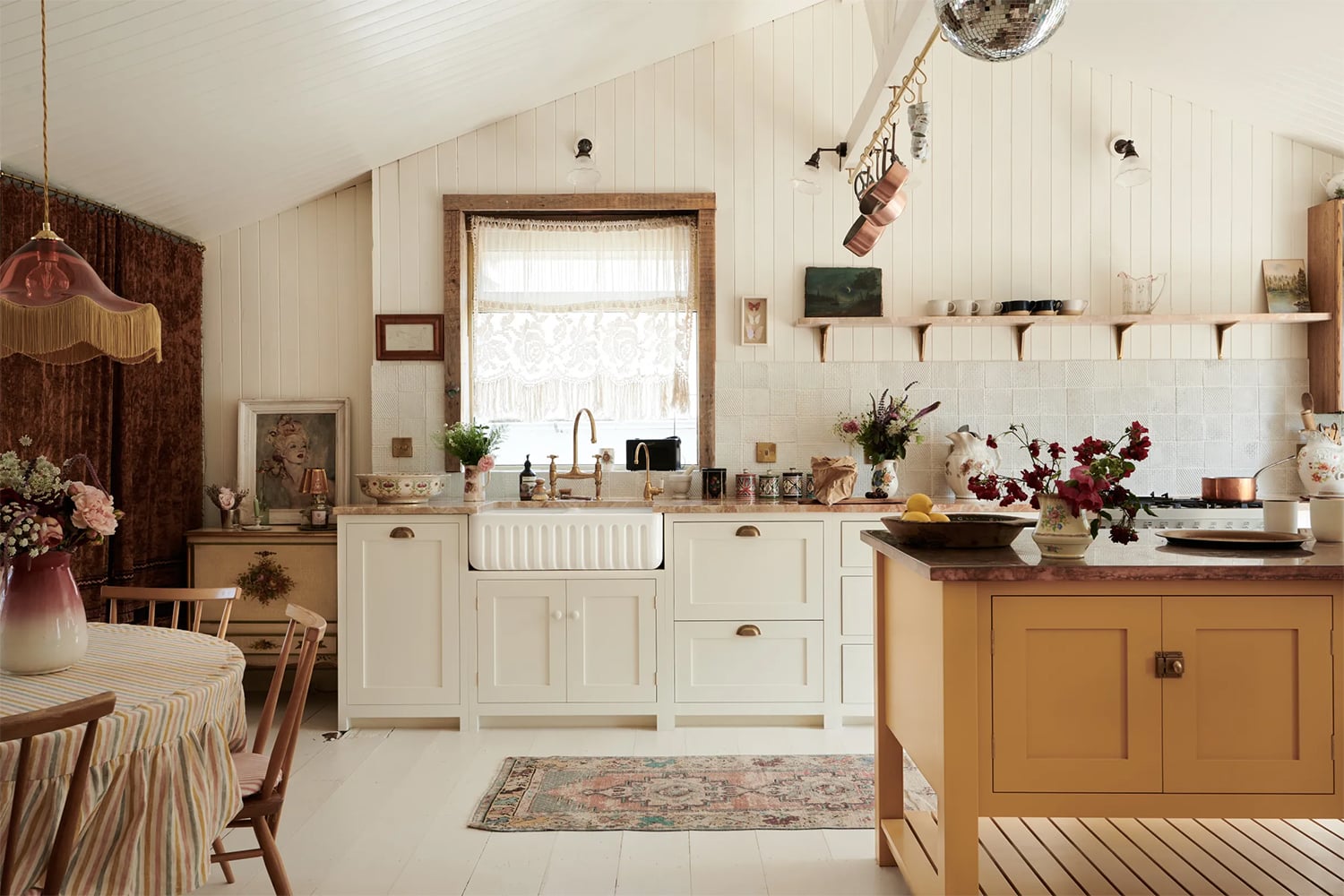
A Country Kitchen That Feels Genuinely Lived-In
Image courtesy of deVol Kitchens
Designer Mood Board: Country Kitchen Ideas
For this mood board, I set out to capture what I consider the essential quality of a well-designed country kitchen — the sense that every element has been deliberately chosen but arrived gradually. The palette, inspired by a kitchen designed by Amber Lewis, builds from rich wood finishes, creamy neutrals, and warm metals layered in a way that feels collected rather than coordinated.
Dark wood flooring and a matching island establish depth and contrast against white quartz countertops, while creamy taupe walls hold the composition together without competing. A recessed range alcove with vertical shiplap introduces the kind of architectural country detail that gives a kitchen its backbone — the brass hanging rod with copper pots adding both function and the warm, well-used quality that country kitchens do best.
Pattern is where country kitchens truly distinguish themselves from other warm styles. The banquette seating in the breakfast nook incorporates striped, floral, solid, and checked fabrics together — a combination that would feel chaotic in a farmhouse kitchen but reads as authentically collected in a country one. Woven counter stools with linen cushions and oversized circular copper pendants complete a palette of warm browns, creams, and antique brass that feels genuinely lived-in.
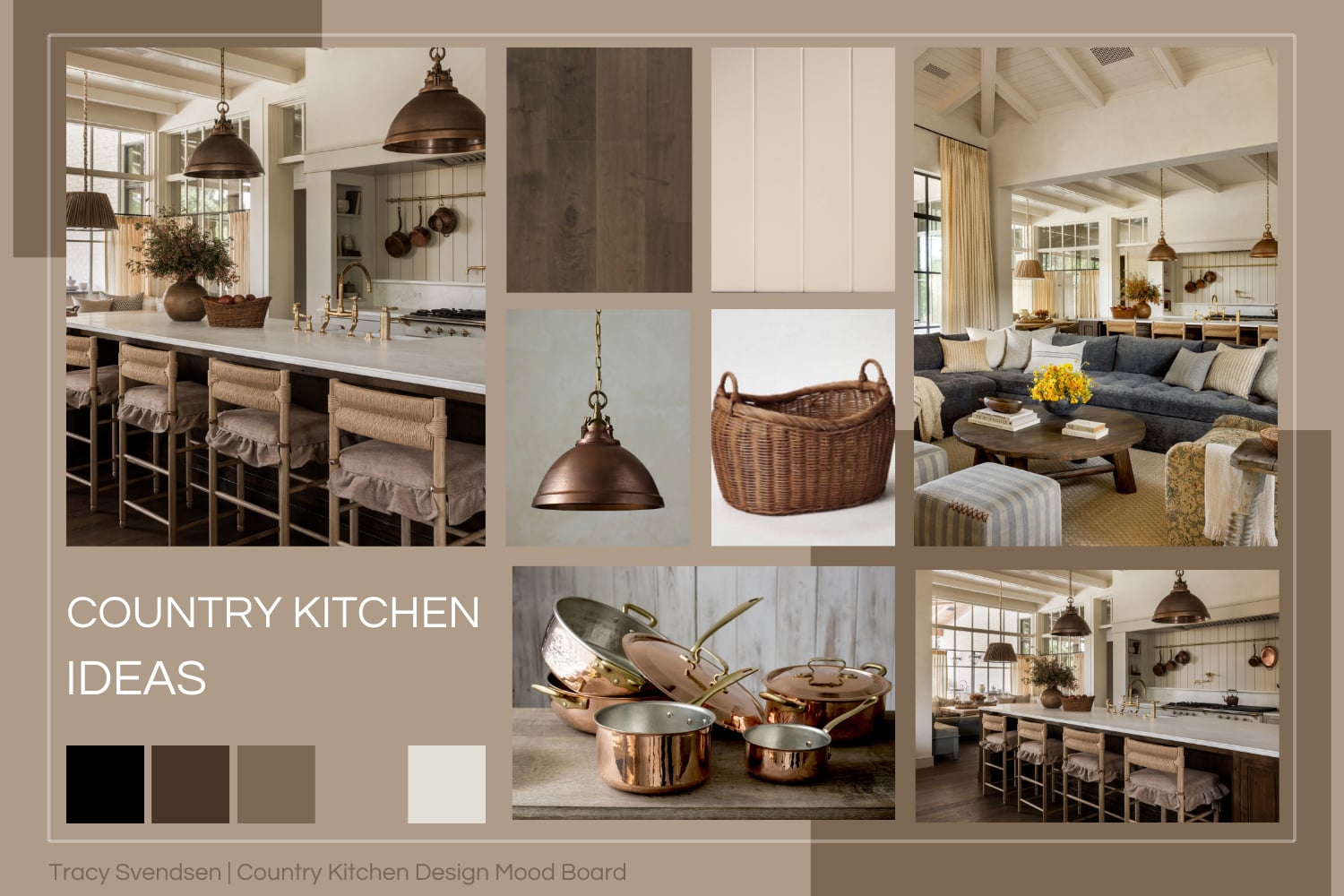
Country kitchen mood board by Tracy Svendsen featuring warm wood finishes, layered textiles, copper accents, and classic country detailing.
What Defines a Country Kitchen: Key Elements and Characteristics
A country kitchen is defined less by any single feature than by the cumulative effect of its elements — natural materials, warm colors, vintage accents, and layered pattern working together to create a space that feels personal and unhurried.
The foundations are consistent across every country kitchen style: warm earth tones and neutrals as the base palette, natural materials — wood, stone, brick, and ceramic — as the primary surfaces, and a mix of old and new that gives the space its accumulated character. Large kitchen islands, farmhouse sinks, exposed ceiling beams, open shelving, handcrafted tiles, and patterned fabrics appear repeatedly — not as decorative choices but as the defining elements that make a country kitchen immediately recognizable.
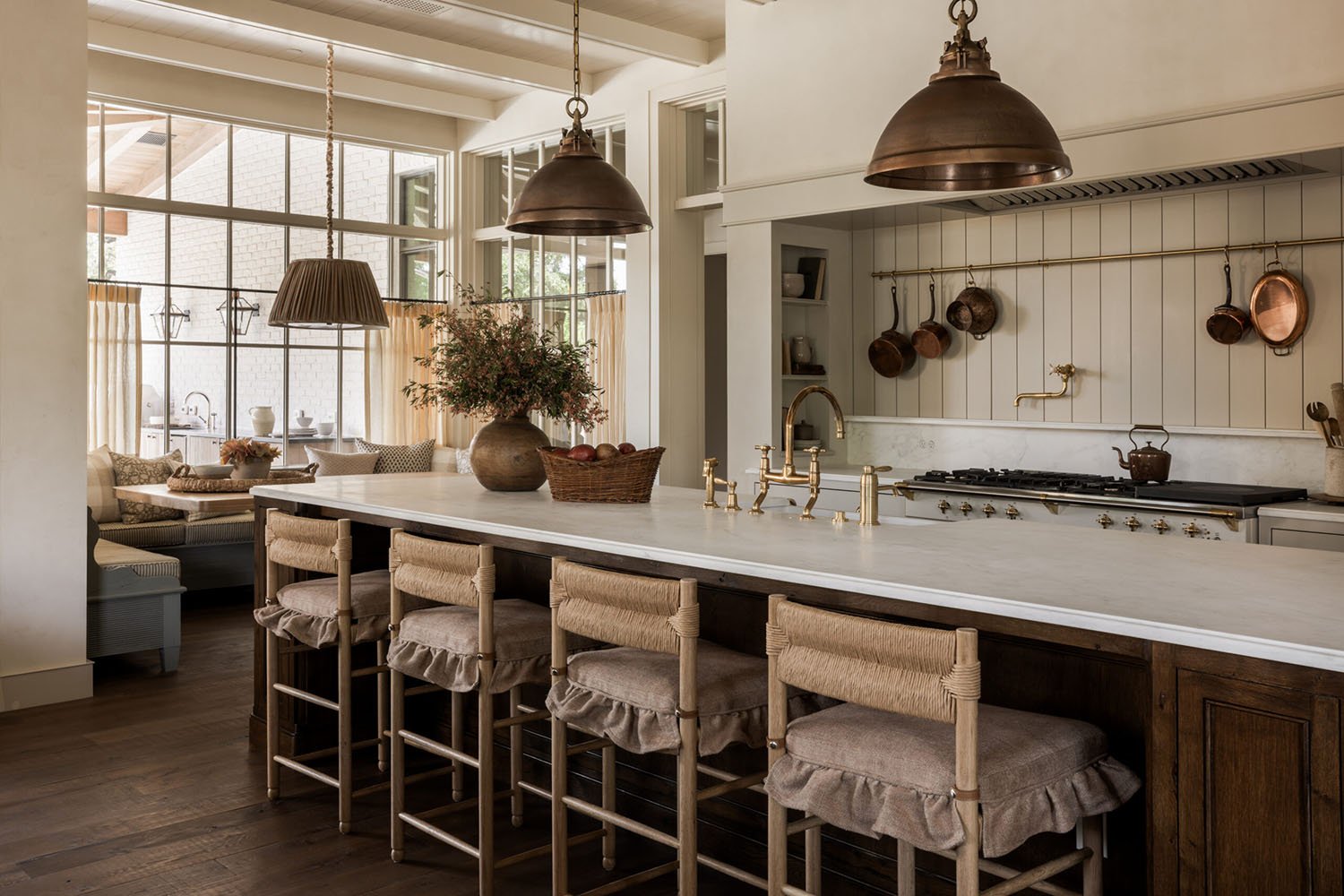
Beautiful Country Kitchen
Image courtesy of Amber Lewis Design
1. Warm and Earthy Tones: Adding Character to a Country Kitchen
Warm earth tones are the natural starting point for a country kitchen color scheme — not because they’re safe or neutral, but because they genuinely reflect the materials that define the style. Browns, rusted reds, warm greens, and deep ochres echo the wood, stone, brick, and aged metals that country kitchens are built around. When the color palette and the materials share the same warmth, the kitchen reads as cohesive.
The kitchen below, designed by Ashley Montgomery, demonstrates how confidently earth tones can be layered in a country context. Plaid window coverings, a cherry-toned wood island, a black range with a robin’s-egg-blue range hood, copper countertops, and heavily veined marble surfaces work together through a shared warmth that prevents the varied elements from feeling busy. The pale blue range hood — a bold choice — works precisely because it’s surrounded by enough warm tones to balance its coolness.


A Country Kitchen With Layered Earth Tones and Vintage Accents
Image courtesy of Ashley Montgomery Design
2. Neutral Tones: The Quiet Foundation of Country Style
While earth tones give a country kitchen its character, neutrals give it its calm. Cream, warm white, and soft beige provide a foundation that allows wood, stone, vintage accessories, and bolder accent colors to register clearly without competing with one another. In my experience, the most successful country kitchens use neutrals as the dominant palette — perhaps 70 to 80 percent of the visual space — with earth tones and accent colors doing the expressive work.
The kitchen below by Becca Interiors combines cream cabinetry, white quartz countertops, glossy white subway tile, and white walls to create a luminous, calm backdrop — but the space is anything but plain. A brass rod with copper pots above the range, an antique brass-framed artwork leaning against the backsplash, a gray-and-white striped area rug, and a crock of wooden utensils fill the space with the kind of collected detail that makes a country kitchen feel genuinely lived-in. None of those elements would read as clearly against a busier background.

A Country Kitchen With a Neutral Foundation and Collected Vintage Details
Image courtesy of Becca Interiors
3. Natural Materials: Wood, Stone, and Tile in a Country Kitchen
Natural materials are the structural language of country kitchen design — not decorative additions but the primary surfaces that give the style its warmth, texture, and sense of authenticity. Wood flooring, natural stone countertops, handcrafted tile, exposed brick, and plaster all carry an organic variation that manufactured surfaces cannot replicate, and country kitchens are designed to celebrate rather than conceal that quality.
The kitchen below, by Design Shop Interiors, demonstrates how natural materials can anchor a clean, contemporary country kitchen without losing the warmth and texture that define the style. White cabinetry and gray-and-white marble countertops provide a calm foundation, while dark wood flooring and a light wood island introduce tonal variation and grain, keeping the palette from feeling flat. The mosaic tile backsplash adds a handcrafted pattern, and open light-wood shelving flanking a white plaster range hood reinforces the natural-material story at eye level — the point where country kitchens make their strongest visual statement.

A Modern Country Kitchen With Natural Materials and Handcrafted Details
Image courtesy of Design Shop Interiors
4. Vintage Accessories: Adding Authentic Character to a Country Kitchen
Vintage accessories are what provide a country kitchen with its sense of accumulated personality — the difference between a space that looks designed and one that feels genuinely inhabited. The key is selectivity. A few well-chosen pieces — aged pottery, antique artwork, a display of branches or dried botanicals — add layers of texture and story that no new accessory can replicate. The mistake most people make is either avoiding vintage entirely for fear of clutter, or overcrowding surfaces until the effect feels chaotic rather than collected.
The kitchen below, designed by Heidi Woodman, demonstrates the right balance. Warm wood cabinetry, taupe walls, and rectangular stone tile on the backsplash and range hood create a grounded, natural backdrop. Against this, the vintage accessories — pottery, artwork, a display of branches — read with real clarity. The plaid counter stools are well considered: their curved backs upholstered in grey, orange, and cream plaid echo the subtle orange streaks in the white marble island countertop, creating a connection between the vintage textile and the natural stone that feels entirely intentional. Brass hardware and a black island base complete a palette that is warm, layered, and deeply personal.

Modern Country Kitchen with Plaid Counter Stools
Image courtesy of Heidi Woodman Interiors
5. Country Kitchen Island Ideas: Function, Character and Design
A kitchen island is one of the most defining features of a country kitchen — providing the workspace, storage, and social anchor that makes the style as functional as it is beautiful. The most successful country kitchen islands go beyond adding counter space: they introduce a contrasting material, color, or finish that gives the kitchen its focal point and personality.
The kitchen below from Design Shop Interiors is one of the most inventive island solutions I’ve encountered. Rather than a conventional straight-run placement, the island is positioned at an angle—a response to the kitchen’s relationship to the adjoining dining and living rooms, creating a natural work triangle within a literal triangular space.
Designer Gilbert chose earthy green V-groove paneling with a soapstone countertop, and extended the living-finish philosophy throughout — unlacquered brass faucets, cabinet hardware, and a handmade light fixture that will patina alongside the soapstone over time. Handmade zellige tiles on the backsplash complete the organic material story, their variation in glaze and texture adding warmth that mass-produced tiles cannot replicate. The soapstone’s green veining connects back to the island paint color — three living surfaces aging together, each deepening the character of the space.

A Country Kitchen Island With Green V-Groove Paneling and Soapstone Countertop
Image courtesy of Design Shop Interiors
6. Green Kitchen Cabinets: A Natural Choice for Country Style
Green cabinets are one of the most natural color choices for a country kitchen — sage, olive, and soft forest greens share the same organic quality as the earthy palette that defines the style, connecting to the landscape in a way that cream and white don’t.
The kitchen below, designed by Heidi Callier, pairs sage-green cabinets and antique-brass hardware with black soapstone countertops, hexagonal terracotta tile flooring, and warm-white vertical shiplap walls. Botanical wallpaper in the archway introduces pattern that reinforces the green cabinet color, while warm wood counter stools with woven backs complete a space that is deeply rooted and genuinely country.
The adjacent breakfast nook continues the palette — a green banquette with gray-and-white striped fabric, a gallery wall of antique frames, organic wood chairs, and the same terracotta flooring throughout, creating a single, considered space rather than two separate rooms.


Sage Green Country Kitchen With Terracotta Tile Flooring and Botanical Wallpaper
Image courtesy of Heidi Callier Design
7. Rustic Elements: Exposed Beams, Reclaimed Wood and Distressed Finishes
Rustic elements — exposed beams, reclaimed wood, distressed finishes, and aged stone — are what give a country kitchen its sense of history and weight. They’re not decorative choices so much as structural ones: the difference between a kitchen that looks country and one that feels as though it has always been there.
The rustic kitchen below, designed by Bobby McAlpine in Louisiana, demonstrates this at its most refined. A La Cornue range anchors the cooking area, while a large antique dining table, surrounded by antique French chairs, occupies the adjoining space — the boundary between kitchen and dining room dissolved by the continuity of aged materials and warm tones. Grand French doors flood the space with light, and a 17th-century portrait overlooking the dining table adds the kind of layered history that no new piece can replicate.

A Rustic Country Kitchen With Antique French Furnishings and Grand French Doors
Image courtesy of Architectural Digest
8. French Country Kitchen Style: Rustic Elegance and Old-World Character
French country kitchen design occupies its own distinct territory within country style — richer in architectural detail, more overtly European in character, and more focused on the elegant side of rustic than the casual. Where English country kitchens lean toward collected charm and modern country toward clean simplicity, French country embraces ornate detailing, aged patina, and the kind of layered warmth that suggests generations of use.
The Locati Architects kitchen below captures this character with particular authenticity. Aged cream cabinets, warm wide-plank wood flooring, a wood ceiling with weathered beams, and vintage area rugs create a foundation of accumulated warmth. The copper range hood — ornate and substantial — is set within a stone arch, framing the cooking area as a focal point, as French country kitchens traditionally do. Two vintage French crystal chandeliers hang above a dark wood island with a white marble countertop, their formality balanced by the rustic warmth of the surrounding materials. Provençal counter stools in weathered cream with black leather seats complete a space that appears as though it has always been exactly this way.

A French Country Kitchen With Copper Range Hood and Vintage Crystal Chandeliers
Image courtesy of Locati Architects
9. White Cabinets in a Country Kitchen: Timeless and Versatile
White cabinets are a natural fit for country kitchens — not for their crispness, but for their versatility. Against white cabinetry, natural materials like wood, stone, and marble read with particular clarity, and the contrast between light cabinets and darker elements creates the visual depth that country kitchens do well.
The Veranda kitchen below pairs warm white cabinets with dramatically veined Carrara marble countertops and a full-height marble backsplash. Black-framed windows, a classic apron-front sink, and a brushed metal range hood in the same dark tone as the island countertop and pendant lights create a consistent tonal thread throughout. Warm honey-toned wood flooring anchors the palette — the balance of light and dark giving this kitchen its depth.

White Country Kitchen Cabinets With Dramatic Carrara Marble and Black Accents
Image courtesy of Veranda
10. Cream Cabinets in a Country Kitchen: A Natural Partnership
Cream cabinets and country kitchens share a natural compatibility — both lean toward warmth and character. In a country kitchen, specifically, cream cabinetry serves as a unifying element, tying together wood tones, stone surfaces, and vintage accents into a cohesive palette without imposing its own personality on the space.
The French country kitchen below illustrates this beautifully. Cream cabinetry with an ornate island base and butcher block countertop is paired with light wood flooring, wood ceiling beams, a plaster range hood, and an arched window frame — architectural details that give the space its French country character. Vintage counter stools and an intricate vintage tile backsplash add the pattern and personality that cream cabinets so naturally support.

A French Country Kitchen With Cream Cabinets and Vintage Tile Backsplash
Image courtesy of LuxeSource
11. English Country Kitchen: Heritage Details and Colonial Character
If the French country kitchen leans toward Provençal warmth and ornate detailing, the English country kitchen leans toward heritage craftsmanship, understated elegance, and the kind of considered detail that rewards closer inspection. This Becca Interiors kitchen is one of the finest examples of English country character I’ve encountered.
The foundation is classical — taupe kitchen cabinets with warm cream walls, warm-toned wood ceiling beams, and light wood flooring creating a palette that feels simultaneously grounded and luminous. A custom stucco hood anchors the cooking area with architectural weight, while a 13-foot dark wood island with a white marble countertop and black kitchen countertops creates the high-contrast drama that English country kitchens handle so naturally.
The details are what set this kitchen apart. A brass sink sits on the island alongside copper and brass accents that will develop patina over time — the same living-finish philosophy we saw in the Design Shop Interiors kitchen earlier. Three Ann Morris Station Lights in dark bronze hang above the island — recreations of classic British railroad station lights that honor the heritage quality at the heart of English country design. Every element earns its place through craft and character rather than trend.

An English Country Kitchen With Heritage Lighting and Brass Accents
Image courtesy of Becca Interiors
12. Gray Kitchen Cabinets: A Bold Country Contrast
Gray cabinets might seem like an unlikely choice for a country kitchen — the color reads as contemporary and urban rather than warm and rustic. But in practice, charcoal cabinets bring a depth and drama to country kitchens that softer neutrals simply can’t achieve, and when balanced with warm accents, they feel entirely at home in the style.
The kitchen below pairs dark charcoal cabinets with creamy white vertical shiplap walls — the contrast between deep gray and warm white creating the visual foundation. What makes this kitchen distinctly country rather than simply contemporary is the layering of warm, organic accents — terracotta pots filled with plants crowding the island, throw pillows in pink, purple, and orange, and a floral patterned lamp in orange and green. These elements prevent the charcoal from reading as cold or minimalist and pull the space firmly into country territory.

A Country Kitchen With Gray Cabinets and Warm Organic Accents
Image courtesy of Veranda
13. Black Kitchen Cabinets in a Country Kitchen: Drama and Contrast
Black cabinets in a country kitchen work for the same reason black countertops work with cream cabinets — the contrast is striking enough to feel intentional while the surrounding warmth prevents the space from feeling cold or severe. The key is ensuring black never dominates alone. Paired with honey-toned wood beams, warm flooring, rattan textures, and organic accents, black cabinetry anchors a country kitchen with drama rather than weight.
Set in a home that called for drama without formality, this Zoe Feldman kitchen incorporates a black kitchen island with brass trim running along the perimeter, and a base that sits beneath dome-shaped black metallic pendant lights — the brass detail warming the black and connecting it to the honey-toned wood ceiling beams above. White subway tile runs floor-to-ceiling on the backsplash, and white-and-gray-veined countertops provide a light contrast that prevents the black from overwhelming the space. Rattan counter stools and a vase of sunflowers complete a kitchen where drama and warmth exist in equal measure.


A Country Kitchen With Black Cabinetry, Brass Accents and Natural Wood Beams
Image courtesy of Zoe Feldman Design
14.Farmhouse Sinks: A Defining Feature of Country Kitchen Design
Of all the fixtures that signal country kitchen character, the farmhouse sink is the most immediately recognizable. Its deep apron-front basin is both genuinely practical — accommodating large pots, oversized cutting boards, and the kind of serious cooking for which country kitchens are built — and visually definitive in a way that no undermount or drop-in sink can replicate.
In this Design Shop Interiors kitchen, a deep white farmhouse sink with brass faucets and handles sits against taupe cabinetry and white countertops — a quietly sophisticated palette that lets the sink’s architectural presence speak for itself. Taupe vertical shiplap on the backsplash adds texture without competing, while open shelving displays the kind of collected objects — copper accents, stoneware, recipe books — that give a country kitchen its lived-in personality.

A Country Kitchen With a White Farmhouse Sink and Open Shelving
Image courtesy of Design Shop Interiors
15. Country Cottage Kitchen: Vintage Charm and Handcrafted Character
Country cottage kitchens are the most personal expression of country style — less structured than English country, less formal than French country, and entirely unconcerned with perfection. The defining quality is accumulation: pieces chosen for character rather than coordination, materials that show their age honestly.
The kitchen below, featuring cabinetry by British Standard by Plain English, has tongue-and-groove paneling painted in Dead Salmon by Farrow & Ball lining the walls, alongside cream cabinets and a fabric-skirted lower cabinet that adds softness and unhurried detail. The deliberate absence of wall-mounted cabinetry keeps the space open and bright despite the uneven stone walls and terracotta tile flooring. Vintage copper utensils, hand-painted wall sconces, antique furniture, and a large dark-wood dining table complete a warm, inviting kitchen.

A Country Cottage Kitchen With Dead Salmon Walls and British Standard Cabinetry
Image courtesy of British Stand Cupboards
16. Wood Kitchen Cabinets: Natural Warmth in a Modern Country Kitchen
Wood cabinets are perhaps the most natural fit for country kitchen design — they share the same organic quality as the exposed beams, stone countertops, and reclaimed wood elements that define the style. Where painted cabinets bring color and personality, wood cabinets bring material continuity — connecting the cabinetry to every other natural surface in the room.
In this Heidi Woodman kitchen, light wood cabinets work within a deliberately high-contrast modern country palette. Honey-toned wood flooring, warm wood ceiling beams, and light wood cabinetry establish a warm foundation, while a black island with a waterfall-edge countertop and three dramatic pendant lights introduce a contemporary contrast that keeps the space from feeling too traditional.

Modern Country Kitchen with Wood Kitchen Cabinets
Image courtesy of Heidi Woodman Interiors
17. Open Shelving
Open shelves are one of the most practical and visually rewarding additions to a country kitchen — they provide accessible storage for everyday items while creating a display surface for the collected, personal objects that give a kitchen its character. Cookbooks, mugs, stoneware, pottery, artwork, glassware, and greenery all work well on open shelving, and the mix of functional and decorative pieces is what makes the display feel genuinely lived-in rather than styled.
This kitchen by Design Shop Interiors uses black metal open shelving with brass accents on either side of the range hood — a placement that frames the cooking zone and creates a symmetrical architectural moment without requiring any additional cabinetry. A black range with gold accents anchors the center, paired with a white hood above and white lower cabinets with brass hardware below. Two brass pendant lights above the shelves provide focused task lighting while reinforcing the warm metallic thread running through the hardware and shelf brackets. White veined quartz countertops and backsplash keep the palette light and cohesive — the black shelving and range read as deliberate high-contrast accents against the white rather than competing elements.

Country Kitchen with Open Shelving
Image courtesy of Design Shop Interiors
18. Sage Green Cabinets with Light Oak Island
Sage green is one of the most enduring cabinet colors in country kitchen design — it connects naturally to the garden and landscape outside while reading as sophisticated rather than overtly rustic. This kitchen by Kelsey Leigh pairs sage green perimeter cabinets with a light oak island and white countertops, a combination that balances the cooler green tone with warm natural wood in a way that feels considered rather than contrived.
Upper glass-front cabinets with light wood shelving display servingware openly, adding a collected, personal quality to the kitchen’s upper portion. Slate gray countertops along the perimeter provide a grounding contrast to the white island countertop and the white-and-gray quartz backsplash. Vintage artwork on the wall and a piece propped on a ledge above the backsplash introduce the layered, gathered quality that defines country kitchen styling at its best. Brass pendant lighting and two glass vases filled with branches complete the picture — warm metallic accents and natural elements that reinforce the connection between the kitchen and the outdoors without requiring anything elaborate.

Country Kitchen with Wood Kitchen Island
Image courtesy of Kelsey Leigh Design
19. Exposed Wood Beams and Stone Accent Walls
Exposed wood beams are among the most effective architectural elements in a country kitchen — they add genuine material warmth at ceiling level, where paint and cabinetry can’t reach, and they visually define the kitchen zone within an open-plan space without requiring any physical separation. When paired with natural stone, the combination creates a layered, material-rich interior that defines rustic country design at its most authentic.
This kitchen by Anne Rae demonstrates both elements working together at full scale. A natural stone fireplace and a matching accent-wall nook frame a vibrant blue range — the stone providing an organic, textural backdrop that makes the bold range color feel grounded rather than jarring. Dark wood ceiling beams run the length of the kitchen, connecting to a smaller island with wood countertops in the same tone — a material threading detail that creates cohesion between the ceiling and the work surface. White cabinetry and light oak flooring keep the palette from feeling heavy despite the substantial presence of stone and dark wood, and two islands provide the generous workspace that a kitchen of this scale requires.

Country Kitchen with a Fireplace
Image courtesy of Anne Rae Design
20. Fresh Flowers, Branches, and Plants
Fresh flowers, potted plants, and foraged branches are among the most effective and affordable country kitchen additions — they bring the outdoors in directly and change with the season in a way that no purchased decoration can replicate. Sunflowers, daisies, and lavender suit the country kitchen particularly well, both visually and in terms of scent.
This kitchen by Beth Webb Design captures the organic, lived-in quality that fresh botanicals create at their best. Light oak cabinetry and black countertops provide the neutral foundation, while slate gray tile floors add texture underfoot. The real character comes from the window treatment — or rather, the absence of one. Large windows with high ceilings flood the space with natural light and frame the country views beyond, while pots filled with flowers and plants gathered from outdoors sit directly on the sill, blurring the boundary between inside and out. Fresh bread and lettuce on the countertop reinforce the same connection — this is a kitchen that feels genuinely connected to the land surrounding it rather than simply decorated to evoke it. Metallic planters and wicker baskets add the material contrast that keeps the organic elements from feeling too casual.

Country Kitchen with Greenery
Image courtesy of Beth Webb Design
21. Farmhouse Backsplash
The backsplash is one of the most impactful design decisions in a country kitchen — it covers a large, highly visible surface and sets the material tone for the whole cooking zone. Natural materials like stone, brick, wood, and handmade tile all suit the country aesthetic well, adding texture and warmth that standard subway tile alone rarely achieves. For more inspiration on the full range of farmhouse backsplash options, I’ve covered them in detail in a dedicated guide
.
This kitchen by Leanne Ford shows the backsplash used with genuine restraint and precision. Mosaic diamond zellige tiles in a neutral tone create a small but highly textured backsplash area that adds pattern and visual interest without competing with the surrounding cream cabinetry and open shelving. The zellige’s handmade quality — slightly irregular surfaces that catch light differently at different times of day — does more to establish the rustic, organic character of the kitchen than a more conventional tile choice would. Open shelving layered with collected objects reinforces the same organic, unhurried quality throughout the space.


Country Kitchen with a Farmhouse Backsplash
Image courtesy of Leanne Ford Design
22. A Built-In Coffee Bar
A dedicated coffee bar within a country kitchen creates a self-contained zone for the morning routine without disrupting the main kitchen workflow — and when designed to connect with the surrounding cabinetry rather than sitting as a separate piece, it reads as a considered architectural feature rather than an afterthought.
This coffee bar by Banner Days Design is built directly into existing light blue cabinetry — a wood-trimmed archway with glass doors that frames the station and gives it a distinct identity within the larger kitchen. The arch is the detail that elevates this beyond a standard cabinet cutout — it adds a genuine architectural moment that draws the eye and signals intentional design. The light blue cabinetry and warm wood trim combination sits comfortably within a country or French kitchen direction, and the glass doors allow a view into the station while keeping it visually contained when not in use.

Country Kitchen with a Coffee Bar
Image courtesy of Banner Days Design
23. Blue Kitchen Cabinets in a Rustic Kitchen Design
Blue cabinets bring a relaxed, painterly quality to a country kitchen that neutrals and wood tones alone can’t achieve — the color reads as both fresh and historically grounded, which is exactly the combination that suits the country aesthetic. Light blue pairs naturally with wood, brick, and stone, while navy creates a stronger contrast that works particularly well alongside brass hardware and white countertops.
This large country kitchen with coastal leanings shows light blue cabinets used with genuine commitment — running across three perimeter walls, with the range hood in the same blue and the ceiling trim that echoes it above. White countertops and white walls provide a clean backdrop that keeps the blue from feeling heavy, while warm wood flooring and a rustic vintage wood table at the center of the room ground the cooler cabinet tone with the warmth of natural materials. Brass accents throughout — lighting fixtures, hardware — add a warm metallic thread that ties the blue and wood tones into a cohesive palette. Rustic pottery on the table and countertops completes the country character, giving the kitchen its collected, personal quality despite the scale of the space.

Country Kitchen with Blue Kitchen Cabinets
Image courtesy of Veranda
24. Pot Racks & Copper Pots for a Country Look
A pot rack above the island or range is one of the most functional country kitchen additions available — it keeps cookware within immediate reach, frees up cabinet storage, and adds a display element that signals a kitchen that’s genuinely used rather than simply designed. Copper and brass pots are particularly effective in this role: they add warmth and a material richness at ceiling level that nothing else achieves quite as naturally.
This white country kitchen shows the approach at its most generous. A large brass pot rack hangs above the substantial island, filled with an extensive collection of copper pots that becomes the room’s defining visual element — the warm metallic tones reading as a striking contrast against the white cabinetry and glass-front uppers surrounding it. Brass canisters on the white countertops extend the metallic palette down to the work surface level, creating a consistent material thread from ceiling to countertop. The glass-front upper cabinets allow the dishware inside to enhance the kitchen’s display without requiring open shelving — a practical middle ground between fully open and fully concealed storage.

Country Kitchen Pot Rack and Copper Pots
Image courtesy of Architectural Digest
25. Hardwood Flooring in Country-Style Kitchens
Hardwood flooring is one of the most reliable choices for a country kitchen — it adds warmth and material authenticity that tile and stone rarely match at the floor level, and it ages well, developing character over time rather than showing wear. The range of available finishes, tones, and patterns means hardwood works across every country kitchen direction, from pale Scandinavian-influenced oak to darker, more traditional wide-plank finishes.
This kitchen by Valerie Grant Interiors shows light wood flooring paired with warm white cabinetry, white countertops, and a zellige tile backsplash — a combination that keeps the palette consistently warm and tonal while the zellige introduces the textural variation that prevents the all-white surfaces from feeling flat. The large wood island anchors the center of the kitchen in the same natural material as the floor, creating a visual connection between the two horizontal planes that gives the room a grounded, cohesive quality. Industrial light fixtures above provide the slight contrast that stops the warm palette from becoming too soft — the same role that brass hardware plays in many of the kitchens throughout this guide.

Warm Wood Flooring
Image courtesy of Valerie Grant Interiors
26. Mixing Wood Tones for Warmth and Depth
One of the most common misconceptions in kitchen design is that wood tones need to match — that the flooring, cabinetry, and ceiling beams should all be the same species and finish for the room to feel cohesive. In my experience, intentionally mixing wood tones creates far more visual interest and depth than a single uniform tone, as long as the undertones remain consistent.
This kitchen by Design Shop Interiors clearly demonstrates the principle. Light wood flooring, dark wood cabinetry, and warm wood ceiling beams each occupy a different level of the room — floor, cabinet, and ceiling — creating a layered material story that reads as rich and considered. White walls provide the neutral backdrop that allows each wood tone to register separately without competing, and woven leather counter stools add a fourth natural material that bridges the wood tones through its own warm, organic quality. Brass lighting fixtures and hardware run consistently throughout, providing the metallic thread that connects the varied wood tones into a single cohesive palette. A large rustic pot filled with overflowing branches on the counter reinforces the natural-material direction — in a kitchen this warm and layered, the botanical detail feels entirely at home.

Rustic Country Kitchen
Image courtesy of Design Shop Interiors
27. Pattern in a Country Kitchen
Patterned fabrics and ceramics are one of the clearest signals of country kitchen style — gingham, floral prints, and hand-painted patterns on textiles and pottery add the layered, collected quality that distinguishes a genuinely country kitchen from one that simply uses natural materials. Curtains, chair cushions, table linens, and decorative ceramics are all natural places to introduce pattern without committing to anything structural.
This Devol kitchen shows pattern used with a light, personal touch that feels genuinely eclectic rather than themed. Warm white cabinetry and warm copper-toned quartz countertops establish the palette, with open wood shelving on brass brackets and a vintage brass farmhouse sink with deep grooves adding the material character at the perimeter. The pattern comes in through the details — a floral pink and green antique lamp on the counter, country pitchers with floral motifs, and a whimsical bird-print pillow on a vintage olive green chair that brings the seating area into the room’s decorating story. Shiplap wall details above textured tiles complete the layered, textural backdrop. Nothing here is loud or dominant — the pattern notes are personal and specific, scattered throughout rather than concentrated in one place, which is exactly what gives this kitchen its genuinely lived-in, collected character.

Vintage Country Kitchen
Image courtesy of Devol Kitchens
28. Glossy Subway Tiles
Glossy subway tile is one of the most effective contrasts available in a country kitchen — its clean, reflective surface reads as a deliberate counterpoint to the rough, matte natural materials surrounding it. Rather than competing with wood beams, stone, and aged cabinetry, the glossy tile makes those elements read more clearly by providing a smooth, light-reflecting backdrop against which their texture becomes more visible.
This kitchen by Of Place Studio in a modern-rustic country home demonstrates contrast at its most natural. Rough wooden beams, wood flooring, and warm cabinetry fill the room with organic material warmth, while the glossy subway tile backsplash introduces the one refined, contemporary element that keeps the kitchen from feeling too heavy or dark. Natural sunlight flooding the space amplifies the tile’s reflective quality — bouncing light into the room and reinforcing the warm, earthy color palette rather than washing it out. The result is a kitchen that feels genuinely connected to the surrounding countryside while remaining fully functional and contemporary in its layout.

Glossy Subway Tiles
Image courtesy of Of Place Studio
29. Distressed Cabinets and Antique Details
Distressed finishes and vintage-inspired cabinetry add the patina and history that new construction rarely achieves — the sense that a kitchen has been used and loved over generations rather than recently installed. In a country kitchen, this aged quality feels entirely appropriate, connecting the interior to the same tradition of craft and natural materials that defines the style.
This kitchen, featured in Devol’s television series For the Love of Kitchens, sets the standard for what antique country kitchen design can achieve. Located in a Cornish castle dating back to 1068, the space has an authenticity that no amount of distressing technique can replicate — the architecture itself is the history. Warm white cabinetry and light wood flooring provide the calm foundation, while a freestanding dark kitchen island grounds the center of the room with the kind of substantial, independent piece that built-in cabinetry never quite matches. A cream-and-brass vintage stove with a large copper range hood is the room’s defining moment — the copper hood drawing the eye upward, while the copper pots on the range reinforce the warm metallic palette at countertop level. Olive green zellige tiles ranging from light to dark shade the backsplash with the same handmade, tonal variation that defines the best country kitchen surfaces. Everything here feels genuinely earned rather than designed.

Kitchen with Vintage Accessories
Image courtesy of Devol Kitchens
30. The Farmhouse Kitchen Island as a Focal Point
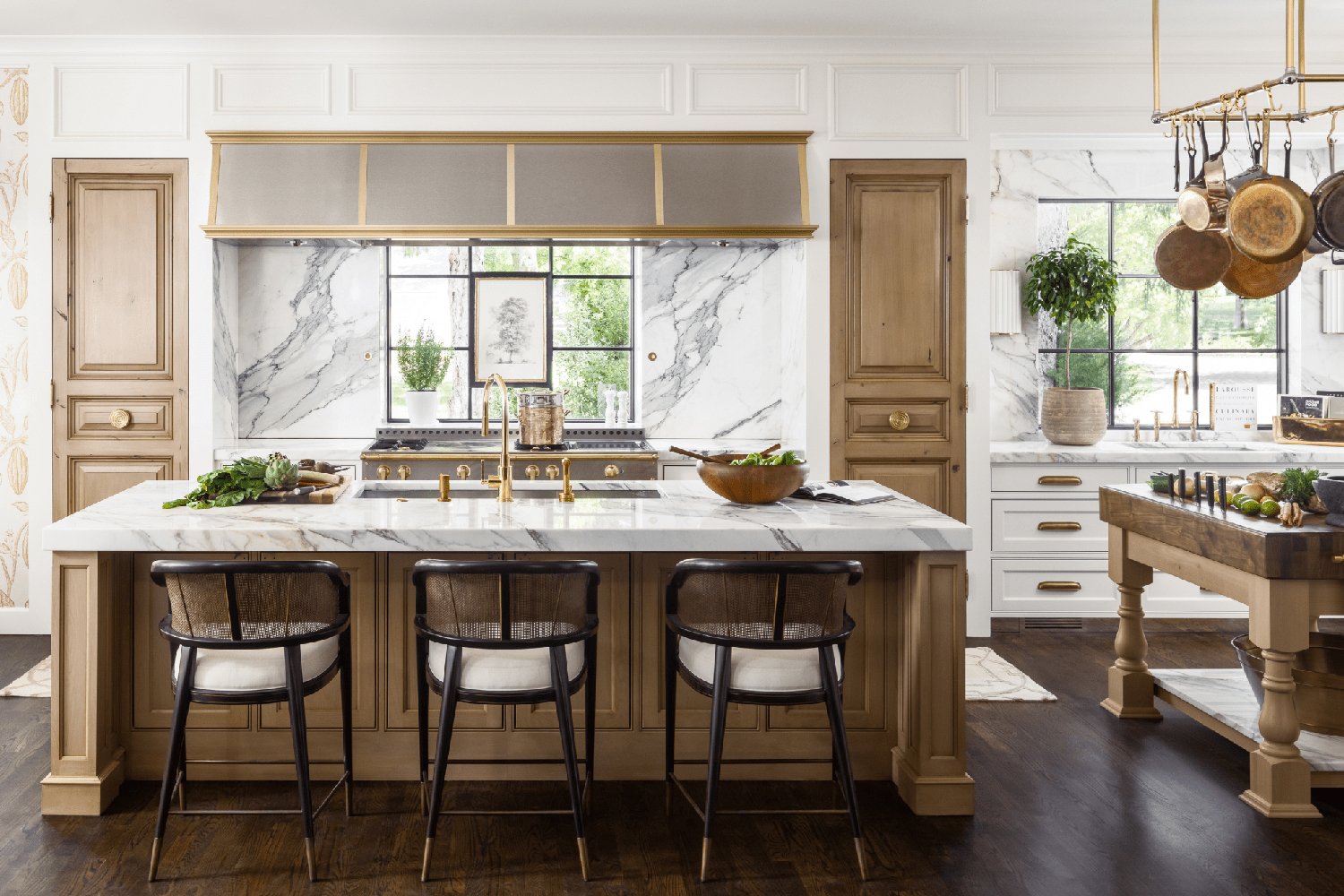
A freestanding farmhouse island or table brings a completely different quality to a country kitchen than built-in cabinetry — it reads as furniture rather than architecture, which gives the room a more relaxed, collected character and allows the island to be the room’s visual anchor without dominating the perimeter.
This kitchen by Laura McCroskey, featured on the cover of Traditional Home’s fall issue, shows the approach at its most refined.
Light wood cabinetry and dark wood flooring establish the warm, contrasting palette, while a freestanding rustic farmhouse island with a pot rack above becomes the room’s clear focal point — substantial, independent, and visually connected to the ceiling through the hanging cookware above it. The La Cornue range and detailed millwork add the French-country quality that elevates the design beyond a conventional farmhouse — as chef Ryan Pias described the brief: “I wanted a very functional kitchen, but we also wanted it to be really pretty.” It’s a concise summary of what the best country kitchens achieve — function and beauty treated as equally non-negotiable.
Rustic Farmhouse Table
Image courtesy of McCroskey Interiors
31. Stone Walls
Stone walls in a kitchen add a permanence and material authenticity that no other wall treatment replicates — the sense that the room has been built from the landscape rather than decorated to evoke it. In a country kitchen specifically, natural stone connects the interior directly to the architectural tradition of rural building, whether left in its natural state or refined through careful selection and installation.
This kitchen by Studio McGee demonstrates stone used at full architectural scale. Multiple stone walls in tonal creams and grays run through the space, anchored by high vaulted ceilings with wood beam accents that reinforce the natural material palette above. Two kitchen islands in cream with white quartz countertops provide generous workspace and visual balance across the generous footprint, with dove gray pendant lights above each island adding the warm lighting layer that a kitchen of this scale requires. The light oak cabinetry keeps the overall palette from feeling too heavy despite the substantial stone presence — the consistent warm undertone running through the cream stone, oak cabinetry, and quartz countertops is what holds the whole composition together.

Kitchen with Eclectic Accessories
Image courtesy of Studio McGee
32. Mason Jars & Glass Canisters
Glass canisters and mason jars are one of the most practical and visually satisfying country kitchen storage solutions — they keep pantry staples organized and immediately visible while creating a display that signals a kitchen that’s genuinely used for cooking rather than simply designed to look like one. The contents themselves become part of the aesthetic: flour, pasta, nuts, and grains in clear glass add texture and warm neutral tones to open shelving without requiring any additional decoration.
This kitchen by Chelsey Hale shows the approach at its most considered. A built-in cabinet with open shelving is filled with glass canisters holding flour, pasta, nuts, sugar, and snacks — organized clearly enough that everything is immediately findable while still reading as a cohesive display. Baskets below hold everyday staples like onions, fruit, and potatoes, adding the natural, organic layer that woven materials always bring to a country kitchen. On either side of the window above the sink, open wood shelves with brass brackets hold additional storage, with a brass rail and hooks beneath each shelf holding copper pots — a practical arrangement that keeps cookware within reach of the range while contributing to the warm metallic thread running through the brass accents throughout the kitchen. The organization here is the design — nothing is hidden, and nothing needs to be.


Mason Jars & Glass Canisters
Image courtesy of Chelsey Hale Design
33. Dual Islands
Two kitchen islands rather than one is a significant design decision that changes how the kitchen functions entirely — one island handles prep while the other handles serving, seating, or display, eliminating the competition for surface space that a single island in a busy kitchen creates. For a country kitchen designed around cooking and entertaining, dual islands are one of the most practical investments available.
This kitchen by Jeremiah Brent shows the arrangement at its most considered. Two large islands with warm wood bases and dramatically veined white and gray marble countertops anchor the center of the room, their substantial presence balanced by the generous perimeter of warm white cabinetry with brass hardware running around all sides. A square white tile backsplash and wood ceiling beams frame the space above and behind, while four brass pendant lights — two above each island — provide the focused task lighting that a kitchen of this scale requires. Large glass jars filled with leafy branches sit on both islands, bringing the botanical, organic element that country kitchens depend on down to the work surface level where it’s most immediate. The branches are the detail that softens what could otherwise feel like an imposing, formal kitchen — making it feel genuinely lived-in despite the scale.

Dual Kitchen Island
Image courtesy of Jeremiah Brent
34. Bold Color in a Country Kitchen
Color is one of the most direct expressions of personality in a country kitchen — and this kitchen by Elizabeth Drake makes the case for committing to it fully rather than using color as a tentative accent. Soft yellows, fresh greens, and cherry red work together here because they’re all drawn from the same garden palette, the same source that country design has always returned to.
A warm wood island holds a pot of sunflowers and a bowl of red tomatoes — the most natural possible centerpiece for a kitchen that cooks with what the garden provides. White cabinetry keeps the perimeter calm, while a large built-in cabinet in a buttery yellow tone becomes the room’s clear focal point — warm, specific, and entirely committed to its color in a way that a more cautious approach would never achieve.
Through the opening into the dining room, green-and-white gingham walls establish the pattern foundation, with a cherry-red table base and red, white, and green bench pillows carrying the palette into the eating area. Pottery with red tulip and green leaf patterns on the countertop reinforces the garden connection at every surface. Nothing here is accidental — every color choice connects back to the same natural, seasonal source, which is what gives the kitchen its cohesive, joyful character despite the variety of patterns and colors throughout.

Country Color Palette
Image courtesy of Drake Interiors
39. Banquette Seating
A banquette or upholstered bench alongside a dining table creates a more relaxed, intimate seating arrangement than chairs alone — it encourages people to settle in rather than sit formally, which is exactly the quality a country kitchen dining area should have. The combination of bench seating on one side and chairs on the other also allows more flexible seating capacity than a matched set of chairs would.
This kitchen by Pure Salt Interiors shows the dining zone integrated naturally into the kitchen design rather than separated from it. Dark green and light oak cabinetry run through the kitchen with a natural stone backsplash — the combination of the deep green and warm wood creating the layered, material-rich backdrop that country kitchens depend on. Natural woven fiber counter stools at the island bridge the kitchen and dining zones through their organic material.
At the table, a dark wood oval surface is surrounded by a mix of curved dark and light wood chairs on three sides, with a high-backed upholstered bench in cream fabric with thin gray stripes on the fourth — the stripe subtle enough to read as a neutral while adding just enough pattern to distinguish the seating from the surrounding wood tones. The oval table is worth noting specifically as a recommendation for country kitchen dining areas — it softens the geometry of a typically rectangular room and allows conversation across the full table rather than between people seated directly opposite.

Banquette Seating
Image courtesy of Pure Salt Interiors
40. Statement Range & Hood
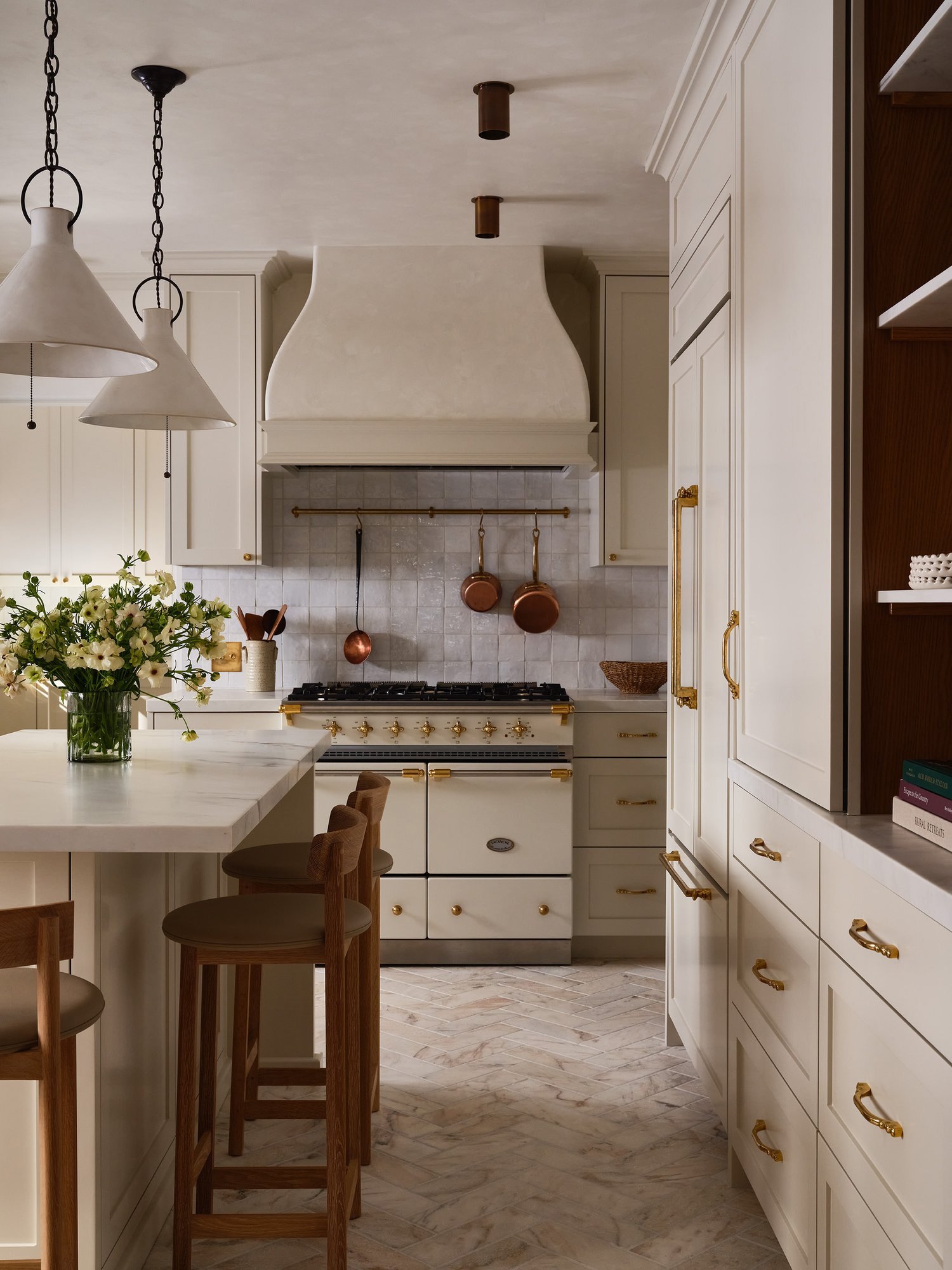
The range and hood are the kitchen’s natural focal point — they occupy the most prominent wall, draw the eye immediately, and set the tone for every other material decision in the room. In a country kitchen, a statement range in a period-appropriate color paired with a custom hood elevates the cooking zone from functional to architectural.
This kitchen remodel by Anja Michals shows the combination at its most considered. A cream range with brass hardware sits beneath a custom textured limestone range hood — the limestone’s natural, matte surface adding a genuinely tactile quality that painted or plaster hoods rarely achieve. White zellige tiles on the backsplash provide the handmade, tonal backdrop that suits both the cream range and the limestone hood, their irregular reflective surfaces catching light in a way that flat subway tile wouldn’t.
A brass rail above the stove holds copper pots — the warm metallics of the brass and copper connecting the range hardware to the cookware display above in a single cohesive material thread. Cream cabinetry with brass hardware throughout the kitchen ensures the range zone feels like the natural culmination of the room’s palette rather than a standalone statement. The open plan layout Michals created beyond the kitchen — with a breakfast nook visible from the cooking zone — reinforces the country kitchen’s defining quality: a space designed as much for company as for cooking.
Statement Range & Hood
Image courtesy of Anja Michals Design
Creating Your Country Kitchen
A country kitchen works because it treats cooking and gathering as equally important — the design decisions that make it functional (generous prep space, good storage, natural light) are the same ones that make it feel genuinely warm and personal. Natural materials, vintage accents, handcrafted details, and a connection to the landscape outside aren’t decorative choices so much as a design philosophy: a kitchen that feels like it belongs to the people who use it.
Whether you’re drawn to the refined elegance of a French country kitchen, the organic warmth of an English farmhouse, or the rustic character of an American country kitchen with exposed beams and a cast iron range, the ideas in this guide cover the full range. The common thread running through all of them is authenticity — materials chosen for their genuine quality, details that improve with age, and a space that gets better the more it’s actually used.
For more kitchen inspiration, explore my Kitchen Design Ideas collection.
Frequently Asked Questions About Country Kitchen Ideas
What defines a country style kitchen?
A country style kitchen is defined by natural materials, handcrafted details, and a design philosophy that treats cooking and gathering as equally important. The foundational elements are wood — in cabinetry, flooring, ceiling beams, and open shelving — alongside natural stone, farmhouse sinks, and vintage or antique-inspired hardware. The aesthetic varies significantly by region: English country kitchens lean toward painted cabinetry, flagstone floors, and Aga ranges; French country kitchens favor soft neutrals, ornate detailing, and stone surfaces; American country kitchens draw from farmhouse and rustic traditions with exposed beams, shiplap, and cast iron ranges. What connects all of these directions is an emphasis on authenticity — materials that age well, details that improve with use, and a space that feels genuinely personal rather than recently installed.
How do I make my kitchen look country?
Start with the materials — replacing flat, contemporary surfaces with natural ones is the single most effective change available. Open wood shelving in place of upper cabinets, a farmhouse sink, exposed ceiling beams, and hardwood or stone flooring all establish the country character before any decorative decisions are made. Hardware matters significantly: brass, oil-rubbed bronze, and aged iron all suit the country aesthetic far better than brushed nickel or chrome. From there, the details carry the look — a pot rack above the island, glass canisters on open shelving, fresh flowers or branches from the garden, vintage pottery, and patterned textiles in gingham or floral prints. The goal is a kitchen that looks collected and lived-in rather than coordinated and new.
What colors are best for a country kitchen?
Warm whites, cream, and soft off-whites are the most enduring country kitchen colors — they reflect light, complement natural wood and stone, and provide the neutral foundation that allows other materials to do the visual work. Beyond white, sage green, soft blue, pale yellow, and warm gray are all classic country kitchen cabinet colors, each with a slightly different character: sage green suits English and French country directions, soft blue reads as coastal or Scandinavian country, pale yellow brings warmth and a garden quality, and warm gray bridges country and contemporary directions. Earth tones — terracotta, warm ochre, and dusty rose — suit more eclectic or Mediterranean country interpretations. The key principle regardless of color choice is warmth: country kitchens should lean toward warm undertones rather than cool ones, since the natural materials throughout the room are inherently warm and cool colors work against them.
Are country kitchens still in style?
Yes — and the country kitchen direction is arguably stronger in 2026 than it has been in years. The broader design movement toward natural materials, handcrafted quality, and spaces that feel genuinely personal rather than trend-driven has brought renewed attention to everything the country kitchen has always done well. The style has evolved significantly from its more literal, heavily themed expressions of previous decades — today’s country kitchens are more refined, more selective, and more willing to mix contemporary elements with traditional ones. The farmhouse sink, the open wood shelving, the statement range and custom hood, and the connection between the kitchen and the garden outside are all design choices that feel as current now as they have at any point in the past thirty years.
What is the difference between a farmhouse and a country kitchen?
The terms are often used interchangeably but they have distinct characters. A farmhouse kitchen tends to be more utilitarian in its origins — driven by function, with an emphasis on generous prep space, practical storage, and durable materials like shiplap, cast iron, and butcher block. The palette is typically neutral and restrained. A country kitchen is a broader category that encompasses farmhouse but also includes English country, French country, and cottage directions — each with their own material palette, color sensibility, and level of ornamentation. French country kitchens, for example, favor elegance and detail over utility; English country kitchens lean into painted cabinetry, flagstone floors, and a layered, collected quality that farmhouse kitchens rarely pursue. In practice, most contemporary kitchens described as either farmhouse or country draw from both traditions — the distinction matters most when establishing a specific regional or historical direction rather than a general warm, natural aesthetic.
View Recent Posts
Stunning Range Hood Design Ideas
Range hood design ideas covering stone, wood, plaster, copper, and stainless steel — with designer tips on proportion, material selection, and installation.

Fireplace Design Ideas
Discover fireplace design ideas that range from rustic to modern, country, traditional, Scandinavian and farmhouse with stunning photos.
Rustic Bedroom Ideas
Rustic bedroom ideas covering natural materials, layered textiles, color palettes, and professional design strategies for log cabin, modern rustic, Scandinavian, and luxury retreat styles.
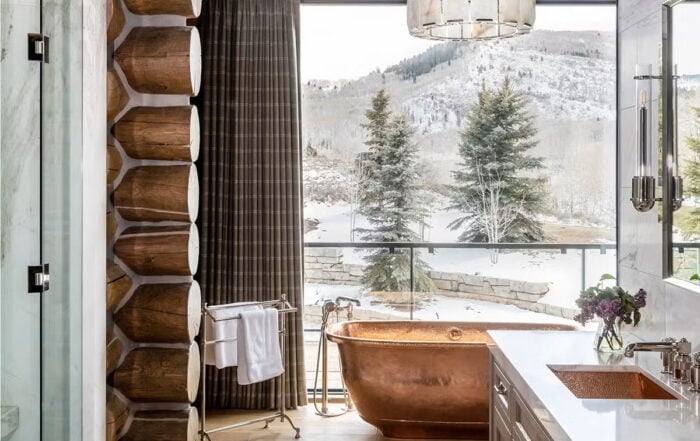
Rustic Bathroom Ideas
Rustic bathroom ideas — natural materials, vintage fixtures, earthy palettes, and designer tips for log homes, cabins, and mountain retreats.
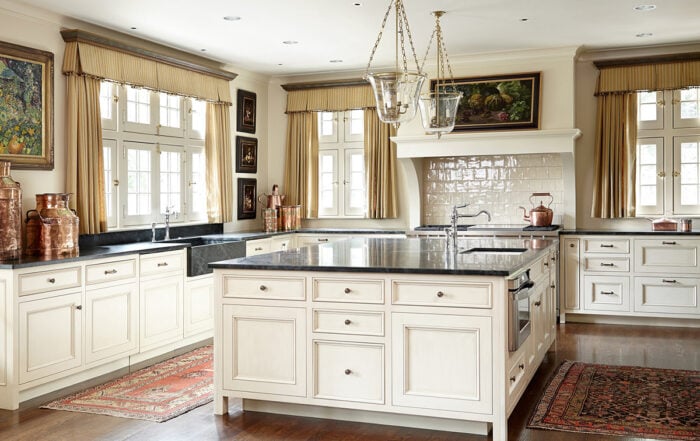
Cream Kitchen Cabinet Ideas
Cream kitchen cabinet ideas curated by interior designer Tracy Svendsen. Warmer than white and more versatile than beige, cream cabinets work beautifully across farmhouse, rustic, traditional, and modern kitchens.
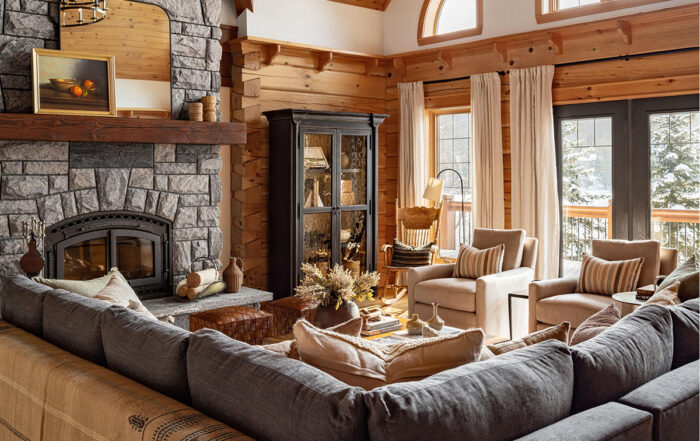
Log Home Decorating Ideas
Log home decorating ideas covering color palettes, furniture selection, lighting, stone fireplaces, and modern approaches to handcrafted log home interiors.

