
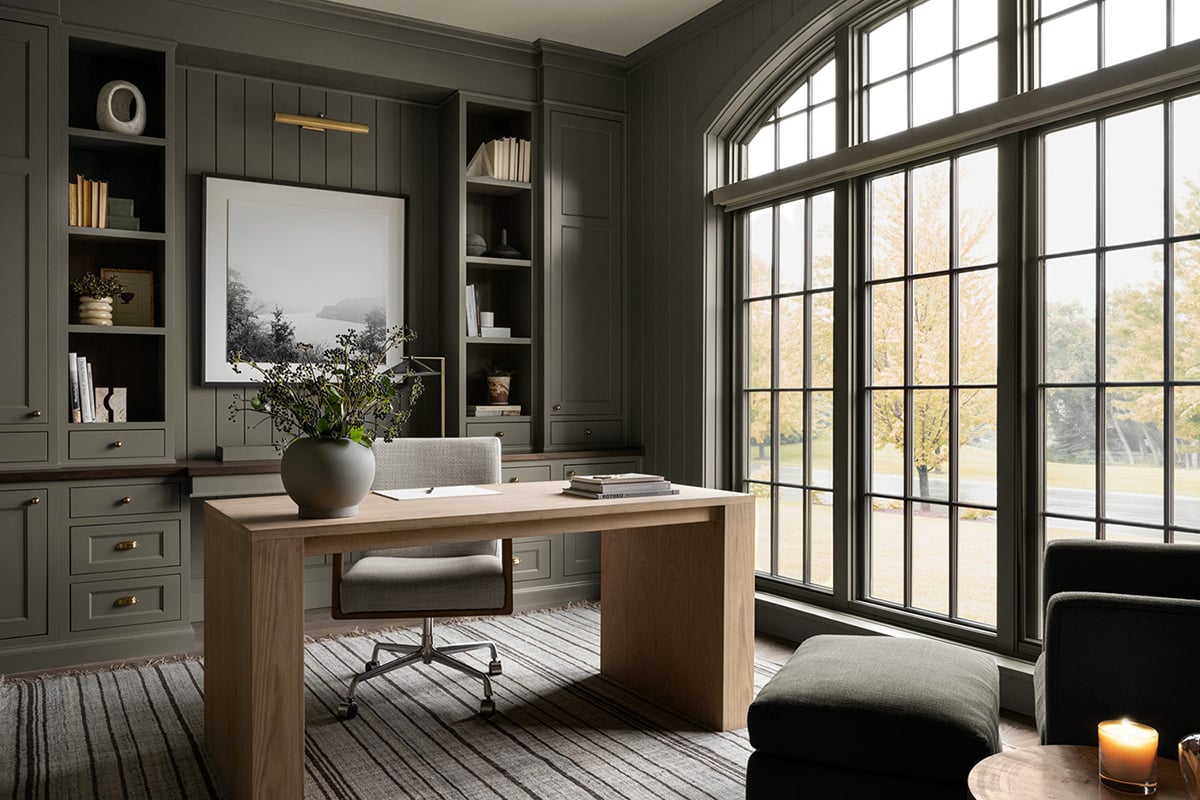
26 Modern Farmhouse Home Offices by Top Designers
By Interior Designer TRACY SVENDSEN | Published on July 21, 2022 | Updated on August 10, 2026 |
The home office has become one of the most considered rooms in the house — and the modern farmhouse direction suits it particularly well. The warmth and material authenticity of farmhouse design create the kind of environment that’s genuinely pleasant to spend eight hours in, while the clean lines and functional clarity of modern design keep the space organized and focused.
As an interior designer, I approach home office design the same way I approach any other room — starting with the architecture and the light, then building the material palette around what the space already offers. A farmhouse-style home office draws from the same principles as the broader aesthetic — natural materials, warm tones, and a mix of old and new — applied to a space that needs to support focused, sustained work as much as it needs to feel personal and considered.
The 26 ideas in this guide cover the full range of modern farmhouse home office directions — from dedicated built-in desk and shelving arrangements to converted spaces and multipurpose rooms — with specific material, furniture, and lighting recommendations throughout. Feature image courtesy of McGee & Co.
Key Takeaways: Modern Farmhouse Office Ideas
- The modern farmhouse home office succeeds when natural materials — wood, leather, linen, and warm metals — establish the warmth while clean desk lines and organized shelving maintain the functional clarity. Neither quality alone achieves the balance the style depends on.
- Built-in cabinetry is the highest-impact investment in a home office — whether in a deep saturated tone like navy or forest green, or painted to match the wall color, it transforms a functional room into a genuinely designed space.
- The desk position relative to natural light matters more than most people realize — a window beside or behind the workspace changes the quality of time spent working in a way that interior design choices alone cannot replicate.
- Statement lighting elevates a home office as decisively as any furniture decision — one fixture with genuine presence, in a natural material or organic form, does more for the room’s character than multiple competent but unremarkable fixtures.
- The most memorable home offices are the ones that reflect the person working in them — collected artwork, travel objects, personal photographs, and inherited pieces give a workspace the specific, irreplaceable quality that no amount of carefully coordinated furniture achieves.

A Neutral Modern Farmhouse Home Office with Open Shelving
Image courtesy of Lindye Galloway
1. Why Modern Farmhouse Works in a Home Office
The modern farmhouse direction suits a home office particularly well because it resolves the tension between two competing needs — the warmth and material richness that makes a space genuinely pleasant to spend hours in, and the clean lines and functional organization that sustained focused work requires. Neither purely modern nor purely farmhouse alone achieves both simultaneously.
In this home office by McGee & Co., symmetrical light oak built-in shelving units with fluted lower cabinet fronts and varied open compartments flank a large landscape painting centered on the wall — the composition creating an architectural backdrop that reads as genuinely designed rather than assembled. A whitewashed trestle desk, leather task chair, brass wall sconces, and a woven basket on light oak flooring complete the modern farmhouse material palette throughout.
Designer Tip: I recommend designing a home office around a central piece of artwork rather than the desk itself — when the artwork anchors the composition, the desk and shelving arrange themselves naturally around it, creating a room that feels considered from the moment you walk in rather than simply functional.

A Modern Farmhouse Office with a Seating Area
Image courtesy of McGee & Co
2. A Tonal Neutral Palette
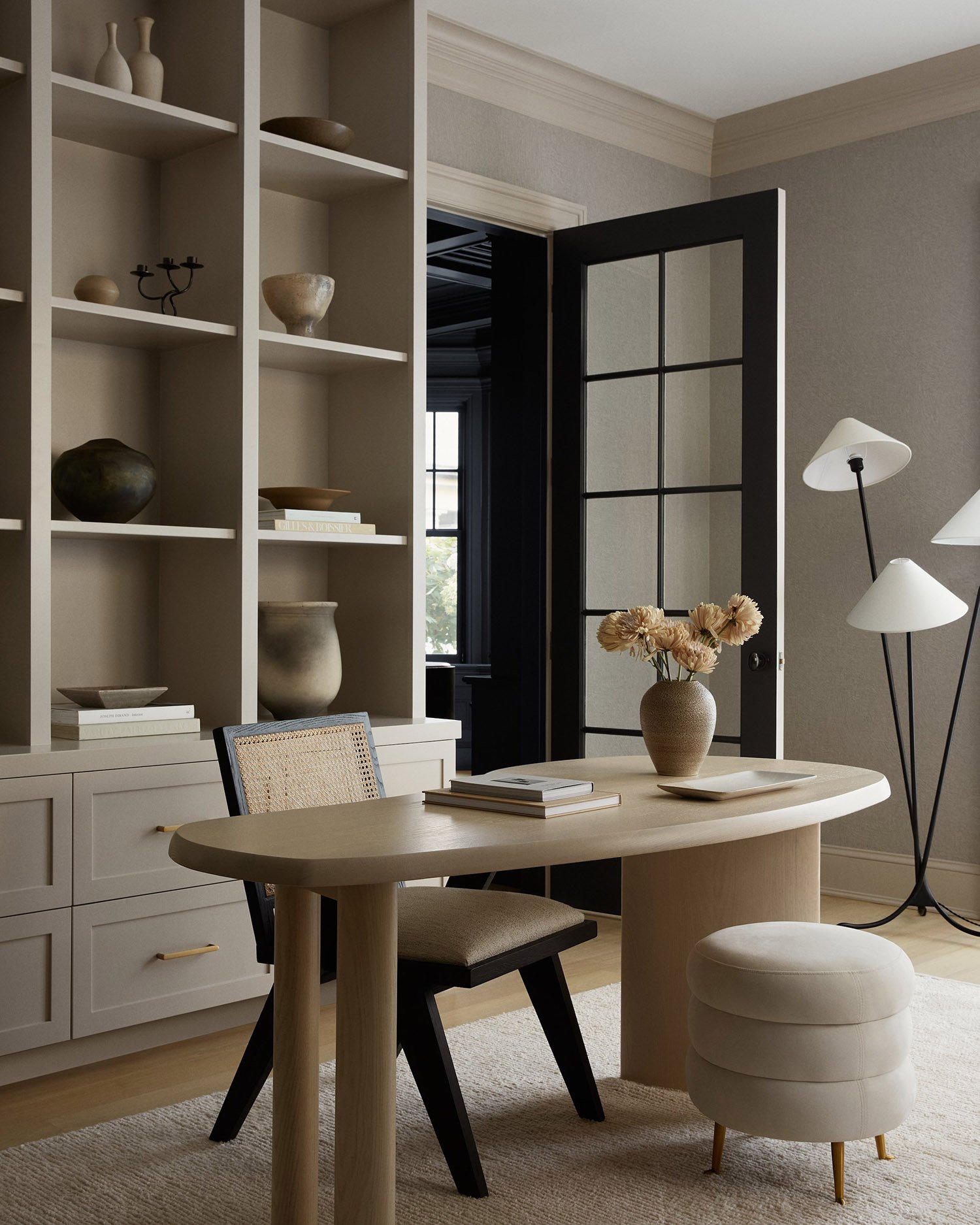
A tonal neutral palette — where walls, built-ins, and flooring share the same warm beige and taupe family — creates a home office with genuine visual calm. The absence of color contrast between surfaces allows the furniture forms, sculptural objects, and one high-contrast element to carry the entire visual interest of the room.
In this home office, taupe grasscloth-style walls and matching cream built-in shelving with brass hardware create the unified neutral envelope. The sculptural oval oak desk with pedestal base and a cane-back chair with black legs introduce the organic and contemporary furniture elements, while a black-framed glass door provides the single high-contrast architectural moment that prevents the warm neutral palette from feeling flat. Earth-tone pottery and sculptural objects on the open shelving complete the considered, restrained composition.
Designer Tip: I recommend matching the built-in shelving color to the wall color in a home office — when the shelving recedes into the wall rather than contrasting with it, the room feels larger, and the objects displayed on the shelves read with more clarity. The built-ins become architecture rather than furniture.
A Neutral Home Office with a Curving Desk and Black Accents
Image courtesy of Brittany Hakimfar Design
3. A Sculptural Desk as the Room’s Focal Point
The desk is the most used piece of furniture in a home office and the one that most directly communicates the room’s design direction. A sculptural desk — one with genuine three-dimensional form rather than a conventional rectangular surface — elevates the office from a functional room into a genuinely considered interior.
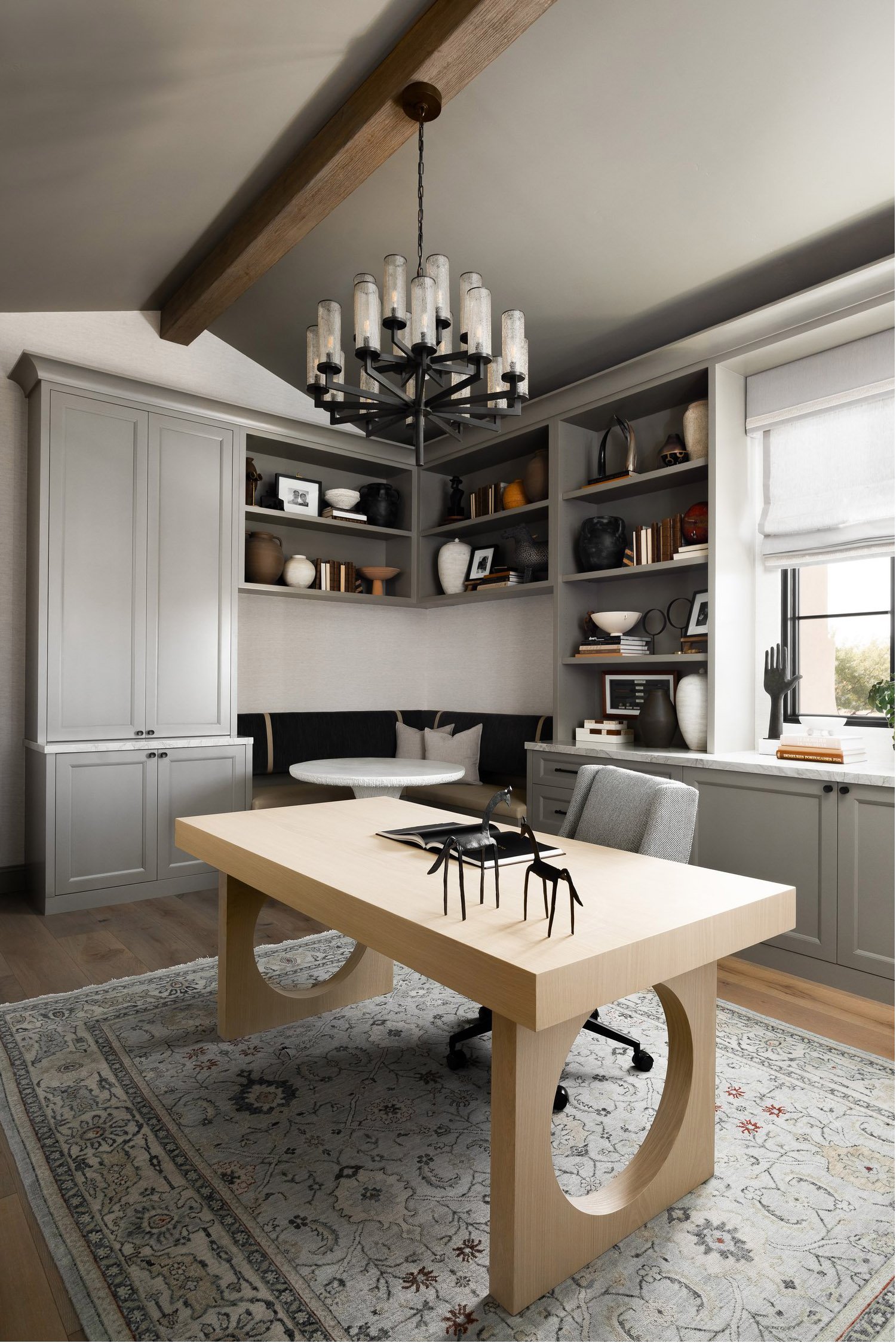
This home office by Britany Simon Design centers on a light oak desk with dramatically curved cutout legs — a sculptural form that reads as a piece of furniture worth choosing rather than simply a work surface. Gray built-in shelving wraps the corner walls, a built-in banquette with a round marble table creates a secondary meeting or reading zone, and a dark iron multi-arm chandelier with glass cylinder shades anchors the ceiling above a wood beam. A vintage Persian-style area rug and a gray upholstered task chair complete the layered, considered composition.
Designer Tip: I recommend investing in one genuinely sculptural piece in a home office — a distinctive desk, an unusual chair, or a statement light fixture — and letting everything else support it. In a room where you spend significant hours working, the quality and character of that one piece matter more than the sum of everything else in the room.
A Modern Office with a Sculptural Desk and Gray Built-In Cabinetry
Image courtesy of Britany Simon Design
4. Brass and Blush in a Feminine Modern Office
A brass-and-blush palette creates one of the most distinctive modern home office directions — the warm metallic tone of brass naturally connecting to the soft pink and cream surfaces, while the sculptural quality of the furniture pieces elevates the space beyond a conventional workspace.
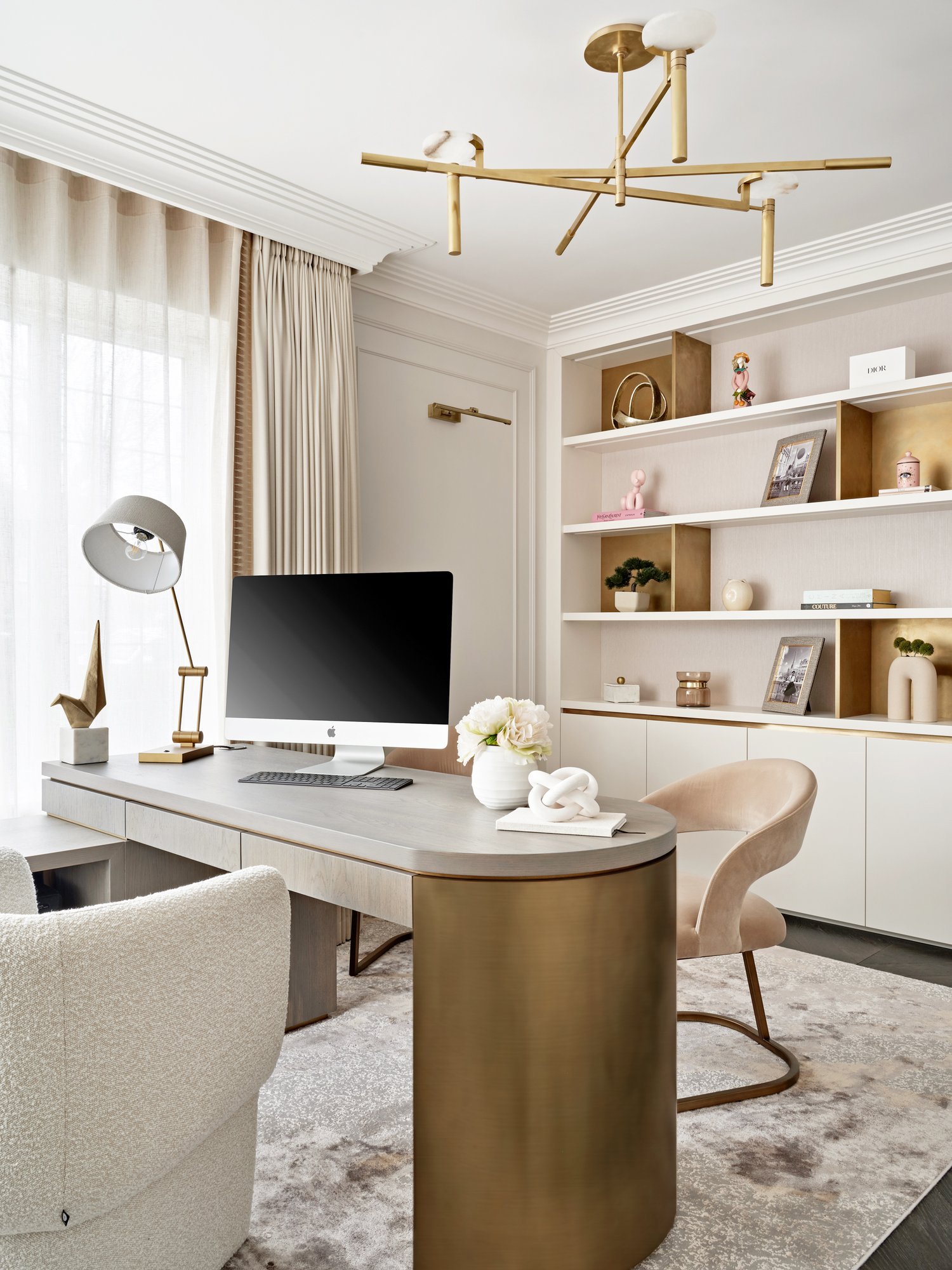
The oval desk with a dramatic curved brass pedestal base is the room’s defining piece — its warm metallic form connecting directly to the sculptural brass ceiling fixture above and the brass desk lamp. Blush velvet accent chair, white boucle guest chair, built-in shelving with brass-backed niches displaying personal objects and fashion books, floor-to-ceiling cream linen curtains, and a soft abstract area rug complete the warm, considered palette throughout.
Designer Tip: I recommend brass as the primary metal finish in a home office when the overall palette is warm and neutral — it adds warmth and a refined quality that chrome or brushed nickel can’t achieve in the same tonal range. Limiting brass to two or three key pieces — the desk, the ceiling fixture, and one lamp — creates cohesion without the space feeling overdone.
A Modern, Feminine Home Office with Brass and Blush Accents
Image courtesy of Cam Interiors
5. Dark Walls and Light Oak Built-Ins
Dark walls in a home office create an atmosphere of focus and depth that light walls rarely achieve — the contrast between a deep charcoal or near-black wall and warm light oak built-ins is one of the most sophisticated combinations available in contemporary office design.
This study shows dark walls used with real confidence. Light oak floor-to-ceiling built-ins with black hardware sit against deep charcoal walls — the warm wood reading with maximum clarity against the dark backdrop. A record player and vinyl collection displayed on the lower shelves alongside books, artwork leaning within the shelving, and sculptural objects add the personal, collected quality that transforms a functional storage wall into a genuine expression of the room’s character. Two tan velvet accent chairs with dark wood frames create the seating zone in front of the built-ins, with floor-to-ceiling black-framed windows bringing natural light and garden views into the space.
Designer Tip: I recommend dark walls in a home office or study, especially when the built-in shelving is a warm natural wood tone — the contrast between the dark wall and the warm wood creates depth and sophistication that neither light walls nor dark cabinetry alone can achieve.
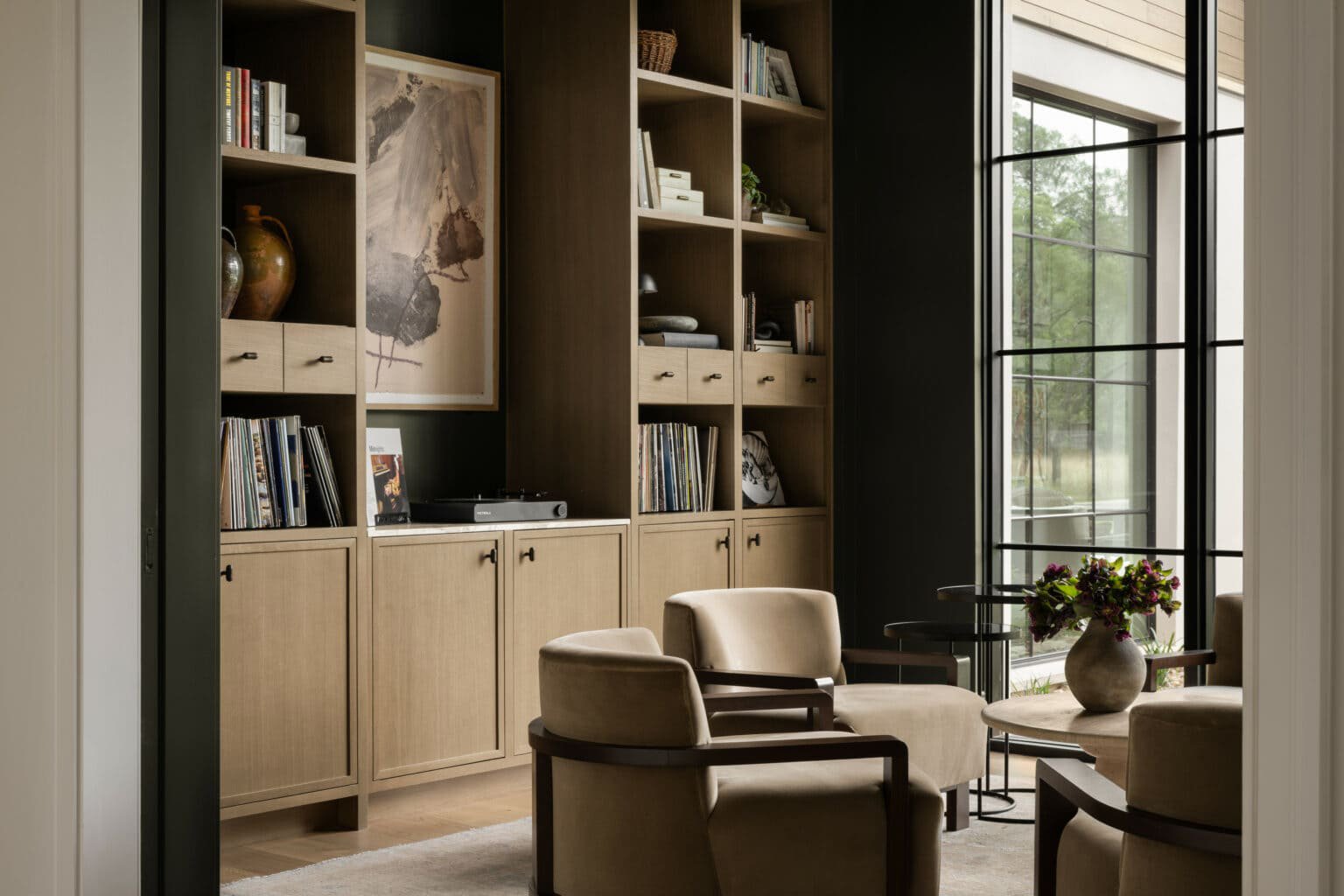
A Home Office with Dark Olive Walls, Light Oak Cabinetry, and Tan Velvet Accent Chairs
Image courtesy of Studio McGee
6. A Vaulted Wood Ceiling
A vaulted wood ceiling transforms a home office from a functional room into a genuinely architectural space — the warmth and structural character of the timber above creates the farmhouse quality that no wall treatment or furniture choice replicates as effectively.
This home office shows natural materials working at every level simultaneously. The vaulted wood ceiling with exposed beams establishes the architectural foundation, while warm wood built-in shelving with fluted panel details, a dark wood and black stone desk, and sculptural turned wood objects on the desk surface layer the natural material palette throughout. A dark stone fireplace surround, fluted gray wall panels, and a cluster of black dome pendant lights introduce the contemporary counterpoint that prevents the warm wood from feeling too rustic. A garden view through the window behind the desk connects the interior directly to the landscape outside — a reminder that natural elements in a home office work best when they reference the natural world rather than simply serve as decorative objects.
Designer Tip: I recommend a vaulted or beamed ceiling as the single highest-impact architectural investment in a home office — it adds the spatial quality and material warmth that no amount of furniture or decoration achieves after the fact. If the existing ceiling allows, exposing the structure or adding false beams in a warm wood tone immediately transforms the room’s character.
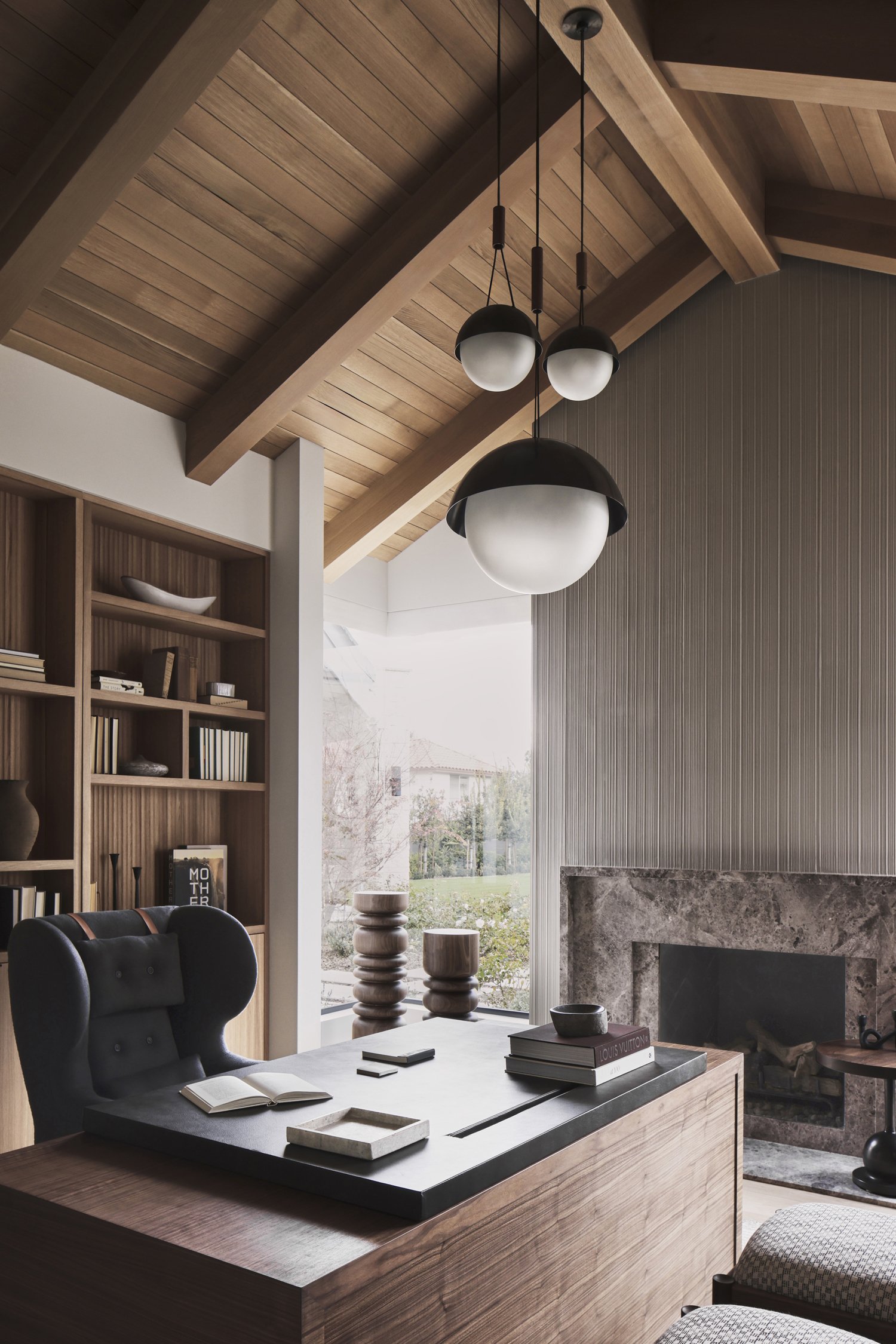
A Moody Home Office with a Light Oak Vaulted Ceiling and a Gray Marble Fireplace
Image courtesy of Studio McGee
7. A Bold Color Commitment in a Home Office
The most impactful color decisions in a home office involve applying a single deep tone to all surfaces simultaneously — walls, ceiling, trim, and window frames unified in one color creates an immersive envelope that transforms the room’s entire character. A single accent wall or painted ceiling alone never achieves the same depth.
This home office shows deep teal-green applied to every surface — walls, ceiling, crown molding, paneling, and window frames in the same saturated tone. Against that envelope, a warm walnut sculptural desk with curved ends, a large brass conical pendant, a gold-framed landscape painting, and a dark vase with burgundy dried botanicals read with extraordinary clarity and warmth. The warm walnut and brass read almost luminous against the deep teal — a material contrast that works because the color is applied at full saturation across every surface rather than held back.
Designer Tip: I recommend painting the ceiling the same color as the walls in a home office when using a bold color — the immersive envelope produced by matching walls and ceiling is transformative in a way that a painted wall with a white ceiling simply isn’t. It’s a decision that feels significant on a paint chip and genuinely compelling in the room itself.
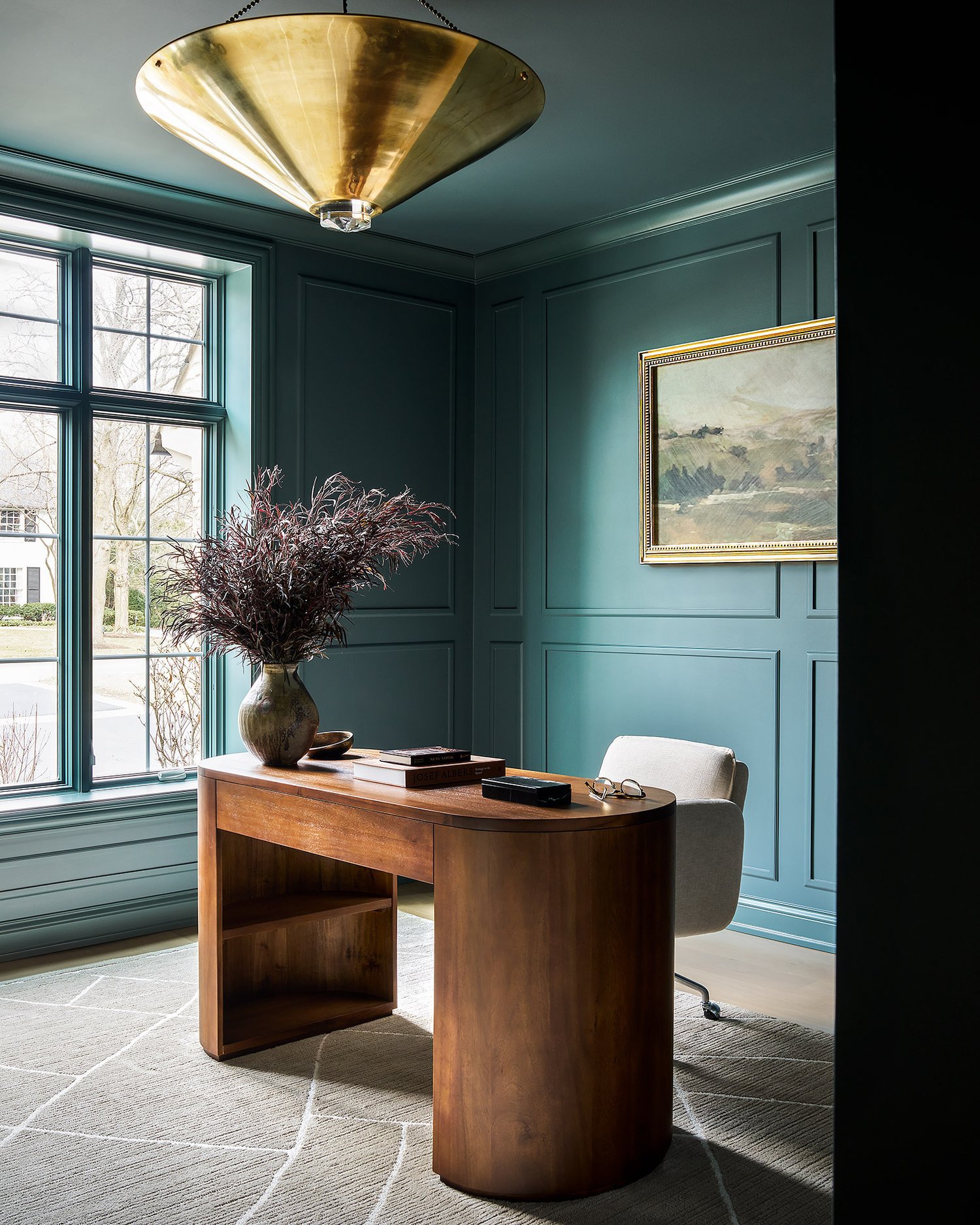
Teal Green Walls, Ceiling and Crown Molding in a Home Office with Brass Accents
Image courtesy of Studio McGee
8. Style Open Shelving
Open shelving in a home office serves a dual purpose — functional storage and a display opportunity that communicates the personality and design sensibility of the person working in the space. The styling of the shelves is as important as the shelving itself.
This Studio McGee shelf display shows open shelving styled with genuine material restraint — rustic pottery, organic sculptural objects, wood bowls and vases, and sculptural wooden pieces arranged with breathing room between each grouping. A large rustic pot in front holds a branch with leaves, adding the organic botanical element that connects the display to the natural world. The restraint is the point — each object reads clearly because it isn’t competing with too many others.
Designer Tip: I recommend limiting a home office shelf display to three material types — ceramic, wood, and one organic or botanical element. More than three materials in a single shelf display tends to feel accumulated rather than considered, and in a workspace where visual clarity supports focused thinking, restraint in the shelving pays practical dividends beyond the aesthetic ones.
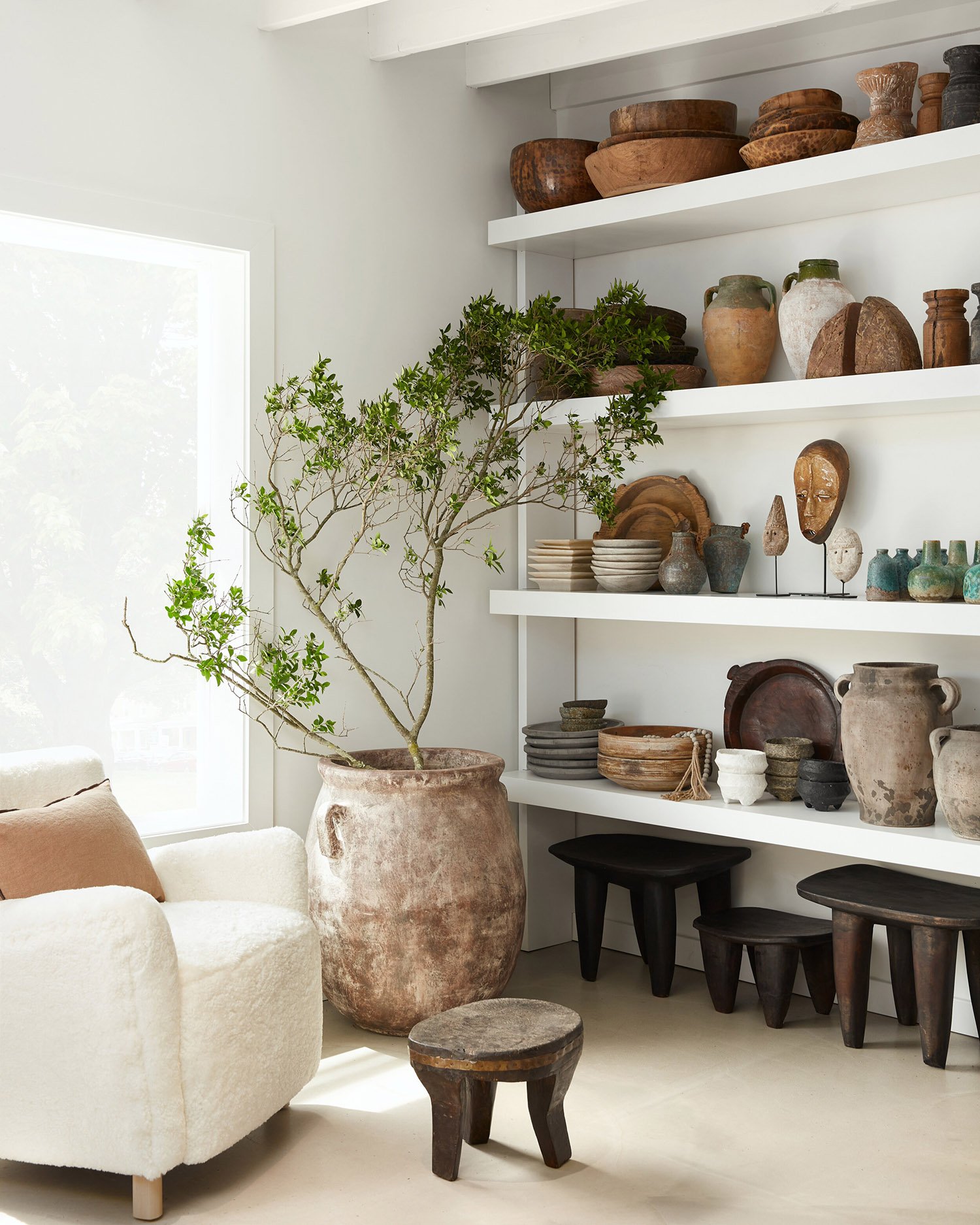
Open Shelving with Rustic Pots, Sculptures, and Vases
Image courtesy of Studio McGee
9. Blue-Green Cabinetry with Leather Hardware
The hardware choice in a home office is as important as the cabinetry finish — leather bin pulls on painted cabinetry introduce an organic, tactile detail that metal hardware rarely achieves, and they connect naturally to the warm wood tones and farmhouse material palette throughout the space.
This Kate Marker Design home office applies a deep blue-green to both the floor-to-ceiling cabinetry and the trim throughout — the color running consistently across both elements, creating the architectural envelope that makes the space feel genuinely designed rather than decorated. Leather bin pulls on the closed cabinetry below add the distinctive hardware detail, while a dark wood desk, modern furniture, light oak-trimmed doors, and a large textured area rug complete the layered, considered composition.
Designer Tip: I recommend treating cabinet hardware in a home office as a genuine design decision rather than a finishing detail — oversized pulls, distinctive knobs, or hardware in an unexpected finish like unlacquered brass or blackened steel can elevate a painted built-in from standard to genuinely considered. In a deep-toned cabinetry color like this blue-green, the hardware is one of the most visible elements in the room and deserves the same attention as the paint selection itself.


A Farmhouse Home Office with Sage Green Walls and Leather Cabinet Pulls
Image courtesy of Kate Marker Design
10. Sculptural Objects and Statement Lighting
A home office with genuine design ambition treats sculptural objects and statement lighting as primary design decisions rather than finishing touches — the pieces that give the room its distinctive character and signal that the space was designed with real intention.
A capiz shell chandelier with black iron structure anchors the ceiling above a dark executive desk positioned in front of warm oak built-in cabinetry — the organic shell material of the chandelier connecting naturally to the warm wood palette below. A tall sculptural totem on the left — its vertical form and layered textural quality reading as genuinely artisan — adds the distinctive personal object that gives the room its most memorable design moment. Potted plants, a patterned ceramic lamp, abstract artwork leaning within the built-in niche, and a hammered brass side table complete the layered, modern farmhouse composition.
Designer Tip: I recommend including at least one genuinely unexpected sculptural object in a home office — a piece that couldn’t have been purchased on a single shopping trip, and that reflects a specific personal interest or collection. That object does more to give the room its character than any amount of carefully coordinated furniture and accessories.
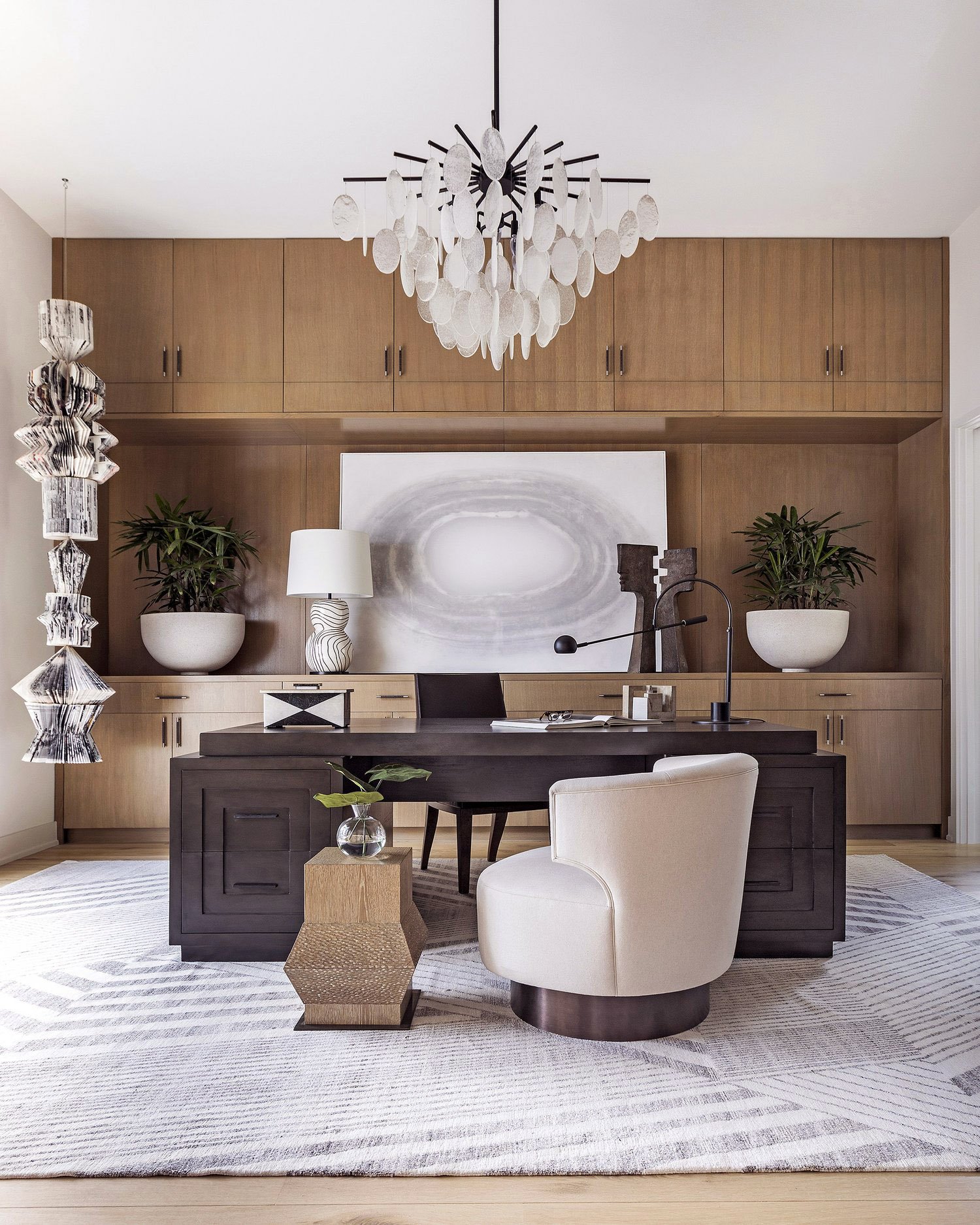
A Contemporary Office with a Capiz Shell Chandelier, and Sculptural Objects
Image courtesy of Benjamin Johnston Design
11. A Neutral Office with Indoor-Outdoor Connection
A home office that connects directly to an outdoor space — through French doors, a garden view, or a covered porch — offers a quality of light and spatial openness that no interior arrangement can replicate. The indoor-outdoor connection is one of the most underconsidered opportunities in home office design.
This Studio McGee home office shows the connection used with genuine restraint. Two sets of large double doors opening to an outdoor area flood the white-walled space with natural light and garden views — the exterior landscape doing the atmospheric work that the deliberately simple interior supports rather than competes with. A white desk, two curving tan upholstered chairs, and a round copper-toned velvet ottoman keep the palette and furniture selection quiet enough to let the green of the outdoors read as the room’s primary color accent.
Designer Tip: I recommend positioning the desk perpendicular to — rather than directly facing — large windows or doors in a home office. The perpendicular placement gives the natural light access to the work surface without creating screen glare, while keeping the view available as a visual rest between periods of focused work.
Modern Farmhouse Home Office with Double Doors Leading to a Patio
Image courtesy of McGee & Co
12. Green Farmhouse Office
Green is one of the most naturally suited colors for a home office — its connection to the natural world creates the calm, focused quality that sustained work requires, and it works across a wide range of tones from deep sage to soft celadon depending on the mood and material palette of the space.
The first office is an intimate, personal space — a rustic wooden desk on light parquet flooring, surrounded by travel photography, pottery, and sculptures collected over the years. The green comes through the cabinetry and leather chair rather than the walls, keeping the focus on the personal objects that give the room its character. The second takes a full-color approach — dark sage green on the cabinetry, walls, ceiling, and trim, warmed by a beaded chandelier, brass hardware, colorful abstract artwork, floral arrangements, and black-and-white family photos on a picture ledge above the cabinetry.

Green Built-In Cabinets & Warm Wood Tones in a Rustic Home Office
Image courtesy of Sadie & Co

Feminine Office with Green Cabinets, a Chandelier and Modern Art
Image courtesy of Kelsey Leigh Design
At the lighter end of the green spectrum, soft green built-in cabinetry with open shelving, light green walls, and a coffered white ceiling with green detailing create a contemporary, polished result. A glossy wood desk with a silver base, two cream contemporary accent chairs, and a white faux fur area rug complete the refined, considered composition.
Designer Tip: I recommend choosing the green tone based on ceiling height and natural light — deep sage and forest green suit rooms with generous height and good natural light, while softer celadon and sage tones suit smaller or north-facing offices where a darker green would feel oppressive rather than grounding.

Large & Open Office with Green Built-In Cabinets & Soft Area Rug
Image courtesy of Houzz
13. Blue in a Farmhouse Office
Blue suits a home office particularly well — its connection to sky and water creates a focused, clear-headed quality that warm tones don’t always achieve. Paired with warm wood flooring, natural materials, and leather, blue reads as grounded rather than cold.
In this home office, blue is applied to both the walls and the vertical panel backing of the floor-to-ceiling open shelving — the color running continuously across both surfaces, creating a unified envelope where books, sculptures, photographs, and artwork read clearly against the consistent blue. A gray stone desk, warm wood flooring, and a large leather accent chair introduce a warm natural-material counterpoint that prevents the palette from feeling too cool. Two framed pieces mounted directly to the shelving add gallery-quality that transforms a functional storage wall into a considered display.
Designer Tip: I recommend extending the wall color into the built-in shelving backing panel when using a strong color in a home office — the continuity between wall and shelving creates a depth and cohesion that a white or contrasting backing panel simply doesn’t. The objects on the shelves become the display; the color becomes the architecture.

Modern Farmhouse Home Office with Blue Built-In Cabinetry
Images courtesy of Sara Lynn Brennan Design
14. Enclosed with Glass – A Home Office Within an Open Plan
Enclosing a home office with black-framed glass sliding doors solves one of the most common open-plan home challenges — creating acoustic separation and visual focus for work without losing the light and spatial connection that defines open-plan living.
Viewed through the black-framed glass doors, this home office combines dark charcoal built-in shelving with warm oak cabinet fronts — the mix of open shelving, closed storage, and glass-front lower cabinets creating a wall system that handles both display and functional storage simultaneously. A dark wood desk positioned at the center, a black articulating wall sconce, a textured charcoal area rug, and a warm wood ceiling panel above complete the considered material palette. The glass enclosure frames the entire composition — the office reading as a room within a room.
Designer Tip: I recommend black-framed glass sliding or pivot doors for a home office in an open-plan space — they provide the acoustic separation focused work requires while maintaining the visual connection to the rest of the home. The black frame reads as an architectural detail rather than a partition, which matters significantly in a space where the office is visible from the main living areas.
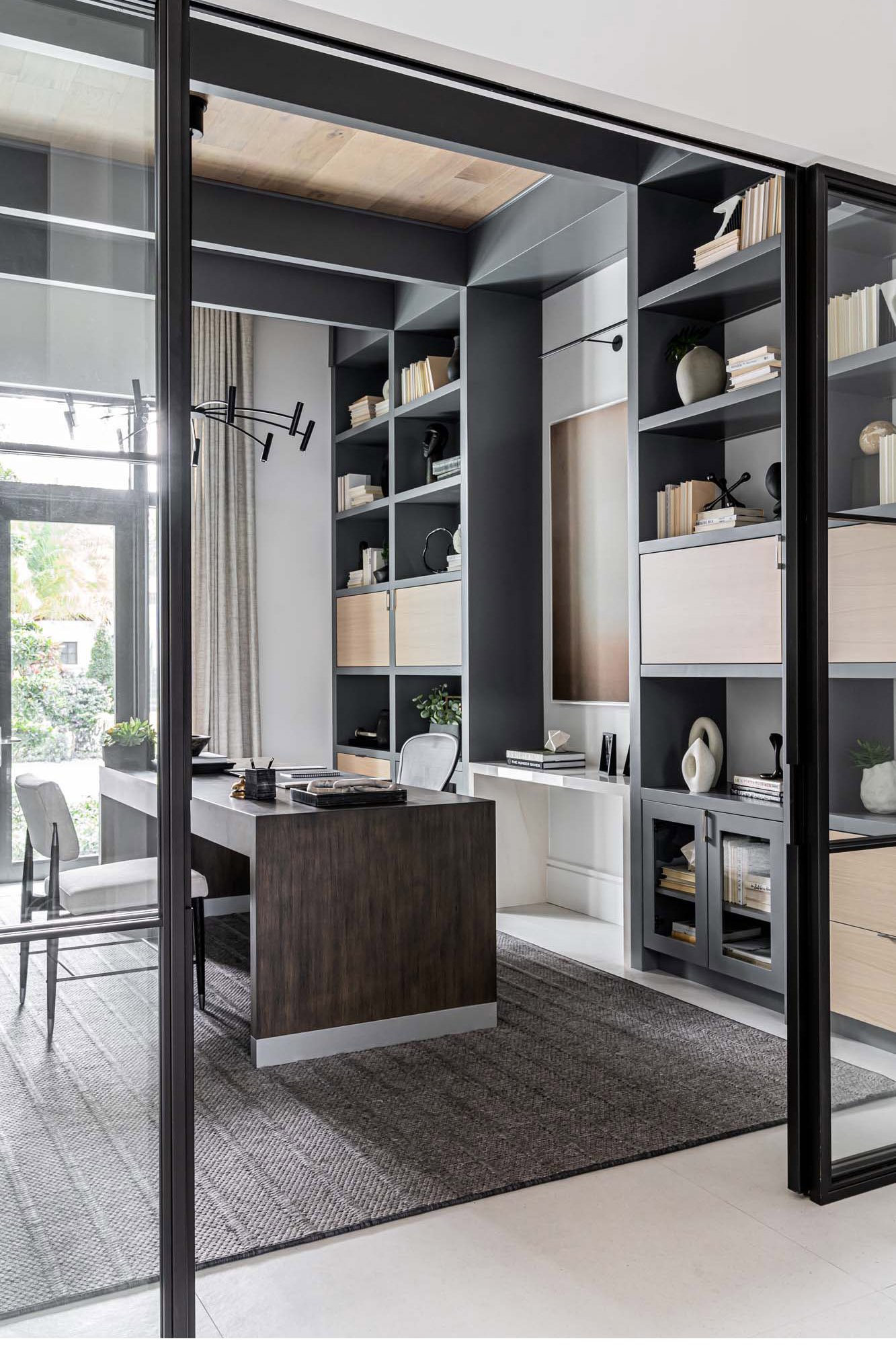
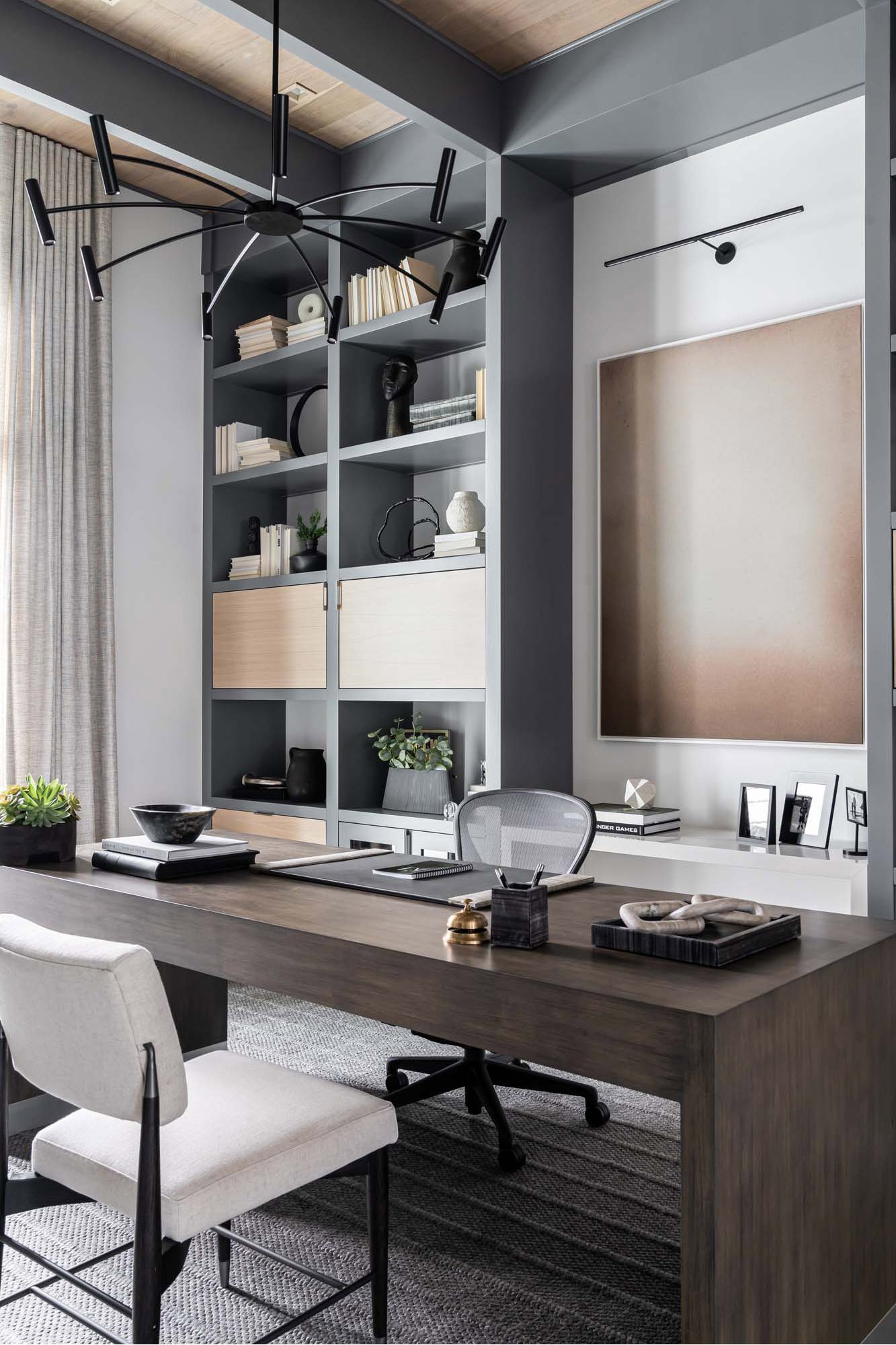
A Modern Office with Black-Framed Glass Doors, and Warm Gray Cabinetry
Image courtesy of Krista Home
15. Creating a Client Seating Zone
A home office designed purely for solo work misses a significant functional opportunity — incorporating a client or meeting seating zone transforms the space from a personal workspace into a room that supports professional conversations, creative collaboration, and client presentations without leaving the home.
This home office shows the client seating zone executed with genuine design confidence. Two cream linen accent chairs with warm wood frames face the light oak desk — the arrangement creating a clear meeting configuration that reads as intentional rather than incidental. The chairs are substantial enough to anchor their own zone within the room without competing with the desk as the primary furniture piece. Floor-to-ceiling navy built-ins with brass hardware and picture lights, framed credentials displayed on the shelving, and a geometric globe chandelier complete the professional, considered atmosphere that client meetings require.
Designer Tip: I recommend positioning client seating directly facing the desk rather than at a side angle — the face-to-face configuration signals that the space is designed for genuine conversation rather than simply accommodating an occasional visitor. Two chairs of equal scale and quality on a defined rug zone create the meeting area without requiring a separate room.
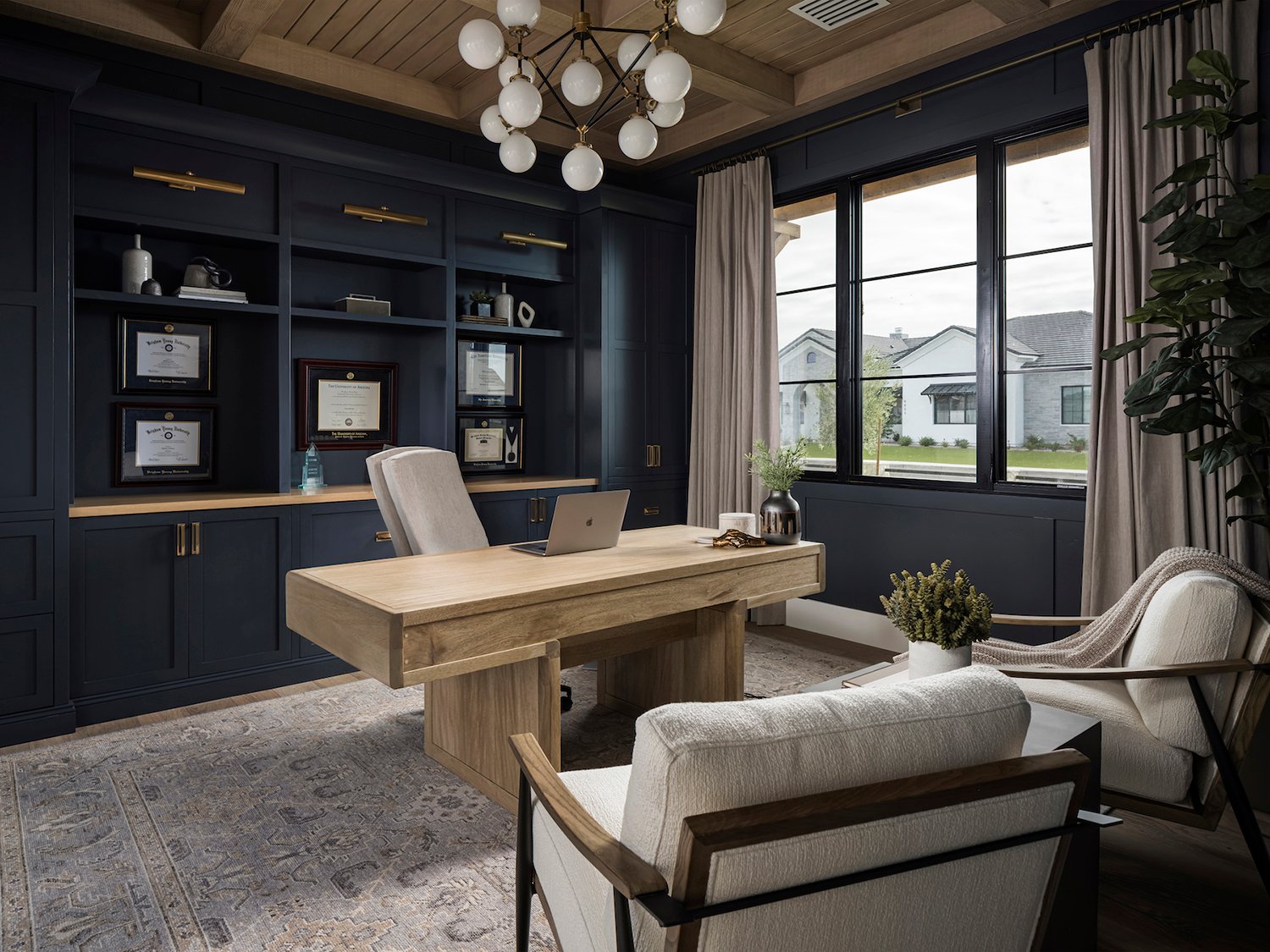
A Home Office with Navy Blue Built-In Cabinets and Walls
Image courtesy of Alisha Taylor
16. Conceal Tech
Cable management is one of the most practical and most overlooked aspects of home office design — a beautifully designed workspace loses significant visual quality the moment cords become visible. The solution doesn’t require expensive furniture or built-in cable channels.
In my own home office, I use a combination of double-sided Velcro and multi-purpose cable ties to keep the desk surface and the area beneath it clear. The cables attach neatly to the underside of the desk with Velcro when the desk is positioned against the wall — out of sight, off the floor, and accessible without moving anything while vacuuming. It’s a practical solution that also keeps cords away from pets.
Beyond cable management, desks with built-in drawers, closed cabinetry for printers and scanners, and decorative baskets for smaller devices all keep the functional elements of a working office out of the visual field without physically removing them from the space.
Designer Tip: I recommend addressing cable management before styling any surface in a home office — the most carefully styled desk loses its visual quality the moment cords become visible. Solving the cable problem first means every styling decision after it lands on a genuinely clean surface.

My Home Office Cable Storage Behind the Desk
17. Add Layers
A fireplace in a home office changes the room’s entire character — it makes the space genuinely worth spending time in beyond the functional requirements of work, and it establishes the study quality that distinguishes a considered home office from a converted spare room.
This wood-paneled study shows layering applied at every level simultaneously. Light oak paneling covers walls and ceiling continuously — the wood creating a warm envelope that connects the built-in shelving, fireplace surround, and oval windows into a single cohesive architectural composition. Two boucle lounge chairs with a linen throw and two cognac leather accent chairs surround a round dark wood coffee table with art books and a large leafy plant, layering the warm organic materials throughout on a vintage Persian rug. Art leaning within the shelving, earth-tone pottery, sculptural objects, and a contemporary landscape painting above the fireplace add the personal, collected quality that defines a genuine study rather than a staged office.
Designer Tip: I recommend a fireplace in a home office or study wherever the architecture allows — it’s the single addition that most transforms a workspace into a room you genuinely want to spend time in. Even a decorative or gas fireplace achieves this quality; the visual presence of a hearth changes the room’s entire character regardless of whether it’s actively burning.

A Home Office with Wood Paneling on the Fireplace and Walls
Image courtesy of Amber Lewis
18. Tonal Black and White with Curated Artwork
A tonal black-and-white palette is one of the most versatile directions for a home office — the high contrast between dark accents and white walls creates a focused, graphic quality that suits both contemporary and farmhouse aesthetics, depending on the materials and furniture choices surrounding it.
High ceilings, black-framed windows with black window treatments, dark wood flooring, and a dark wood desk with a black leather chair establish the tonal foundation in the first office. A statement contemporary brass lighting fixture above the desk and two brass lamps with black shades on the console behind introduce the warm metallic accent that holds the composition together. Sculptural objects on the desk surface and a light area rug complete the refined, high-contrast palette.
The second takes a more personal direction — an eclectic mix of earth-tone artwork and photography covers the white wall behind a black desk, with light oak flooring, a white area rug, a wood chair with woven cane seat and back, and a wood floor lamp with black shade completing the space. The accumulation of artwork gives the room its character — pieces gathered over time rather than selected and installed in a single session.
Designer Tip: I recommend brass as the warm metallic accent in a black-and-white home office — it bridges the cool contrast of black and white with genuine warmth and connects naturally to the wood tones that farmhouse design depends on. A single statement brass fixture does more than multiple smaller brass accessories spread throughout the room.

Masculine & Sophisticated Farmhouse Home Office
Image courtesy of Marriane Simon Design

Farmhouse Home Office with Gallery Wall
Image courtesy of URBANOLOGY Design
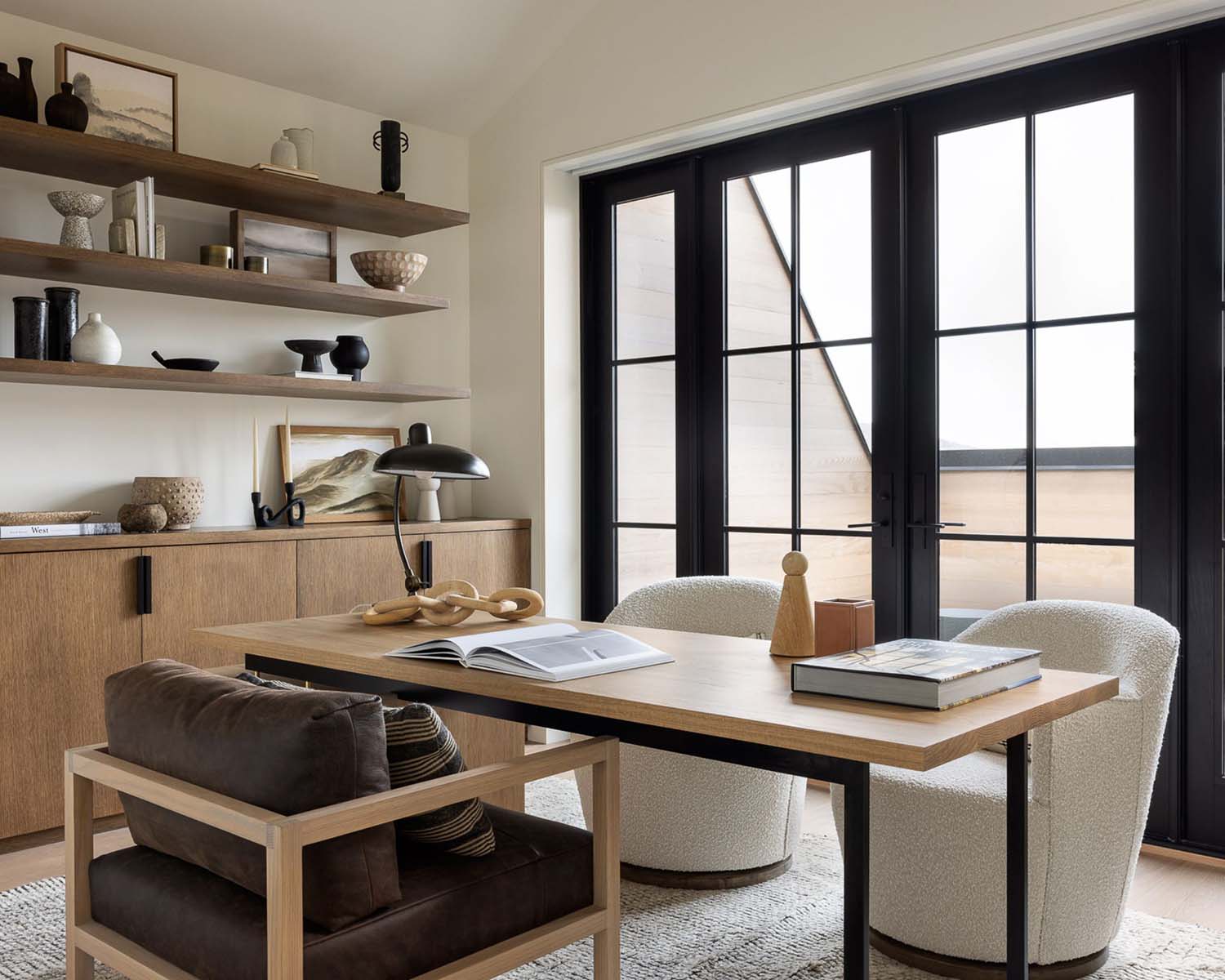
19. Natural Light and the Working Environment
Natural light is the most undervalued element in home office design — its quality, direction, and the view it frames affect how a workspace feels hour by hour in ways that furniture and color choices simply don’t. Before making any desk placement or furniture decision, understanding how light moves through the space throughout the day is the most useful starting point.
In this home office, large black-framed French doors behind the desk flood the space with natural light and frame a desert landscape view — the desk positioned to benefit from the light without creating screen glare. Warm oak floating shelves styled with sculptural ceramics, black objects, and leaning artwork anchor the left wall, while a warm oak credenza below provides closed storage. Two cream boucle swivel chairs face across the light oak desk with a black metal base, creating the meeting configuration that makes the space functional for both solo work and collaborative conversation.
Designer Tip: I recommend treating the view from a desk position as seriously as the desk itself — a window that frames a garden, landscape, or sky view changes the quality of time spent working in a way that most people don’t fully appreciate until they’ve experienced it. When planning a home office, walk the room at different times of day before committing to a desk position, noting where the light falls and what each position looks out toward.
Modern Farmhouse Office with Black-Framed Glass French Doors
Image courtesy of Lindy Galloway
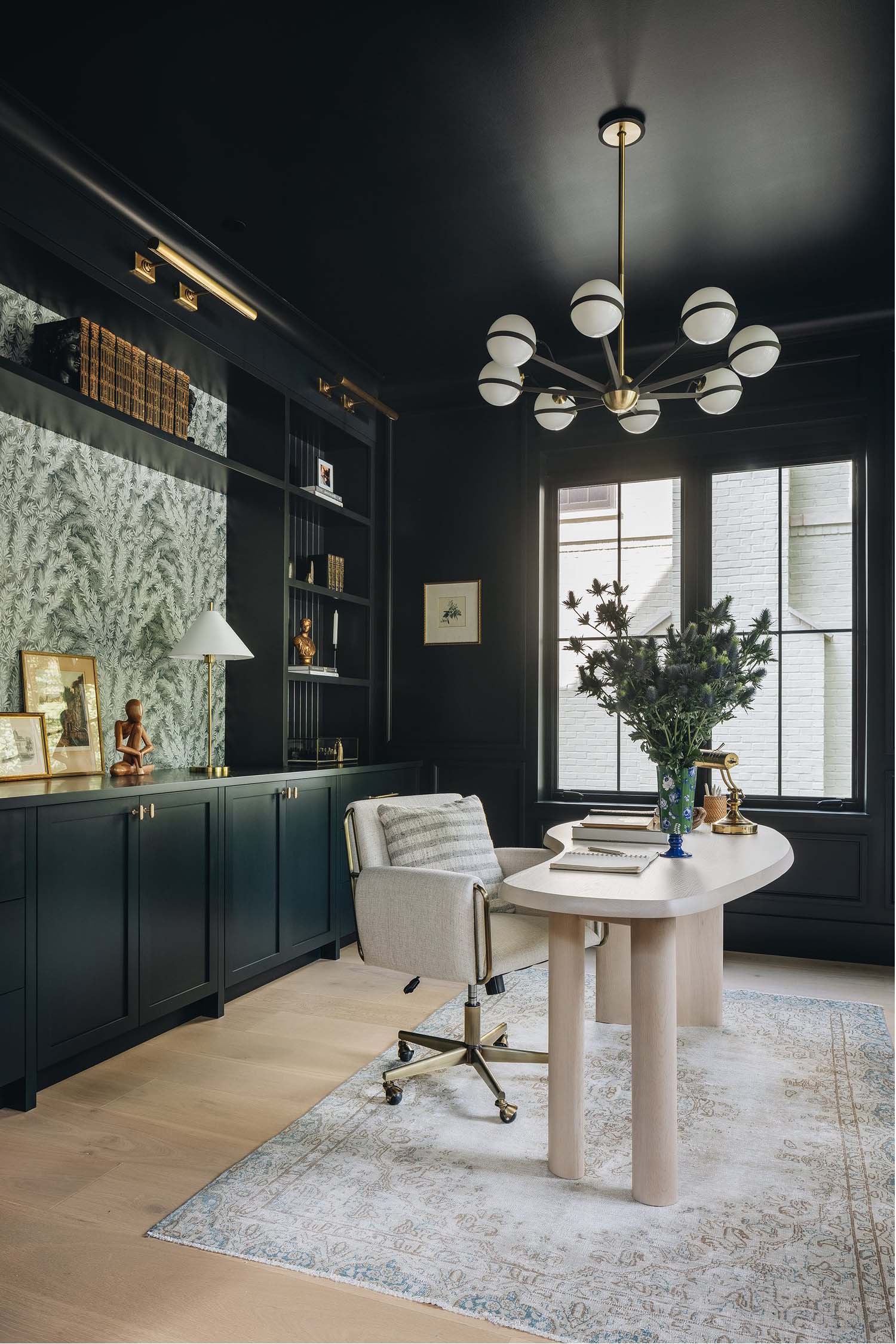
20. Wallpaper as a Built-In Accent
Using wallpaper as a backing panel within a built-in shelving unit — rather than on a full wall — introduces pattern and color at a contained, intentional scale that a fully wallpapered room never achieves. The wallpaper becomes a deliberate design moment within the architecture rather than a surface treatment.
This dark green home office shows the technique applied with real confidence. Dark green cabinetry, walls, and ceiling create the immersive color envelope, with one section of the open shelving backed in botanical wallpaper in white and warm green tones — the pattern providing the visual relief that breaks the deep green without disrupting the cohesion of the palette. A modern white curvilinear light oak desk, white upholstered swivel chair with brass detailing, brass picture frames and hardware, light oak flooring, and a large floral arrangement complete the considered composition.
Designer Tip: I recommend using wallpaper as a backing panel within one section of built-in shelving rather than covering an entire wall — the contained application creates a deliberate focal point within the shelving composition, and it allows a bolder or more detailed pattern than you might commit to on a full wall. The shelving frame contains and defines the pattern, giving even a relatively restrained wallpaper design genuine visual impact within the overall composition.
A Home Office with Dark Green Walls, Cabinetry, Trim and Ceiling
Image courtesy of CM Studio
21. Black Built-Ins with Bold Graphic Curtains
Bold graphic curtains are one of the most impactful and underused design decisions in a home office — floor-to-ceiling panels in a strong pattern establish the room’s personality immediately while framing the window view and adding the vertical scale that plain curtains never achieve.
This large home office uses floor-to-ceiling black-and-white geometric-patterned curtains as the room’s primary pattern statement — their graphic quality connecting directly to the black-framed windows and doors overlooking a front lawn beyond. Black built-in cabinetry with open shelving behind the desk, warm wood flooring, a large gray area rug, a black ergonomic desk chair, two modern white upholstered accent chairs, and a dark wood table complete the high-contrast black-and-white palette throughout.
Designer Tip: I recommend a high-quality ergonomic chair as a non-negotiable investment in a home office — it’s the piece of furniture that directly affects physical well-being during long work sessions, and the difference in quality between a well-engineered ergonomic chair and a standard office chair becomes apparent within the first hour of use. In a well-designed office, the chair should be as considered as any other furniture decision.

Modern Home Office with Black-and-White Curtains and Black Built-In Cabinets
Image courtesy of O’Hara Interiors
22. Designing a Shared Home Office
A shared home office requires more deliberate planning than a solo workspace — two people with different working styles, schedules, and storage needs sharing the same room demands a layout and furniture arrangement that gives each person a defined zone without the space feeling divided.
This shared office demonstrates the principle of resolution through symmetry — two identical black desks with charcoal gray chairs positioned in the same room, each with its own defined workspace while sharing the same visual language throughout. A black fireplace surround, black-and-white photography, white walls, warm wood flooring, and rustic ceiling beams establish a cohesive palette that unifies the two workstations into a single, considered room rather than two separate setups occupying the same space. The ceiling beams are the room’s most important unifying element — their warmth connecting the contemporary black-and-white scheme to the farmhouse material palette throughout.
Designer Tip: I recommend identical or closely matched desk and chair selections in a shared home office — when both workstations use the same furniture, the room reads as intentionally designed for two rather than assembled from separate individual choices. Shared storage, a common rug zone, and consistent lighting above both desks further reinforce cohesion.

Monochromatic Home Office with Warm Wood Floors
Image courtesy of Devon Grace Interiors

23. A T-Shaped Desk Configuration with a Forest View
A T-shaped desk layout — where a counter runs along one wall and extends outward into a perpendicular work surface — is one of the most functional home office configurations available. It maximizes countertop workspace, creates natural zones for different tasks, and positions the primary work surface away from the wall so the view is accessible rather than facing away.
In this home office, the counter runs the full length of the window wall overlooking a forest, then extends outward into a centrally positioned desk — the T-shape giving the primary workspace a full view of the trees beyond the large black-framed windows. Black countertops on a light wood base, black-and-white geometric tile flooring, a white, wood-paneled, peaked ceiling, and warm wood ceiling beams create a high-contrast palette that suits the dramatic forest setting.
Designer Tip: I recommend a T-shaped or L-shaped desk configuration in any home office with a strong window view — the perpendicular extension positions the primary work surface so the view is beside rather than behind the screen, making it accessible as a visual rest throughout the working day without requiring you to turn away from your work to see it.

Large & Open Modern Farmhouse Home Office in Black & White
Image courtesy of Alan Clarke Architects
24. Dark and Moody – A Rich, Warm Home Office
A dark, warm palette in a home office creates a focused, enveloping quality that lighter spaces rarely achieve — the depth of dark walls and rich wood tones makes the room feel genuinely considered and intentional rather than simply furnished.
Dark brown walls and built-in cabinetry establish the rich, warm envelope in this home office, deepened by dark wood flooring and a dark wood desk. A modern brass-and-glass pendant light above the desk and a brass desk lamp introduce a warm metallic accent that connects the dark palette to something refined rather than heavy. Two large leather accent chairs, tan curtains, a light area rug with warm brown tones, and a large potted tree complete the layered, considered composition — the botanical element providing the organic counterpoint that prevents the dark palette from feeling closed in.
Designer Tip: I recommend a large potted tree or substantial plant in a dark-toned home office — the organic, living quality of a significant plant prevents a deeply colored room from feeling too enclosed, and its vertical form adds the height emphasis that low furniture arrangements in a dark room can lack.

A Dark Brown Office with Dark Wood Flooring
Images courtesy of Sara Lynn Brennan Design
25. Wall Molding in a Modern Farmhouse Office
Wall molding — applied in panels across the walls of a home office — is one of the most effective ways to add architectural character to a room that would otherwise read as a plain painted box. It introduces the crafted, considered quality that defines the farmhouse aesthetic without requiring any structural changes.
This home office uses wall molding throughout white walls alongside light wood ceiling panel inserts and dark wood flooring — the combination of the white molded walls, warm wood ceiling, and dark wood floor creating a layered architectural composition. A light wood desk, cream-and-white furnishings, and abundant greenery complete the neutral, organic palette. The molding provides the room’s architectural interest — the modern farmhouse material palette doing the warmth work around it.
Designer Tip: I recommend wall molding as one of the most cost-effective architectural upgrades available in a home office — it adds a level of crafted detail that reads as genuinely considered, and, in a neutral cream-and-white palette, it creates the shadow and depth that flat-painted walls lack entirely. The molding profile itself matters — a deeper, more substantial profile reads as architectural while a thin profile reads as decorative.


Neutral Modern Farmhouse with Wall Molding and a White-Washed Wood Desk
Image courtesy of Sara Lynn Brennan Design
26. Rustic Farmhouse
A rustic farmhouse home office draws from the same material principles as the broader rustic aesthetic — natural wood, aged leather, cowhide, and antler — applied to a workspace that needs to function as effectively as it looks. The key is choosing materials that have genuine age and character rather than manufactured rustic finishes.
Rustic wood-paneled walls, light wood flooring, and a cowhide area rug establish a natural-material foundation, while a dark wood desk and leather chairs introduce the warm, substantial furniture quality that suits the rough-hewn wall texture. An antler chandelier anchors the ceiling — the organic sculptural form connecting the workspace directly to the Western and wilderness traditions that define rustic design. Charcoal-gray-framed windows and a door provide the only contemporary element that prevents the space from feeling too traditional.
Designer Tip: I recommend an antler chandelier as the statement lighting piece in a rustic farmhouse home office — it’s one of the few lighting choices that signals the aesthetic immediately, and at the scale a room with wood-paneled walls and high ceilings requires. Paired with earth-toned textiles and leather furniture, it anchors the space’s rustic character without requiring any additional themed accessories.

Rustic Home Office with Antler Chandelier & Cowhide Area Rug
Image courtesy of Register-Alley Custom Home Builders
Designing Your Modern Farmhouse Office
The modern farmhouse home office works because it resolves a genuine tension — the warmth and material authenticity that makes a space worth spending hours in, alongside the functional clarity that focused work requires. The 26 ideas in this guide cover the full range of how that balance plays out across different palettes, room sizes, and personal styles.
From dark, moody navy-and-green offices to light, neutral spaces with botanical wallpaper accents, sculptural desks, and client seating zones — the common thread is always the same: natural materials, considered furniture choices, and a space that reflects the personality of the person working in it.
Whatever direction you take, the goal is a home office that makes you genuinely want to sit down and work — and that feels worth spending time in beyond the functional requirements of tasks at hand.
Frequently Asked Questions About Modern Farmhouse Home Offices
What are the latest trends in modern farmhouse office design?
Built-in cabinetry in deep saturated tones — navy, dark green, and charcoal — is replacing painted white built-ins as the primary office backdrop. Sculptural desks with curved edges and pedestal bases are replacing conventional rectangular work surfaces. Statement lighting in natural materials — capiz shell, woven rattan, and brass — has become as considered as any furniture decision. And the personal, collected quality of a space — artwork gathered over time, travel objects, inherited pieces — is increasingly valued over the coordinated, showroom-ready look.
How do you style a farmhouse desk?
Start with one functional anchor — a quality desk lamp in brass or aged iron — then build around it with a small number of objects that vary in height, material, and form. A sculptural object, a small plant, a stack of books, and one personal item create the layered, collected quality that distinguishes a genuinely styled desk. Keep the surface at least sixty percent clear — the negative space maintains the functional quality a working desk requires. Avoid matching desk accessory sets, which read as purchased rather than collected.
How do you mix farmhouse with modern in a home office?
Let the architecture carry one direction and the furniture carry the other. Exposed ceiling beams, shiplap walls, or wide plank flooring establish the farmhouse foundation while a clean-lined desk and contemporary lighting introduce the modern counterpoint. Alternatively, a minimal modern shell can carry farmhouse character through natural materials — a reclaimed wood desk, leather seating, and warm metal fixtures. The key is choosing one direction to lead and letting the other support it rather than giving both equal visual weight.
What makes a home office feel modern farmhouse?
Natural wood, leather, linen, woven textures, and warm metals establish the farmhouse material foundation, while clean desk lines, organized shelving, and uncluttered surfaces maintain the modern sensibility. The lighting is often the clearest signal — at least one fixture in a natural material or organic form like an antler chandelier, woven rattan pendant, or brass sconce. Personal objects — collected artwork, travel pieces, plants — add the inhabited, gathered quality that distinguishes a modern farmhouse space from a purely contemporary one.
What colors work best in a modern farmhouse home office?
Warm whites, creamy beiges, and soft grays provide the neutral base that allows natural wood tones and organic textures to read clearly. For bolder directions, deep navy, forest green, charcoal, and warm taupe applied to built-in cabinetry create a dramatic backdrop for natural wood desks and warm metal fixtures. Earth tones — warm browns, muted terracottas, and soft ochres — connect naturally to the farmhouse material palette. Whatever the palette, warm wood tones through the desk, shelving, or flooring prevent the color from feeling disconnected from the natural material foundation.
View Recent Posts
Stunning Range Hood Design Ideas
Range hood design ideas covering stone, wood, plaster, copper, and stainless steel — with designer tips on proportion, material selection, and installation.
Rustic Bedroom Ideas
Rustic bedroom ideas covering natural materials, layered textiles, color palettes, and professional design strategies for log cabin, modern rustic, Scandinavian, and luxury retreat styles.
Rustic Bathroom Ideas
Rustic bathroom ideas — natural materials, vintage fixtures, earthy palettes, and designer tips for log homes, cabins, and mountain retreats.
Cream Kitchen Cabinet Ideas
Cream kitchen cabinet ideas curated by interior designer Tracy Svendsen. Warmer than white and more versatile than beige, cream cabinets work beautifully across farmhouse, rustic, traditional, and modern kitchens.
Log Home Decorating Ideas
Log home decorating ideas covering color palettes, furniture selection, lighting, stone fireplaces, and modern approaches to handcrafted log home interiors.
Country Kitchen Ideas
Discover 43 country kitchen ideas featuring warm earth tones, natural materials, vintage accents, and expert guidance on cabinets, colors, and styling for an authentic country kitchen design.

