
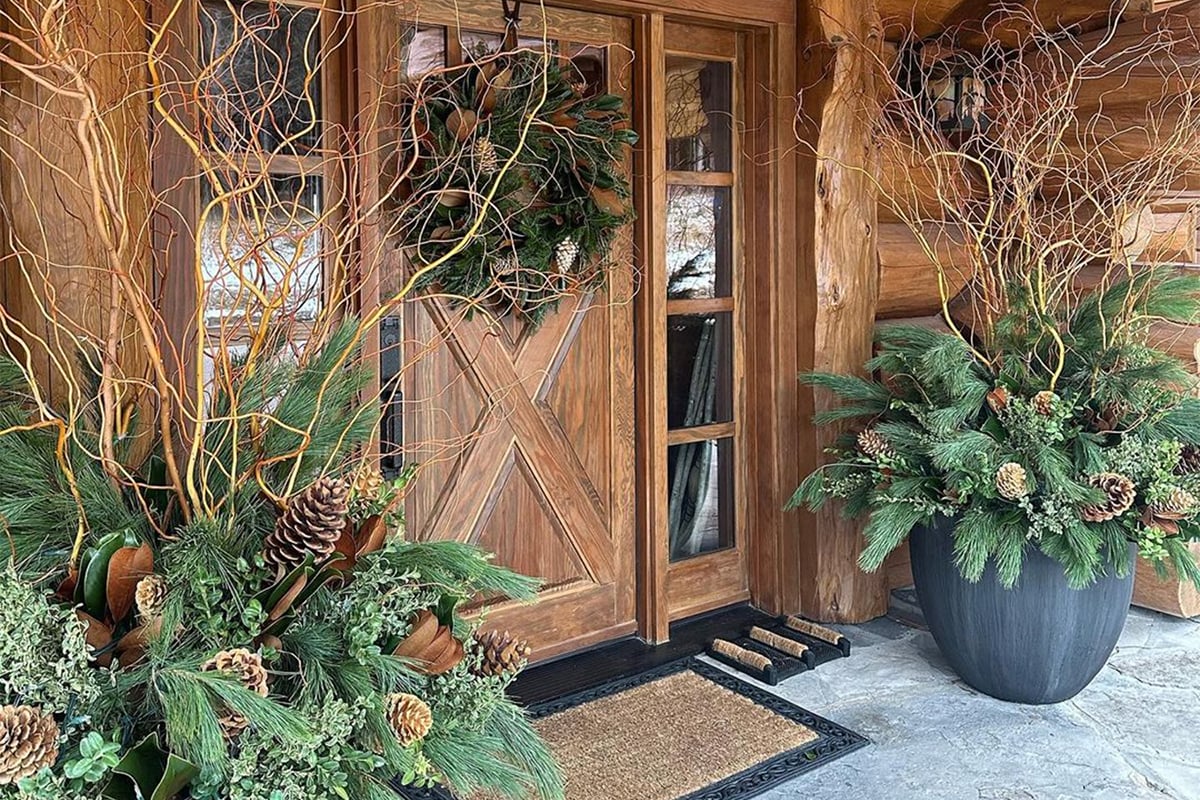
33 Outdoor Winter Planter Ideas for a Festive Front Porch
By Interior Designer TRACY SVENDSEN | Published November 21, 2024 | Updated on October 18, 2026 |
Every year, when the kids come home for Christmas, our family takes nightly walks through the surrounding neighborhoods to see the creative ways people decorate their front porches for the holidays. The lights always stand out first, but the winter planters add the depth and dimension that make an entrance feel like a warm welcome. The following winter planter ideas show how to bring that look to your porch, from Christmas planters filled with evergreens and berries to modern, farmhouse, and Scandinavian styles, whether you are looking for a design to follow or tips for adding height, texture, and form.
Evergreen boughs, red berry branches, birch logs, and oversized bows add color and texture against the snow, and scaling them to the door and the container keeps the display in proportion. Elizabeth Morse of Planters Place writes that saturated burgundy, plum, and emerald green are “replacing pastels for more sophisticated, high-contrast drama,” and the idea suits a winter planter, where deep-toned berries and evergreen foliage gain richness in the low winter light.
These 33 outdoor designs range from matched pairs flanking the front door to oversized urns, tall narrow containers, and small groupings, across rustic, farmhouse, modern, and Scandinavian styles. The opening sections cover the decisions that make the rest last, from color scheme and hardy plants to containers and drainage. Feature image courtesy of Elaine Kettlewell.
Key Takeaways: Outdoor Winter Planters
- Start with a container that suits your home, such as black tapered pots for a modern look or a wooden box for a rustic one.
- Build in layers, with something tall in the center, fuller greens around it, and trailing pieces at the edge.
- Cut evergreens like cedar, pine, spruce and boxwood make the base, and berries, branches, pods and pinecones add texture.
- Take your colors from the house itself, such as brick, trim, and shutters, so the planters look part of the entry.
- For Christmas planters on a front porch, finish with warm white lights, ribbon or plaid bows, ornaments, and red berries.

Outdoor Christmas Planters
Image courtesy of Greenhaven Landscapes
1. Choose a Color Scheme
The palette decides everything that follows, so it’s the first choice to make. Deep evergreens form the base of most winter planters, and the strongest arrangements layer a few brighter notes over that foundation, such as red berries, golden branches, or the white of snow-dusted stems. Placing the darkest greens at the back and the brightest accents toward the front gives the planter depth and movement, and it keeps the color from sitting flat against the front porch. Colored stones or gravel at the base add a final layer, giving the plants a contrasting ground that makes their colors read more clearly.
When the entrance follows a Christmas theme such as Coastal, Scandinavian, or French Country, the planter palette can take its cue from that style. Ornaments or ribbons in the same colors, along with other seasonal decorations, tie the planters to the rest of the porch.
My own holiday preference leans toward an earth-toned palette, but what I enjoy most is seeing how differently people interpret color. There are no mistakes here. As in interior design, the palette can run from vibrant hues to tonal neutrals, as long as it suits your own taste.

Winter Container Garden in a White Pot
Image courtesy of Greenhaven Landscapes
2. Selecting the Right Plants
Plant selection starts with hardiness. Evergreens keep their foliage through the coldest months, so I recommend building every winter planter around them. Boxwood, holly, and juniper add structure and stay full through frost and snow, and dwarf conifers give the arrangement height at the center. Roots in a container are more exposed to the cold than roots in the ground, so check that each plant is rated for a zone or two colder than your own.
Height and spread shape the arrangement as much as the plants themselves. I recommend setting something tall at the center, such as ornamental grasses, red twig dogwood, or branches, with shorter evergreens and leafy cuttings around it, so the planter has a clear profile from every side. Cascading ivy at the rim softens the container’s edge and keeps the arrangement looking full rather than sparse.


Outdoor Winter Planters with Natural Elements
Image courtesy of Susan Nock Garden Design (Thistle Containers)
3. Choosing Your Containers
Begin with the house. The container should relate to the exterior, whether that means the warm tones of a log or timber-framed entrance or the clean lines of a modern facade. Wood boxes and weathered metal suit rustic and farmhouse porches, while smooth concrete and matte black or white finishes suit contemporary ones.
Material matters in winter as much as style. Ceramic and terracotta can crack when moisture freezes inside the walls, so look for pots labeled frost-proof. Concrete, fiberglass, metal, and wood are more forgiving of freeze-and-thaw cycles.
Scale then sets the tone. One large planter works as a focal point beside the door, and smaller containers read best in groups of three at varying heights. A rustic wooden box filled with evergreen branches, pine cones, and red berries creates a traditional look, while a sleek planter in white, silver, and green offers a cleaner look. Mixing two or three shapes and sizes across a porch keeps the display from looking staged.

Simple Outdoor Planter Pots with Birch Twigs
Image courtesy of The Style Nest
4. Soil & Drainage
Drainage is what keeps a winter planter alive, because water that pools around the roots freezes and either damages them or cracks the pot. I recommend starting with a quality container potting mix and blending in coarse sand or grit so excess water moves through. Check that the pot has drainage holes, and lift it on pot feet or small blocks so melting snow can escape from underneath instead of sitting in the base.
Winter planters need far less water than summer ones, but evergreens do not stop drinking altogether. Water them well before the first hard freeze, then check the soil every few days and water only when the top inch feels dry, and only on days above freezing. Overwatering is the more common mistake and leads to root rot.

Stunning Winter Planter with Christmas Ornaments
Image courtesy of The Contained Garden
5. Creating a Visually Appealing Display
Once you’ve chosen the plants, a simple formula helps arrange them: a tall element for height, mid-sized plants for body, and trailing pieces for the edges. In a winter planter, the tall element is usually a dwarf evergreen, ornamental grass, or a bundle of red-stemmed dogwood, which holds its color against the snow. Mid-sized plants add depth to the center, and ornamental kale, ornamental cabbage, and heuchera tolerate hard frost. In milder regions, hellebores and winter pansies work well here too. Creeping juniper and ivy trail over the rim, softening the container and linking it to the porch below.
Contrasting shapes and colors make the arrangement read as layered rather than flat. Pairing a tall evergreen with red-stemmed dogwood and trailing ivy gives the planter three clear levels, and repeating the same combination in a second pot makes a pair that frames the door.

Outdoor Christmas Container Pots with Fresh Greenery
Image courtesy of Greenhaven Landscapes
6. Incorporate Different Textures
Texture is what gives a winter planter depth once the color palette is set. Soft evergreen needles read differently beside rough bark, and the smooth leaves of broadleaf cuttings stand out against the fine, feathery plumes of ornamental grasses. Pairing opposites like these keeps an arrangement from looking flat, even when the colors stay within a narrow range.
Contained Creations shows how far this can go in a farmhouse-inspired window box. Fresh evergreen boughs sit alongside silver dollar eucalyptus and broad magnolia leaves, with pinecones in their natural tones mixed among others sprayed white and gold. The palette stays with deep forest greens, snowy whites, and warm earth tones instead of relying on bright holiday reds, so the interest comes from the layering of leaf shapes and finishes. The result has the richness of a natural woodland arrangement.

Winter Window Box
Image courtesy of Contained Creations
7. Elevate Your Planters with Stands
Raising a planter lifts it into the line of sight, so its colors and textures read against the winter backdrop. Stands also create layers. Placing planters at different heights adds depth to the display and gives the eye a clear path from one to the next. Plant stands come in a range of styles and heights, so they are easy to match to the style of the home. I use plant stands both indoors and outdoors, and I choose the style to suit the design. In my own home, that means modern stands.
The three winter planters shown here use the same materials: fresh greenery, eucalyptus, and red berry branches, all in rustic terracotta pots. The two at the back sit on rustic iron stands at different heights, while the one in front rests directly on the porch with no stand. The repeated materials tie the group together, and the varied heights add movement and depth.

Elevated Christmas Planters
Image courtesy of Greenhaven Landscapes
8. Place Christmas Trees in Oversized Pots
Outdoor Christmas trees in oversized pots give a front porch height and presence that smaller planters can’t match. They come in a range of sizes and styles, from traditional evergreens to slim minimalist forms, so there is a tree to suit almost any facade.
This porch shows how well the idea works with a restrained palette. Black urns echo the black front door against the neutral stone walls, grounding the entrance and giving the trees a polished base. Twinkling lights wrap each tree and let its natural evergreen shape take center stage, and a red bow on each pot adds a clear accent. Red repeats in the two bows at the upper corners of the door frame, the ribbon on the evergreen wreath and the swags with pinecones on the porch posts, and the lit garland around the door ties everything together. The result is a cohesive, full entrance.
Designer Tip: Choose a pot large enough that the tree reads in proportion to the door, and weight the base with stones or sand so wind can’t tip it.

Beautiful Holiday Porch with Christmas Trees
Image courtesy of Citrine Living
9. Frame the Front Door
Framing the front door with winter planters is one of the most effective ways to boost curb appeal, because a matched pair balances the entrance and draws the eye to the door. Planters also soften large wall areas or steps and make the approach feel finished, and they work equally well with simple or elaborate arrangements.
Contained Creations shows this in a pair of rustic planters set on either side of the door, with a welcome mat between them. Each is a tall black metal planter that anchors the arrangement and is filled with Fraser fir, balsam fir, white pine, boxwood sprigs, and cedar boughs. Pinecones and red berry sprigs add color and texture, gold and silver bows add a quiet shimmer, and white birch logs rise from the center to give each planter extra height. The mix of needle types makes the greenery full and varied, and the black metal gives the whole entrance a clean, defined frame.
Designer Tip: Set the pair an equal distance from the door at matching heights. If you prefer an asymmetrical look, repeat the same materials on both sides so the entrance still feels balanced.

Frame the Front Door
Image courtesy of Contained Creations
10. Infuse With Country Charm
Country charm comes from natural, honest materials. Wood, galvanized metal and frost-proof terracotta suit the look, and weathered wooden crates or antique buckets give a planter instant age and character. Burlap wrapped around a pot, pinecones, twigs, and braided jute twine soften the edges, while cedar, pine, and spruce provide the classic evergreen base.
This planter shows how rich a country arrangement can be, with a textured blend of fresh evergreens, natural accents and holiday baubles. Balsam fir, cedar, pine, boxwood, magnolia leaves, and winter holly form the base; birch logs and natural branches add height; and painted white twigs, sugar pinecones, red glitter pinecones, and lotus pods bring contrast and a touch of sparkle.

Winter Container with Country Charm
Image courtesy of Thrive Planters
11. Take a Rustic Approach
Rustic Christmas planters draw on wood, stone and natural fibers, materials that sit comfortably in an outdoor setting and give the winter landscape warmth. They suit everything from traditional country to modern farmhouse, so the look fits easily on a porch, patio or garden path.
A large weathered black planter pot holds a dense, textured mix of fresh evergreen boughs, cedar and fir, draping over the edges. Large pinecones and coppery-brown magnolia leaves sit within the greenery, and a loop of intersecting rusted iron bands arches through the center, an unexpected element that adds age and character. Wispy natural branches complete the look.
Designer Tip: I recommend letting one sculptural element, like the rusted iron loop, be the focal point, and keep the rest of the arrangement full and natural so the planter has a clear center of interest.

Rustic Outdoor Christmas Planter
Image courtesy of Garden House Florist
12. Add Creative Accents
Accents give a winter planter its personality. Grapevine, curly willow, glitter twigs, birch poles, eucalyptus, hydrangeas, magnolia leaves, red twig dogwood, and winterberry holly all bring their own shape and color, and baubles add a festive note. Shatterproof ornaments in varying sizes hold up outdoors, and mixing metallic finishes with matte ones adds depth. Decorative picks in snowflake, star, or holiday shapes slip easily into the soil and complete the look without overwhelming the arrangement.
Garden House Florist shows how well this works in a planter built in a galvanized metal bucket. A thick, circular woven grapevine wreath anchors the top, adding height and a rustic backdrop. An elongated sugar pinecone sits near the center, flanked by standard pinecones and pods that ground the core of the arrangement, and magnolia leaves, evergreen boughs, and red berry sprigs fill in around them. The design is asymmetrical, with a one-sided triangular flow that gives it movement.

Unique Christmas Planter
Image courtesy of Garden House Florist
13. Embrace a Farmhouse Vibe
Farmhouse Christmas style is rooted in vintage finds, and the container is a good place to start. Old tin buckets, milk cans, and wrought iron troughs give a planter history before you place the boughs. Hardy evergreens fill them, and burlap ribbon, twine and wooden stars add the finishing details, with a few red or plaid touches to bring in the farmhouse palette.
A Garden House Florist design shows the look in a black planter pot, with a full, multi-textured base of fresh-cut pine, cedar and balsam. The boughs are packed tightly and spill over the pot’s edges, while red berry clusters, birch stems, white-tipped pinecones, and magnolia leaves add color and texture. A black-and-white checked ribbon gives the arrangement its farmhouse flair.
Designer Tip: I recommend picking one checked or plaid ribbon and repeating it elsewhere on the porch, on a pillar, a pillow, or a wreath bow, so the planters feel connected to the rest of the entrance.

Farmhouse Christmas Planter
Image courtesy of Garden House Florist
14. Bring in Natural Elements
The natural materials that warm a Christmas arrangement indoors work just as well in a planter. Pinecones, dried citrus slices, and cinnamon sticks bring texture, scent, and a rustic note that evergreens gain from, and each one adds its own shape and color to the mix.
This planter shows how far a mix of textures can go. The pot has a bark-like finish in a natural tone, so it feels part of the greenery, not separate from it. Long-needle pine, cedar, and fir spill over the rim, with large pinecones, clusters of small white berries, eucalyptus, and grey seed pods tucked in among them. A wide, textured chocolate brown ribbon runs through the center and ties in a soft, loose bow, picking up the brown of the cones and the pot.
Pinecones and seed pods hold up outdoors, so this arrangement keeps its shape through the season. To add scent, tuck a few dried citrus slices or cinnamon sticks toward the center, where the greenery shelters them. Cold air mutes fragrance, so a covered porch gives the best result.

Farmhouse Christmas Planter
Image courtesy of Garden House Florist
15. Add a Touch of Silver
Silver reflects whatever light the day offers, which counts for a good deal in winter when the sun sits low. Against the deep greens of evergreens and the reds and whites common to winter arrangements, it adds a cool gleam that brightens the whole planter.
This stone pedestal urn from Vanzelst Landscape layers cedar branches with pine boughs and magnolia leaves that drape down the sides. Large pinecones, some with hints of white frosting, sit among the greenery, and twigs rise from the center to add height. The silver appears in three places: large frosted ornaments, a generous bow, and a round wire orb.
That orb gives the arrangement its contemporary edge. Its clean geometric shape sets off the soft, organic lines of the cedar, and one piece like it is enough to bring a modern note to a traditional planter. Because the silver repeats in the ornaments, the bow and the orb, it reads as part of the design and not as an afterthought.

Winter Planter with Silver Accents
Image courtesy of Vanzelst Landscape
16. Embrace Earth Tones
Earth tones such as browns and greens echo the natural landscape, which makes an outdoor space feel closer to its surroundings. They also carry across the seasons, so a planter in these colors looks at home well beyond the holidays.
This pair from Thrive Planters flanks the top of a stone staircase. Each urn has a wide, flared basin with a rounded rim, set on a round pedestal in a warm neutral tone with a weathered cast stone finish that suits the steps beneath it. Boxwood fills the basin, and brown and green magnolia leaves, birch branches, and small clusters of white berry branches rise above it. With a matching urn on each side of the steps, the porch gets a balanced welcome.
Designer Tip: A tonal palette needs a range of light and dark to hold interest. Here, the pale birch and white berries lift the deep greens and browns of the boxwood and magnolia, keeping each urn from reading as one flat mass.


Earth Tone Seasonal Planters
Image courtesy of Thrive Planters
17. Create an Elegant Display
An elegant outdoor winter planter starts with the container. Stone, ceramic, or metal gives the arrangement a formal base, and a neutral color or metallic finish keeps the attention on the greenery. A refined palette does the rest: deep evergreen with accents of crisp white, rich burgundy, or gold.
Layering holds the design together. Place tall elements at the back or center, medium-height pieces in the middle, and shorter stems at the front; a cascading plant like ivy softens the rim and adds movement.
This formal display shows the approach at full scale. Two round stone urns sit on stone pedestals, and their size suits a grand entrance. Fraser fir trees packed densely in the center give each urn height and structure, and the look of a full, living planting. Mixed winter greens, large pinecones, and red berry branches surround them. What makes it work is the range of greens, from deep forest to a fresh lime tone, which keeps the dense planting varied up close.

Elegant & Sophisticated Planters
Image courtesy of Indiana Harrison Photography
18. Use Red Berry Branches as a Focal Point
Red berries give an arrangement a clear focal point against the greens of the evergreens and the neutral tones of winter. The eye goes to the red first, and the rest of the planter works around it. Their round, glossy surface also contrasts with the roughness of evergreen foliage and bare twigs, which adds depth.
This square black planter keeps to a single focal point. A circular grapevine wreath sits around the base of the arrangement, and a cluster of red berries anchors the center. Three large natural pinecones add texture and, grouped in three, read as a deliberate cluster. Cedar boughs frame the arrangement, with broad glossy magnolia leaves, red dogwood twigs, and boxwood filling in around them. The black container gives the red and the greens a clean, strong backdrop.

Adding Plenty of Red Berries
Image courtesy of Thistle Containers
19. Layer a Large Urn with Thriller, Filler and Spiller
A large planter gives you room to build in layers, and the easiest way to do that is the classic thriller, filler, and spiller structure. Start with the tallest elements in the center or back, add medium-height material around them, and finish with trailing pieces at the edges. The result is a full arrangement with movement from top to bottom.
This cream stone pedestal urn shows the method well. Evergreen boughs, cedar and pine branches form the filler, packed into a full, rounded shape that overflows the rim. Tall red-twig dogwood stems rise from the center as the thriller, adding height and a strong vertical line of red against the green. Silver-blue eucalyptus branches weave through the arrangement for cooler contrast, and soft trailing cedar tips and eucalyptus stems act as the spiller, softening the edges of the heavy stone urn.

Large Outdoor Christmas Pot
Image courtesy of Greenhaven Landscapes
20. Keep the Design Cohesive
Cohesive outdoor Christmas décor begins with the house. Choose a color scheme that suits the exterior and carry it through every element, whether that’s traditional red and green, a frosty blue and white, or a monochrome palette. Settle on a style as well, such as rustic, elegant, whimsical, or modern, and let it guide each choice, from the planters to the lighting.
This entry to a red brick home works with four colors: red, white, black, and green. The brick, white window trim, and black shutters return in the decorations. Matte black cylindrical planters on either side of the steps hold fresh evergreen boughs and red winter berries, and black lanterns with white candles line the flagstone steps. White fluted columns wrapped in lush green garland carry the look up across the gabled portico, and a wreath hangs at its center.
Designer Tip: Take the palette from materials that won’t change, such as brick, trim, and shutters. Decorations drawn from those colors look like part of the house instead of something added to it.

Christmas Front Porch Ideas
Image courtesy of Greenhaven Landscapes
21. Decorate with Large Plaid Bows
Large plaid bows add festive color to a winter planter and create a clear focal point. Scale matters: a bold, oversized bow suits a large planter, while a smaller pot looks better with a more modest one. Choose a plaid that picks up the colors already in the planter. Traditional red and green reads as classic holiday, and softer shades give a quieter winter look. Tie the bow around the base of a tall stem or attach it at the rim.
These two rustic farmhouse planters flank one side of the door in black pots. Each holds evergreen boughs, eucalyptus, red berry branches, and frosted pinecones, with red and silver round ornaments nestled into the greenery. Large plaid bows in red, white, green, and blue are attached to both planters and repeat on the iron candle lantern beside them, so the three pieces read as one grouping.

Christmas Planter with Large Plaid Bows
Image courtesy of Fleurish Container Gardening
22. Opt for a Minimal Design with Evergreens
A Scandinavian-style winter collection relies on a few evergreens chosen for contrasting texture and height. Small boxwoods, dwarf pines and junipers give you a lush green base without any added decoration. Include one tall evergreen to anchor the group, and arrange the pots in a balanced way on the porch or entryway. Two identical planters on either side of a door create symmetry and keep the design simple and calm.
This grouping on a weathered wood deck shows how much variety a single color can hold. Four small evergreens stand side by side: a bright green feathery conifer, a columnar juniper, a lime green shrub and a spruce. Each sits in an aged stone container finished with a natural grapevine wreath collar, and a dark ceramic vessel sits alongside. The matching containers and wreath collars hold the group together, so the different foliage shapes read as a collection

Evergreen Container Gardening
Image courtesy of Contained Creations
23. Add Festive Accents
Festive accents finish a winter planter once the greenery is in place, and lights do the most work. Wrap a string of warm white lights through the branches, starting low near the center and working outward, so the glow comes from inside the arrangement and brings out the texture of the evergreens on long winter evenings. Choose outdoor-rated lights, or battery-powered strings with a timer if there’s no outlet nearby.
Ornaments, ribbon, and small figurines add the seasonal detail. A few rustic ornaments nestled among the evergreen branches give a woodland look, and a length of ribbon tied to a stem or threaded through the greenery adds a line of color. A wrap of burlap around the pot gives a plain container a cozy, cabin-like feel.
Designer Tip: Match the color temperature of the lights to the rest of your exterior lighting. Warm white, around 2700K, blends with lanterns and porch lights, while cool white looks harsh against evergreens.


Layering in Unique Elements
Image courtesy of The Contained Garden & Fleurish Container Gardening
24. Incorporate a Modern Aesthetic
A modern winter display starts with the planter. Choose clean lines and a simple shape in smooth matte ceramic or polished metal, in a neutral such as white, gray, or black, and keep the arrangement symmetrical, varying the heights if you have more than one. Geometric planters with sharp angles, such as hexagonal or tapered forms, suit this style especially well. Fill them with evergreen branches or ornamental grasses, which give the strict lines something soft to play against, for a modern Christmas display.
This display is built around two large black tapered planters, and the greenery inside stays within a short palette of green, white and natural brown. Mixed evergreen boughs form the base, and broad magnolia leaves add a smooth, glossy surface against the needles. White berry picks, ornamental pods, and pinecones add texture, and the white geometric ornaments echo the angled lines of the planters, which ties the arrangement to its containers.

Modern Outdoor Christmas Planters
Image courtesy of North Star Planters
25. Frame the Door with a Pair of Urns
A pair of urns at the front door adds presence, and they work best when their style suits the house’s architecture. Concrete, stone, and cast iron hold up well in winter weather, and the finish sets the tone: matte looks quiet, antiqued looks traditional, and glossy feels more formal.
Two concrete urns flank this door and the welcome mat between them. Each is packed into a full, rounded shape with pine, spruce, and boxwood, then finished with white and red berry bunches and frosted pinecones. Three tall birch branches rise from the center, adding height and pale vertical lines that carry the eye up toward the door.

Two Winter Planter Pots
Image courtesy of Contained Creations
26. Create a Warm Welcome
A winter planter beside the welcome mat is one of the simplest ways to greet people at the door. Choose a container that suits the mat and the house: rustic wood or galvanized metal for a traditional look, or sleek ceramic or concrete in a neutral tone for a modern one.
The arrangement can also do the work of the container. At this brick home, a script “Welcome” mat sits beside a planter so full of red berry branches, varied winter greens and blue-toned berries that the pot disappears completely. Lights woven through the greenery give it a warm glow in the evening, and garland draped around the door, with small twinkling lights of its own, carries the same light up the frame.
Designer Tip: Light an entry at more than one height. Lights in the planter at ground level and along the door frame above create two layers of glow, so the whole entry feels lit, not just one spot.

Creating a Warm Welcome
Image courtesy of Greenhaven Landscapes
27. Incorporate Organic Shapes
Willow, curly birch, and other naturally twisted branches add height and movement to a winter planter. Their irregular lines create a focal point against the rounded mass of the greenery, and they pair well with pinecones, dried seed pods, or a few stones at the base.
This handcrafted log home shows the idea at full scale. A large natural wreath of eucalyptus and pinecones hangs on the wooden door, and on either side stand very large modern rustic black planters filled with fresh boxwood, eucalyptus, and magnolia leaves. Sculptural bare branches rise from the center of each, and their open, twisting lines give the full greenery below a shape to push against. Black planters against the warm wood tones of the logs keep the whole entry grounded.

Rustic Outdoor Planters
Image courtesy of Elaine Kettlewell
28. Use a Rectangular Planter Box
A rectangular planter box fits places where a round pot would not, such as a narrow balcony, a railing, a patio edge or a path. It also gives you more planting space than a round container of similar width, so you can combine more materials in one long arrangement.
This long wooden planter box is filled with winter greens, magnolia and pinecones, with natural, organic ornaments tucked through the greenery. Faux antlers add height and a rustic note to the low, horizontal shape, and the wood of the box ties in with the natural materials inside it.

Rectangular Planter Box
Image courtesy of Portico Planters
29. Create Groups of Small Winter Planters
A group of small planters reads as one display, making it a great way to add warmth to a porch or entryway. Vary the heights, sizes or textures so the group has layers: taller pieces at the back or center, shorter ones around them, and a mix of materials for depth.
Here, three matching black modern planters sit on one side of the door. The pots are identical, so the arrangements create the variety. Each one rises from low at the front to tall at the back, and the greenery is mixed with decorative pods and both plain and snow-tipped pinecones for texture. Magnolia leaves are turned so their golden-brown sides face outward, matching the tone of the sculptural bare branches, and a single birch stick stands in each pot.
Designer Tip: Group planters in odd numbers, such as three or five. An odd number feels more natural than an even one, and the eye moves across the group instead of settling on a middle.

Small Winter Planters
Image courtesy of Porch Pots Direct
30. Keep the Planters Simple
Simple planters leave room for everything else on the porch. A single evergreen in a plain pot, with taller elements at the back or center and shorter ones in front, gives the eye an easy structure to follow, and that balance matters most when the porch around it is full.
This traditional farmhouse porch shows how that works. Wood double doors each carry a natural green wreath with a red bow, and another wreath hangs on the window. On one side, an antique wooden sled leans against a door beside a planter box holding an evergreen tree. On the other, three potted trees stand near a rustic red lantern with a candle and two black rocking chairs. Both chairs have Christmas pillows; one has a red-and-white wool throw, and a table between them holds a vase of red poinsettias. The evergreens stay quiet in their plain pots, and red repeats in the bows, the lantern, the throw, and the poinsettias, which ties the layers together.

Farmhouse Christmas Porch
Image courtesy of Lake Front Farmhouse
31. Use Tall & Narrow Planters for a Contemporary Look
Tall, narrow planters give a contemporary look because their height does most of the work. Look for slender forms in metal, ceramic or fiberglass. A glossy finish sharpens the modern effect, and a matte one is quieter. Keep the planting simple and the palette short, with shades of green or white as the base and no more than one accent.
Two tall black planters with a glossy finish and tapered sides show this well. Each holds a full arrangement of cedar and magnolia leaves, with gold ornaments and winter berries as the accents. The gloss picks up light from the greenery and ornaments, and the planters’ narrow shape keeps the arrangement vertical so it takes up little space on the porch.

Tall & Narrow Planters
Image courtesy of Made for Your Home
32. Use a White Planter Pot
A white pot works as a frame that lets the greenery take center stage. Against white, the deep greens of juniper or cedar look richer, and the reds of dogwood or holly berries look brighter.
This glossy white ceramic farmhouse urn holds a tall arrangement of mixed winter greens and magnolia leaves, with organic pods, pinecones and round carved wood ornaments tucked through for texture. The natural, matte surfaces of the pods, cones and wood balance the glossy white, and the whole arrangement rises well above the rim.
Designer Tip: Make the arrangement about one and a half to two times the height of the container. That proportion is why a tall arrangement like this one looks balanced in its urn, not top-heavy.

Winter Planter in a White Pot
Image courtesy of Edenscapes
33. Add the Finishing Touches
The finishing touches go on last, once the greens are set. A top layer of decorative gravel or snow-like fluff covers the soil or foam at the base, and small accents such as ribbon, ornaments and berries add the final layer of color.
A metal bucket is the container here, filled with a broad variety of winter greens, pinecones and birch sticks. The finishing touches are the red ribbon woven through, the tree ornaments and the red berry branches. Together they carry one red through the arrangement, against the green of the boughs and the pale birch.

Christmas Planter
Fleurish Container Gardening
Winter Planter Ideas Conclusion
Winter planters need very little: a few evergreen boughs, a couple of textures, and one color to repeat. Whether you like the rustic look of birch branches and pinecones, the clean lines of a black tapered pot, or full Christmas planters for the front porch with ribbon, lights, and berries, the same choices carry through. Start with a container that suits the house, build in layers, and let one or two accents finish the arrangement. Most of these planters are made from cut greenery, so they are easy to refresh as the season goes on.

Winter Planter Ideas
Image courtesy of Greenhaven Landscapes
Frequently Asked Questions About Winter Planters
What can you put in planters in winter?
Cut evergreen boughs such as cedar, pine, spruce and fir make a good base, and boxwood, juniper and magnolia leaves add variety. For height and color, add red-twig dogwood, birch branches, willow or red berry branches, then finish with pinecones, seed pods and ornaments. In milder climates, hardy living plants such as ornamental kale, winter pansies and dwarf conifers also work, and they can stay in the pot well beyond the holidays.
What are some good ideas for planting in winter pots?
Build in layers, with a tall element such as birch or dogwood branches in the center, fuller greens around it and trailing cedar or eucalyptus at the edges. Keep the palette short, repeat a color from your house, then add warm white lights and one or two accents like ribbon, ornaments or berries. In freezing climates, push cut stems into the soil and let it freeze to hold the arrangement firmly in place.
What are the planter trends for 2026?
The strongest direction I see is natural. Earth tones, sculptural branches such as curly birch, and textures like pinecones and seed pods are the looks I return to most, and modern black or white containers with clean lines keep them current. For the holidays, plaid bows and layered porch groupings remain popular. Most of these trends rely on materials you can find outdoors, which makes them easy to adapt to your own home.
How do you decorate Christmas planters for a front porch?
Start with fresh evergreens and red berry branches, then add ribbon or plaid bows, ornaments, pinecones and lights. Repeat colors from the door, wreath or garland so the porch looks planned, and place a pair of planters on either side of the door for balance. A lantern beside the planters or a group of three small pots can finish the entry, and a single accent color keeps the look cohesive.
What is the best container for a winter planter?
Concrete, stone, cast iron and galvanized metal hold up best in winter weather, and a wooden planter box suits a rustic home. Thin ceramic can crack when moisture inside it freezes and thaws, so choose a thicker pot or set a liner inside. Match the style to your house, such as black tapered pots for a modern look or a cream stone urn for a traditional one, and make sure there is drainage so water does not collect.
View Recent Posts
Stunning Range Hood Design Ideas
Range hood design ideas covering stone, wood, plaster, copper, and stainless steel — with designer tips on proportion, material selection, and installation.

Fireplace Design Ideas
Discover fireplace design ideas that range from rustic to modern, country, traditional, Scandinavian and farmhouse with stunning photos.
Rustic Bedroom Ideas
Rustic bedroom ideas covering natural materials, layered textiles, color palettes, and professional design strategies for log cabin, modern rustic, Scandinavian, and luxury retreat styles.
Rustic Bathroom Ideas
Rustic bathroom ideas — natural materials, vintage fixtures, earthy palettes, and designer tips for log homes, cabins, and mountain retreats.
Cream Kitchen Cabinet Ideas
Cream kitchen cabinet ideas curated by interior designer Tracy Svendsen. Warmer than white and more versatile than beige, cream cabinets work beautifully across farmhouse, rustic, traditional, and modern kitchens.
Log Home Decorating Ideas
Log home decorating ideas covering color palettes, furniture selection, lighting, stone fireplaces, and modern approaches to handcrafted log home interiors.

