
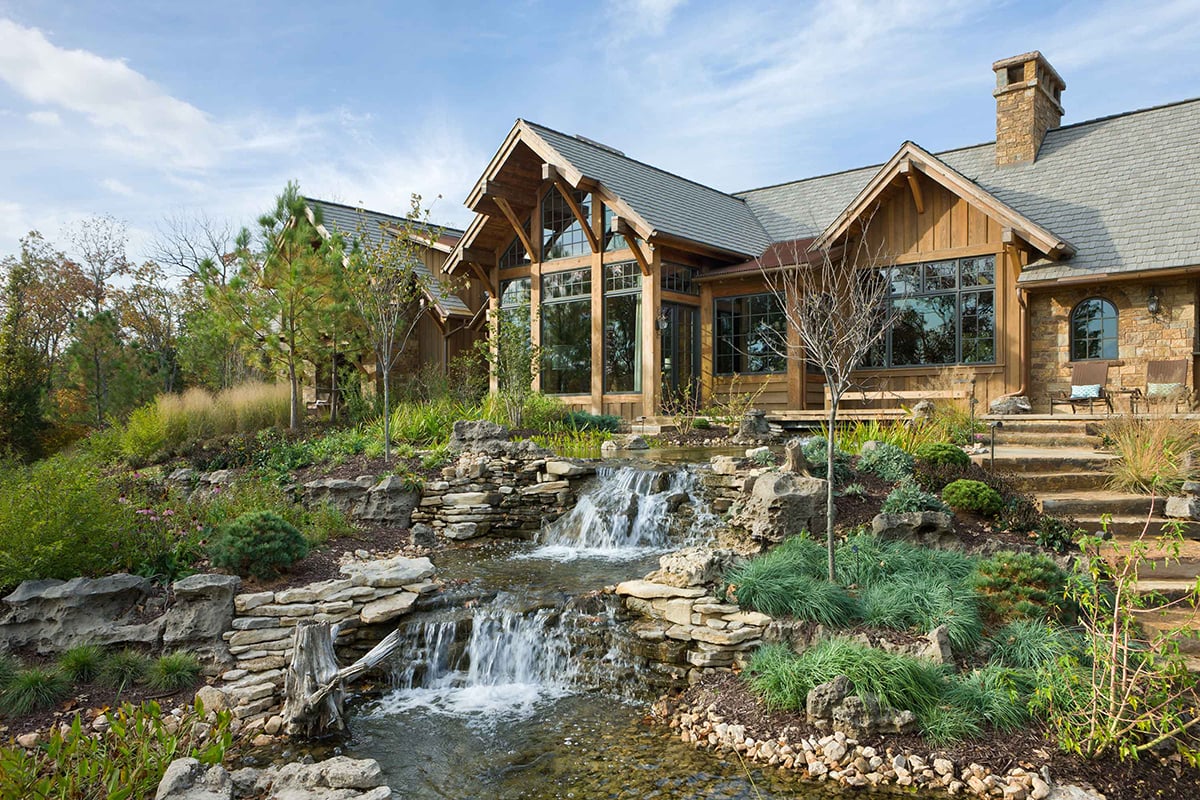
16 Rustic Exterior Home Ideas from Architect Designed Homes
By Interior Designer TRACY SVENDSEN | Published on April 3, 2022 | Updated on September 23, 2026 |
The exterior of a home sets expectations before anyone steps inside — and for a rustic home, it is where the design philosophy is most immediately communicated. Natural materials, honest craftsmanship, and a connection to the surrounding landscape signal what distinguishes a genuinely rustic exterior from one that simply adds a few decorative elements to a conventional facade.
Rustic exterior design works across a wide range of home types — from handcrafted log homes and board-and-batten farmhouses to stone-clad mountain retreats and cedar-sided coastal properties. What connects them is the material honesty and the way the exterior responds to its specific landscape rather than imposing a generic aesthetic on the site.
In my years working in the log home business, I spent a lot of time studying exteriors firsthand — visiting sites and going back specifically to photograph the details that separated a genuinely rustic home from one that only looked the part from the road. The homes that held up on camera were always the ones where the material choices did real work: the stone anchored the structure to its site, the wood grayed the way it was supposed to, and the rooflines matched the terrain rather than fighting it.
The 16 ideas in this guide cover key exterior design decisions—from entryway treatment and front porch design to outdoor living areas, fire pits, and landscaping choices that connect a rustic home to its natural surroundings. Feature image courtesy of Locati Architects.
Key Takeaways
- Design your exterior around the specific site first — the view, the slope, the existing trees — rather than choosing a style and imposing it on the land.
- Pick materials for what they actually do (block wind, filter sun, hold up to snow load) as much as for how they look; the best exteriors solve real problems with their material choices.
- One deliberate material or color contrast reads as intentional; stacking several competing “modern touches” onto a traditional home usually reads as a compromise instead.
- Genuine craftsmanship details — hand-tapered log ends, stone excavated from the building site itself — signal authenticity more convincingly than any single style label.
- A roofline or landscaping plan can echo the shape of the surrounding mountains, trees, or terrain, not just define the building’s footprint.

Rustic Home with Stone Landscaping
Image courtesy of Brown Design Group
1. Build the House Around the Land
The 3D Ranch, a Locati Architects project in Montana, makes the case for this better than any other exterior I’ve studied. The site had no trees when the project began — today it has more than a thousand, along with indigenous plants, because the owners wanted the landscape built with as much native material as the house itself.
The exterior pairs native stone with reclaimed timber, some of it stacked horizontally and vertically in a pattern that echoes the siding on a grain elevator — a deliberate regional reference rather than a decorative one. Intersecting gables with heavy timber overhangs and black steel-framed windows keep the massing modern, while Locati centered the 3,200-square-foot home around its outdoor living area and set it into the hillside so the structure reads as part of the terrain rather than placed on top of it.
“Architecture doesn’t stop or start at the back door,” says architect Locati. “It’s not about the building but placing it in the environment — the placement of trees, the mountains, the berms are all a part of it.”
Designer Tip: Before choosing a single exterior material, walk the actual site and note what’s already there — the tree line, the grade, the direction of the view. The 3D Ranch works because the landscaping decisions came first and the house was built to sit inside them, not the other way around.

Beautifully Designed Rustic Home Exterior
Image courtesy of Locati Architects
2. Mix Timber, Stone and Steel for Texture
The Travertine Ranch, a collaboration between Locati Architects and Schlauch Bottcher Construction in Big Sky, Montana, shows what real material contrast looks like on a rustic exterior. The 12,000-square-foot home combines rough-sawn timber, natural Montana moss rock, and dark contemporary steel panels — three materials that read as distinct textures rather than blending into one another, which is what keeps a facade this large from feeling flat.
The rooflines do similar work: traditional pitched, gabled sections are balanced against flat and shed-roof sections with deep, extended overhangs built to shed heavy winter snowfall — a practical detail as much as an aesthetic one. The home is positioned on a hill facing the Spanish Peaks Mountain Range, with wetlands, meadows, and a pond closer in. To keep the footprint from overwhelming the site, the team tucked a spacious underground garage into the hillside beneath a sod roof.
Lumber sourced from Montana Timbers and dry-stack stone carry from the exterior straight into the interior — a continuity choice that, according to builder Dennee, was deliberate: “There’s a lot of glass, 160 acres, and incredible views, and I had to respect and connect with that to make a seamless transition.” Big Sky Journal
Designer Tip: Notice how the outdoor living spaces are accessible from every public room, not just one — the covered dining patio, the fire pit seating, and the lounge chairs near the hot tub are all oriented toward the mountain views and the pond. If you’re designing outdoor space around a view, give more than one room a door to it.

Rustic Exterior Ideas
Image courtesy of Locati Architects
3. Pair Local Stone With Full-Round Logs for an Elevated Look
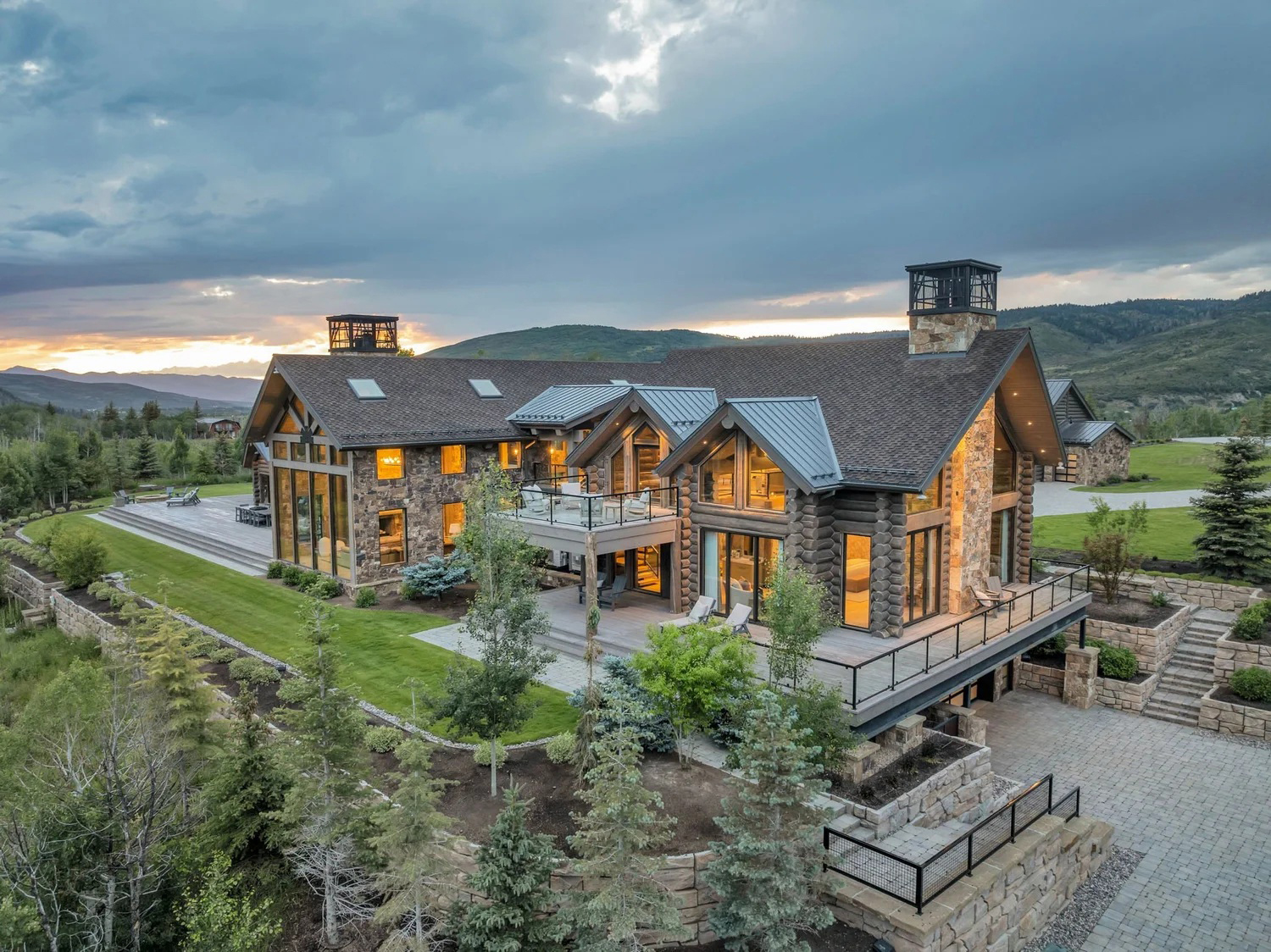
A modern log home renovation on 50 acres in Utah, led by interior designer Jennifer Chipman with architecture firm Arch Nexus and builder Magleby Construction, shows how far this pairing can go past the traditional cabin look. The four-year renovation kept the home’s original handcrafted round logs and added new full-round logs harvested from the bordering forest, set against local Utah stone used throughout the exterior and in the home’s rustic stone fireplaces.
As Chipman put it: “We never intended to create a ‘log-cabin’ log cabin, but rather an elevated take on mountain living with a high level of authentic materials, craftsmanship, and design.” That distinction shows up in the roofline too — a dramatic pitched profile with extensive glazing keeps the massing modern even with a fully log exterior underneath it.
Designer Tip: Preserving the original logs rather than replacing everything is what keeps a renovation like this from reading as a generic “new build with a rustic theme.” If you’re updating a log exterior, keep as much of the original material as the structure allows, and match new logs to the source rather than a different species or finish.
Modern Log Home Renovation
Image courtesy of Bond Design (Lindsay Salazar Photography)
4. Create Contrast Through Transitions, Not Just Materials
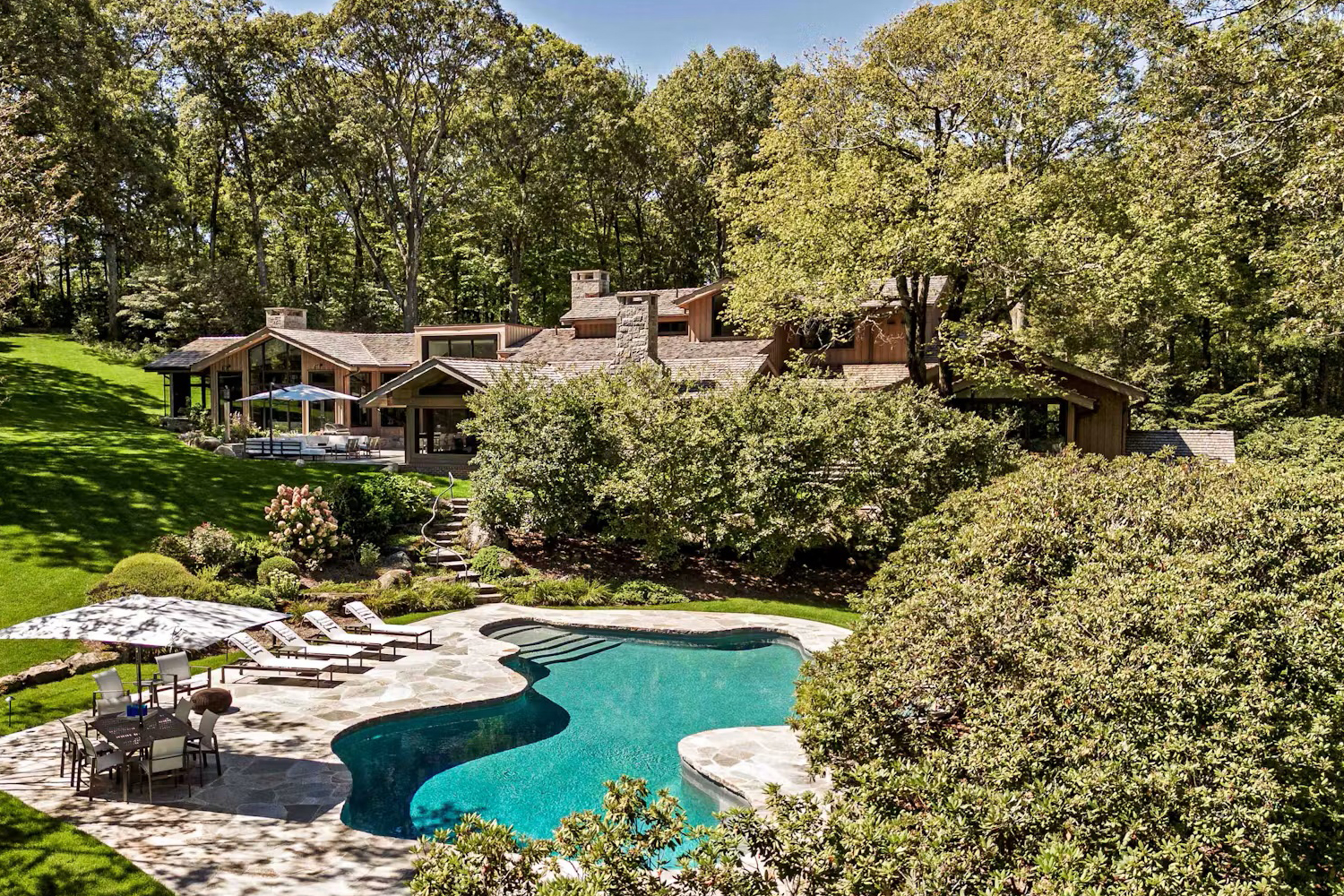
A Hudson Valley estate renovated by Carol Kurth Architecture + Interiors, working alongside Alder & Tweed on interiors and Taconic Builders on construction, makes the case for a different kind of contrast — not between materials, but between eras. The project treated the home’s historic footprint as something to evolve rather than replace, expanding a modest country home into what’s been described as a “modern lodge,” while preserving the site’s original character.
The exterior uses folded rooflines, exposed timbers, and natural siding to root the addition in its wooded setting, but the real contrast lives in the transitions: framed passages, breezeways, and glass-lined corridors blur the line between indoors and out, letting light and landscape move through the home rather than stopping at its walls. A winding gravel drive builds anticipation before opening onto a sculptural entry courtyard — a sequencing choice that sets up the rest of the home’s old-meets-new architecture before you’ve stepped inside.
Designer Tip: If you’re renovating rather than building new, look for a transitional element — a breezeway, a glass corridor, a courtyard — that can do double duty: connecting old and new construction visually while also blurring indoor and outdoor space. That’s often more effective than trying to match materials between the original structure and the addition.
Modern Lodge Country Home With Exposed Timbers and Natural Siding
Image courtesy of Modern Luxury
5. Design Distinct Zones for Outdoor Entertaining
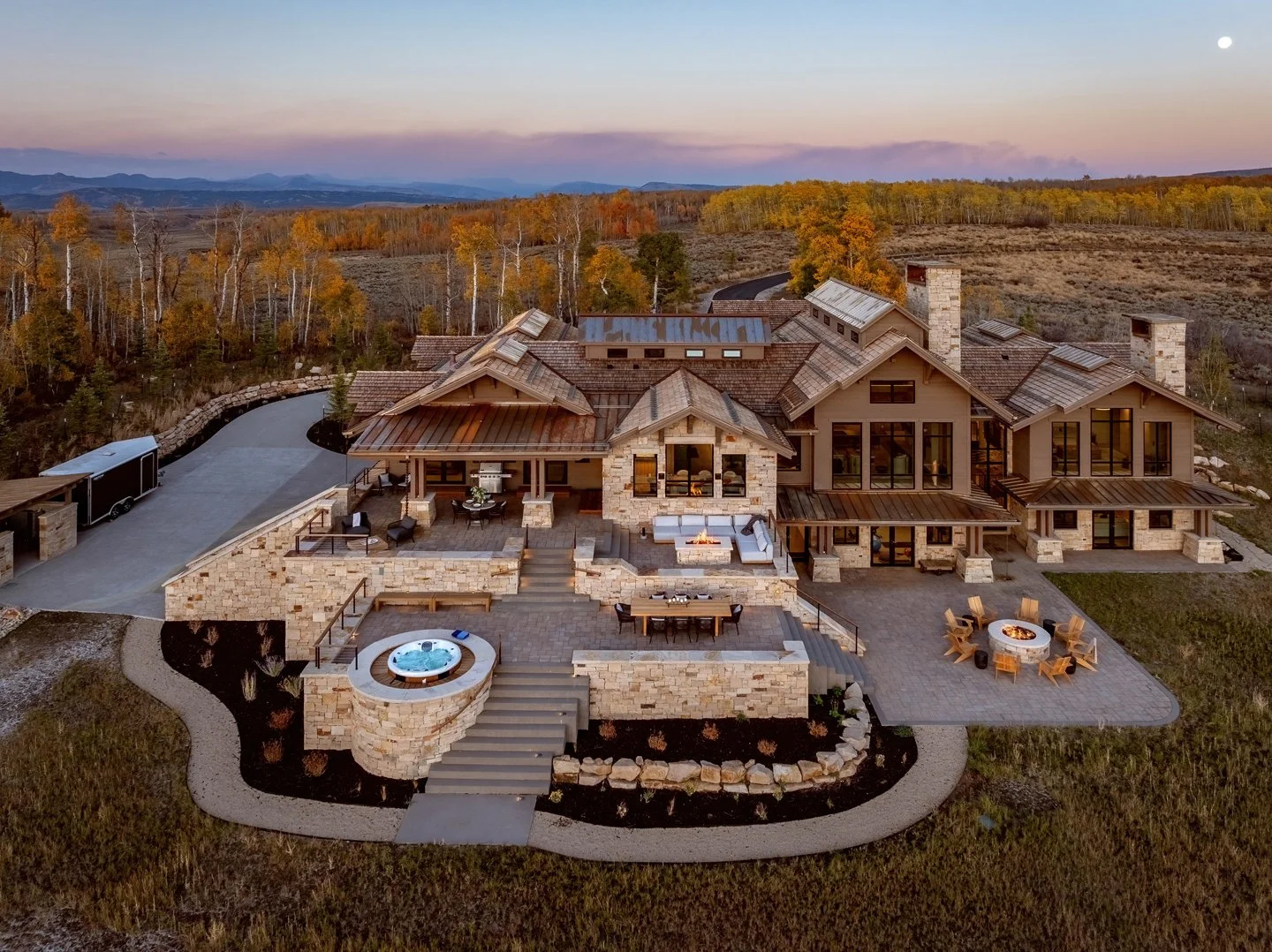
Wolf Creek Ranch, the Utah mountain home designed by Onyx Design Collective with interiors by Hinterland Interior Design and construction by Euclid Timber Frame, treats outdoor entertaining as a sequence of separate rooms rather than one open patio. Stone retaining walls step the site down the hillside into distinct zones: a covered dining and grilling area near the house, a sunken fire pit lounge with sectional seating, a stone-clad hot tub, a second dining table, and a further fire pit with lounge chairs — each one scaled and positioned for a different kind of gathering.
The home was built around four homeowner priorities — sustainability, comfort, technology, and aesthetics — and that same discipline shows up outdoors: every zone faces toward the views of Mount Timpanogos rather than toward each other, so guests in the hot tub and guests at the fire pit each get their own version of the same sightline.
Designer Tip: If your outdoor space is large enough to support it, distinct level-shifted zones — even just a few steps apart — give each activity (dining, lounging, soaking) its own sense of place, and stone retaining walls are an easy way to create that separation on a sloped site. On a smaller property, one well-designed zone that does double duty is the better call than forcing multiple small ones.
Rustic Home with Distinct Outdoor Entertaining Zones
Photo courtesy of Onyx Design Collective
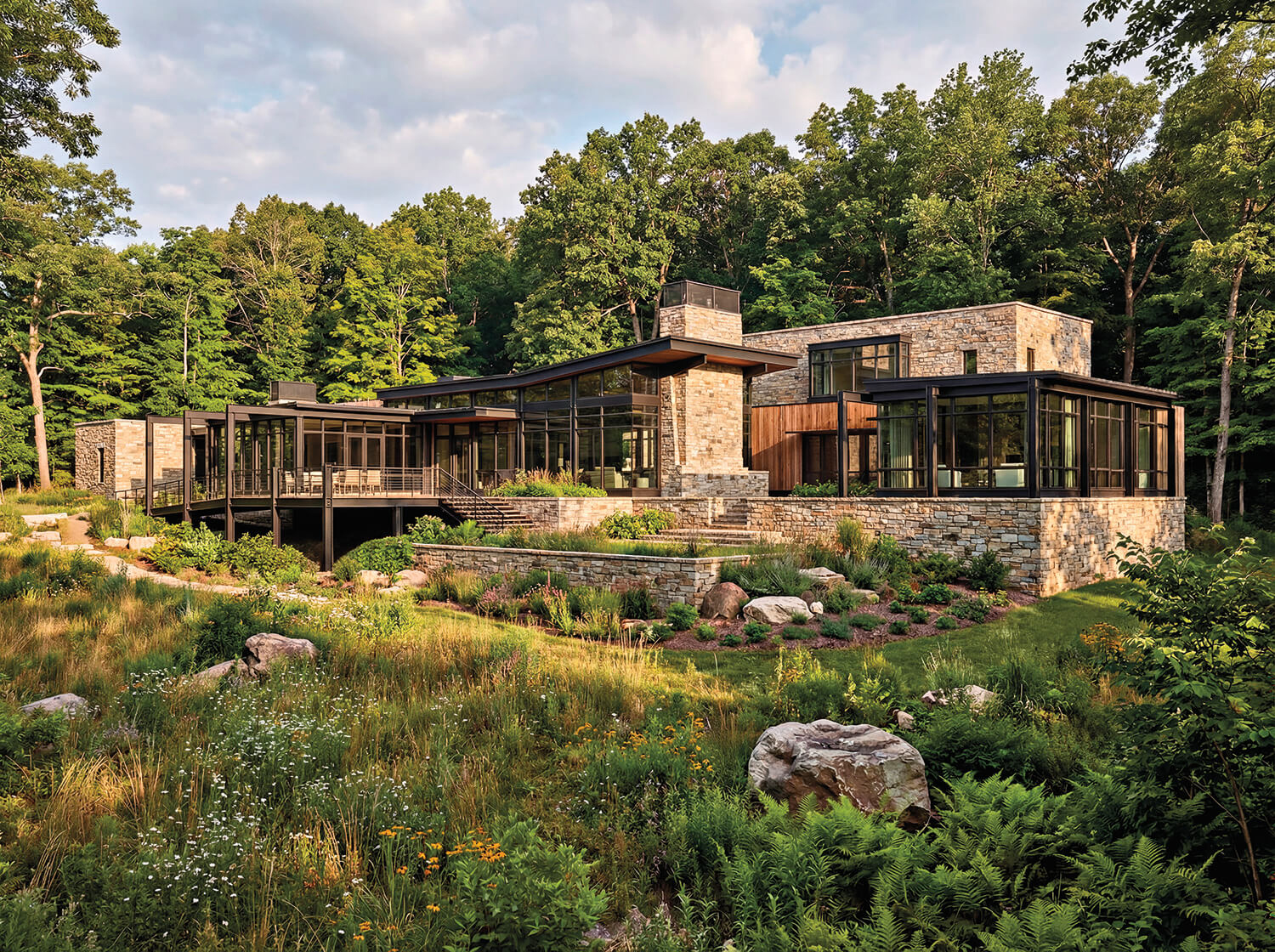
6. Wrap the House in Glass to Frame the Forest
A newly built home outside Chicago, designed by architect Michael Abraham (Michael Abraham Architecture) with interiors by Elizabeth Krueger (Elizabeth Krueger Design), wraps itself in glass to sit inside a canopy of mature oak trees rather than beside it. The original structure on the site had stood for roughly 80 years — “so the trees grew up around it,” Abraham explains — and the design team, including landscape architect Tony Lobello (Mariani Landscape), treated the mature tree cover as the starting point rather than an obstacle. Lobello notes that “every intervention was evaluated through the lens of long-term ecological stewardship.”
The exterior pairs cedar siding with light-hued stone, but it’s the expansive glazing that does the real work of connecting the house to its setting — Krueger describes the primary suite as feeling “like a floating glass tree house.” As she puts it, “a lot of materials inside are used outside as well, so there is a fluidity” between the two.
Designer Tip: If your site has mature trees, design your window placement around preserving and framing them rather than clearing them for a better sightline. The most memorable rooms here work because the glass frames trees that were already decades old, not because the view was manufactured.
Modern Rustic Exterior with Large Expanse of Glass, Cedar Siding and Stone
Image courtesy of Luxe Source
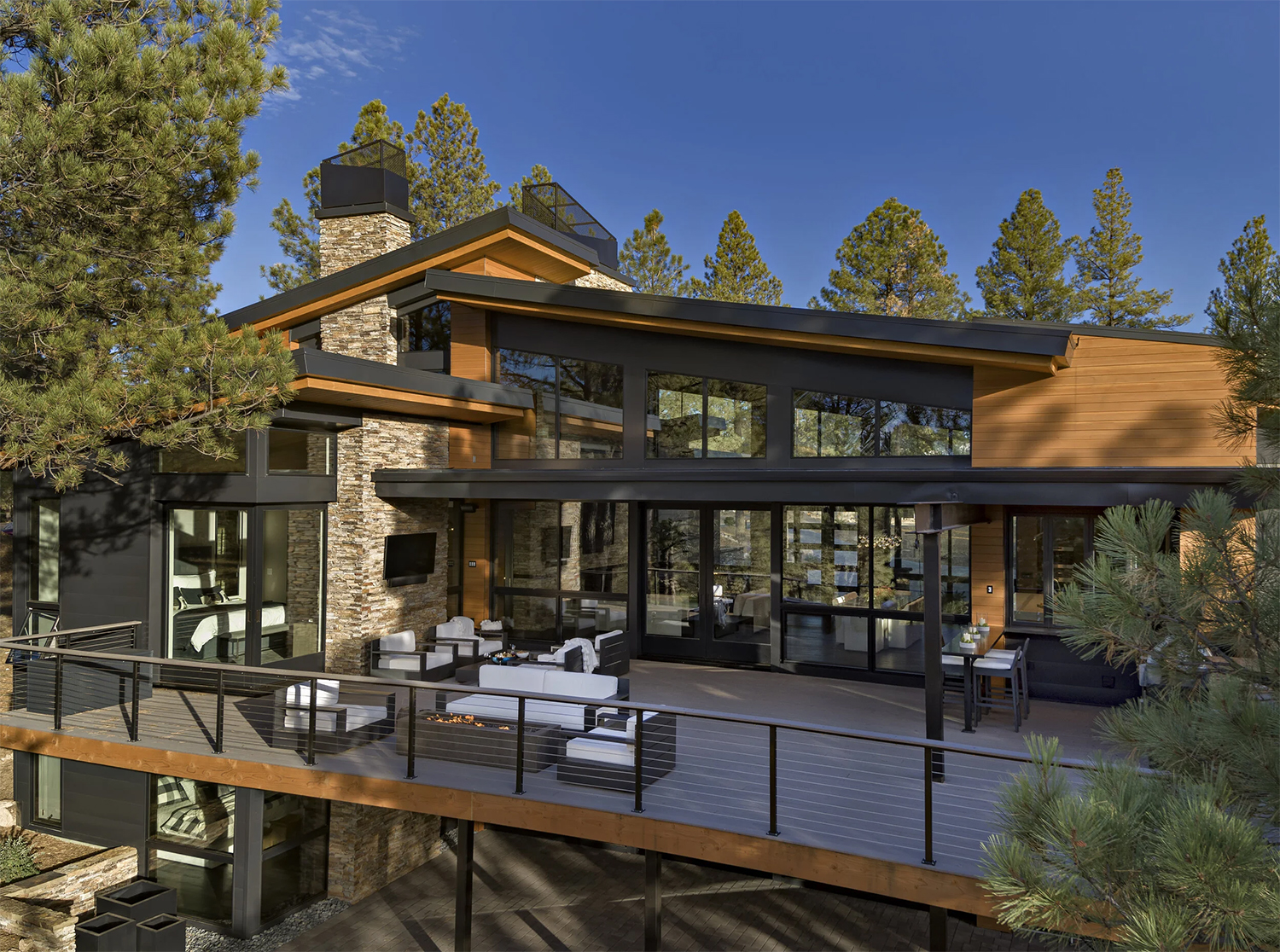
7. Commit to Black Metal as a Through-Line, Not Just an Accent
A 6,000-square-foot home in Flagstaff, Arizona, designed by Tate Studio Architects, shows what the firm calls “mountain transitional” — a style that bridges clean modern lines with natural rustic materials. “The owners wanted a soft, modern home in a community with guidelines that favor a traditional design aesthetic,” explains Justine Chandler, Project Manager with Tate Studio Architects. To find that balance, the team combined a traditional gable roof with elements of a modernized shed roof, visible in the angled overhang running the length of the house.
What actually carries the modern half of that balance is black metal — used on the roofline trim, window frames, chimney cap, and deck railings, running consistently across the entire facade rather than appearing as a single accent. It’s set against warm wood siding and a stacked stone chimney mass, the natural materials Chandler describes: “the combination of natural and manmade materials coupled with the use of a neutral color palette makes this home mountain transitional.”
Designer Tip: A modern material doesn’t have to stay small to read as balanced. This home uses black metal everywhere — roofline, windows, railings, chimney cap — and it works because it’s applied consistently, not sparingly. What keeps a heavy modern material from overwhelming a rustic home is repetition across every element, not restraint in how much you use.
Modern Mountain Home with Black Metal Roofline Trim, Window Frames and Railing
Image courtesy of Tate Studio Architects
8. Use a Retracting Glass Wall to Blur Indoor and Outdoor Space
Kelly & Stone Architects designed this rustic mountain retreat in collaboration with Sarah Jones Interiors, located in the private community of Martis Camp in Truckee, California. A retracting glass wall opens the living room directly onto a terraced stone patio, so the great room and the outdoor gathering space function as one continuous room rather than two separate ones connected by a door.
At 5,900 square feet, the multi-generational family home could easily read as sprawling, but a terraced design that steps the structure up into its hillside site keeps its footprint from overwhelming the lot. Heavy Douglas fir timbers, stained the same color inside and out, reinforce that continuity — the traditional Tahoe lodge aesthetic doesn’t stop at the exterior wall, it carries straight through the retracted glass into the great room’s timber trusses.
Designer Tip: If you want an indoor space to feel like an extension of the outdoors rather than just a room with a view of it, match a structural material — timber stain, stone type, flooring — between the two spaces. The glass wall does the visual work, but it’s the matched materials that make the transition feel seamless once the wall is open.

Rustic Home Exterior – Truckee, California
Image courtesy of Kelly & Stone Architects
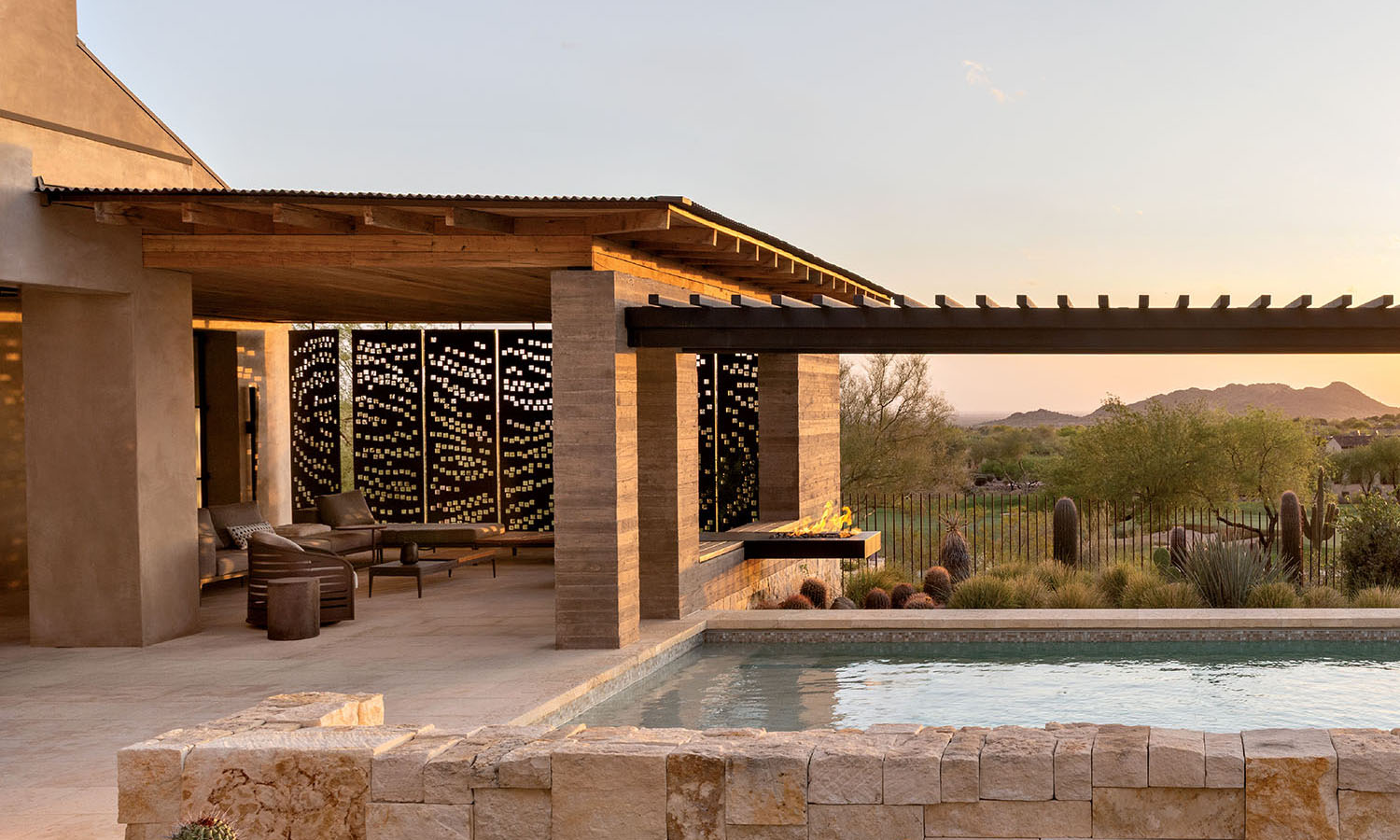
9. Choosing Materials That Respond to Climate, Not Just Style
For a new residence at the foot of Arizona’s Superstition Mountains in Gold Canyon, Oz Architects designed a sleek, ranch-inspired home around a material choice with a job to do: perforated steel panels, fabricated by Accent Design & Manufacturing, that pivot with the wind to dampen breezes while casting a shifting pattern of light and shadow across the patio. The wave pattern on the panels was conceived by the client and realized by the architects — a genuine collaboration rather than a standard catalog choice.
The rest of the material palette (stucco walls, timber pergola beams, and stacked stone) is straightforward desert-rustic, but the steel panels are what make this exterior distinctive: they solve privacy and wind exposure at once, while turning the sun itself into a design element as it moves across the dappled pattern throughout the day. Montara Custom Homes served as builder, with The Green Room Landscape Architecture handling the surrounding desert landscape.
Designer Tip: When you’re choosing an exterior material, ask what job it needs to do beyond looking good — blocking wind, filtering harsh sun, screening a sightline — and look for one material that can solve more than one of those problems at once, the way these panels handle privacy, wind, and shade together.
Southwestern Style Exterior with Perforated Steel Panels
Image courtesy of Oz Architects
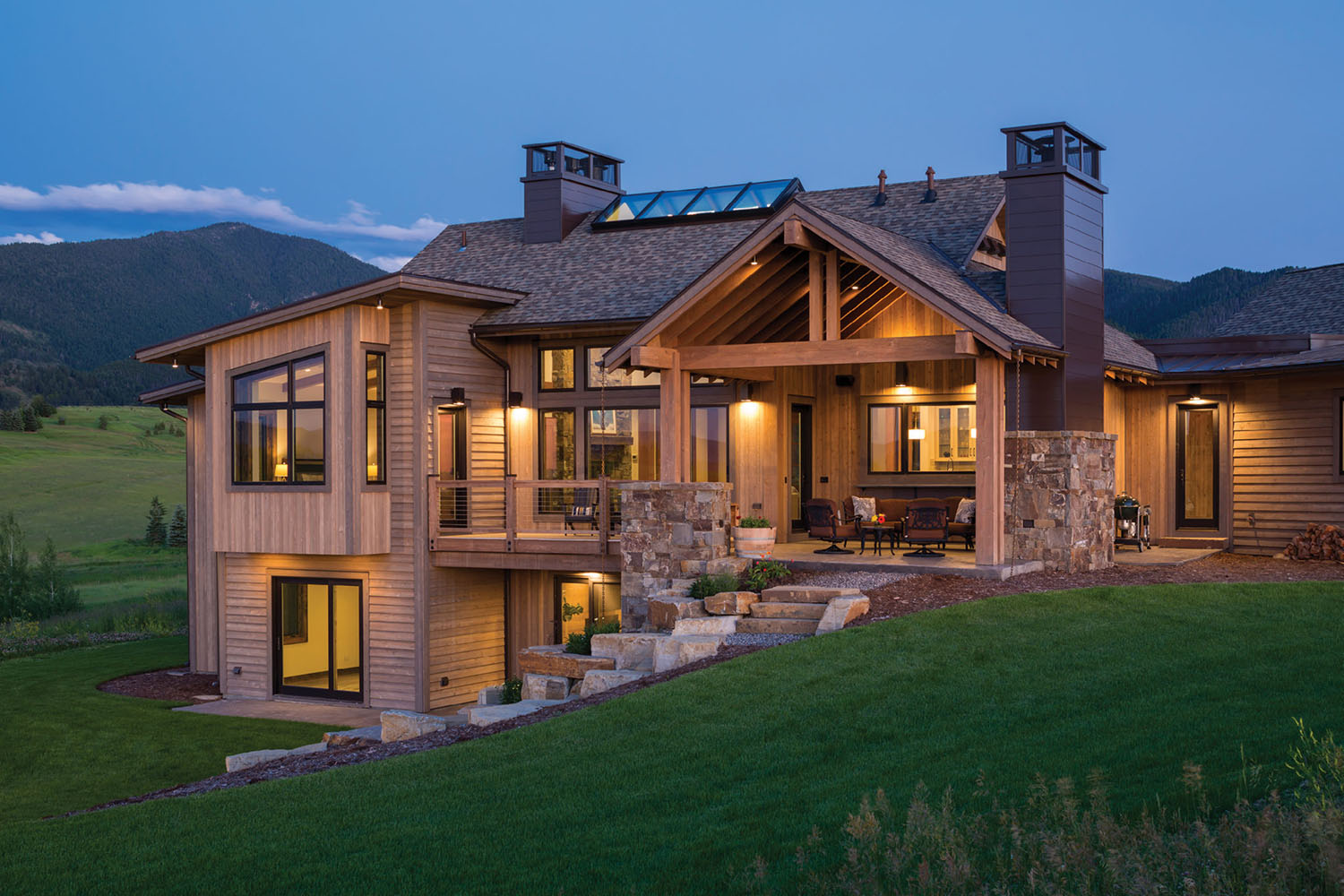
10. Let the Mountain Skyline Shape Your Roofline
When architect Andrew Brechbuhler first saw the site for the Klann family’s home in Bozeman, Montana, he knew the design had to take full advantage of the views. “Our approach is always to design for the site,” says Brechbuhler, principal architect at Brechbuhler Architects. “This parcel has spectacular views, both of the Bridgers and the Gallatin Range.” The resulting home, called Wild Rose, echoes that skyline directly — Brechbuhler notes that the asymmetry on the exterior reflects both the slope of the site and the jagged forms of the Bridger Mountain Range themselves.
The 4,500-square-foot home, built by Dovetail Construction on a 2.5-acre lot, uses its slightly sloping site to full advantage: a walk-out lower level with doors that open directly to grade makes the back of the home read as if the lower level is the main level, complete with its own patio.
Designer Tip: If your site has a distinctive natural silhouette — a mountain range, a tree line, a ridge — look at whether your roofline or massing can echo it rather than sitting apart from it. An asymmetrical roof isn’t just a style choice; here, it’s a direct response to a specific view.
Mountain Home Designed for the Site
Image courtesy of Brech Buhler Architects
11. Look for Handcrafted Details Like Tapered Log Ends
A handcrafted cedar log home in Williams Lake, British Columbia, built by Pioneer Log Homes — the same firm featured on HGTV’s Timber Kings — shows what genuinely natural exterior design looks like at the structural level, not just the decorative one. The logs themselves are hand-tapered with flared butt ends, a traditional handcrafting technique that’s far more time-intensive than milled, uniform log siding, and it’s visible in the exterior’s silhouette rather than something you’d notice only up close.
The 4,500-square-foot, five-bedroom home sits on 3.75 acres on a peninsula with southeast exposure, giving it waterfront views in nearly every direction. Inside, timber, copper, and stone carry the same natural-material logic through to a gourmet kitchen with an open floor plan that keeps the home naturally lit throughout the day.
Designer Tip: If you want a log exterior to read as authentic rather than manufactured, look at how the logs are joined and finished — tapered, hand-fit ends are a sign of real craftsmanship that a uniform, milled log profile can’t replicate.

A Majestic Handcrafted Log Home in BC
Image courtesy of Luxury Homes
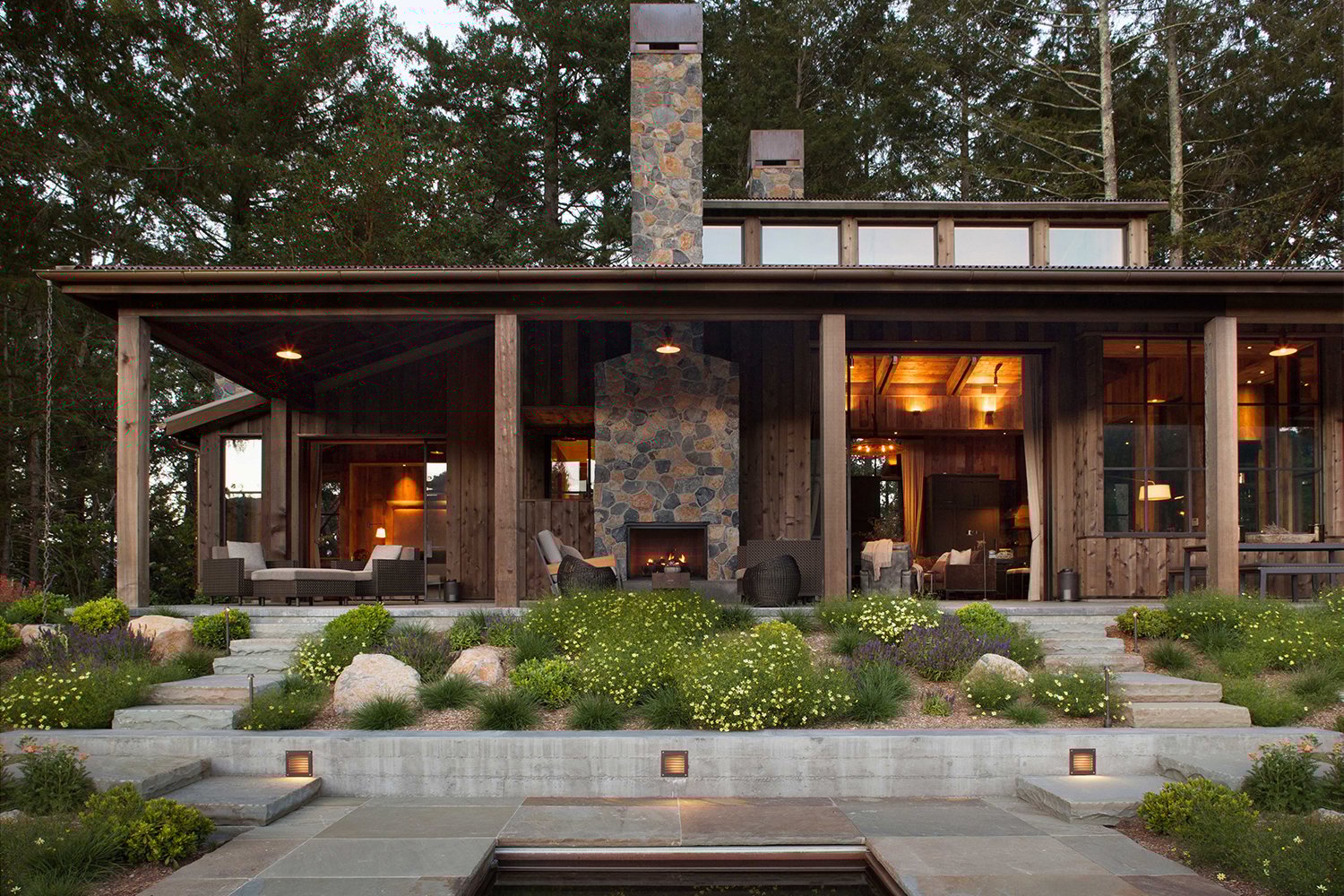
12. Rustic Exterior Landscaping Ideas
This wooded retreat in wine country, designed by Wade Design Architects in collaboration with Jennifer Robin Interiors, demonstrates landscaping fully integrated with architecture rather than added around it. The exterior of patinated board-on-board red cedar, Douglas fir, and native stone excavated directly from the site establishes the material connection to the landscape from the ground up.
The covered concrete deck extends from a natural stone fireplace, with two parallel concrete stairways descending to a narrow pool below — the steps flanking a central landscaped zone of florals, large rocks, and shrubs that reads as both structural and planted simultaneously. The same planting repeats on either side of the steps, creating a symmetrical but entirely natural-feeling composition that feels genuinely designed rather than simply planted.
Designer Tip: If your site has usable stone during excavation, consider keeping it for landscaping or hardscape rather than trucking it away and buying new material — it’s a direct, visible way to tie a home’s exterior materials to the land it sits on.
Rustic Home with Beautiful Landscaping
Image courtesy of Jennifer Robins Design
13. Layer Down Lighting with a Fire Pit for Exterior Warmth
At Last Chance Ranch, a rustic timber-frame home by Locati Architects, a large stone fireplace anchors the outdoor seating area alongside a fire pit and warm down lighting — layering three distinct sources of warmth rather than relying on a single light fixture or heat source. Exposed structural timber trusses accent the gables and porch areas above, catching that warm light rather than sitting in shadow.
Floor-to-ceiling windows and large multi-slide doors blur the line between indoor and outdoor living, so the same warm light carries through both spaces rather than stopping at the glass — and on this site, a natural water feature reflects that lighting at dusk, doubling its visual warmth across the lawn.
Designer Tip: Down lighting, a fire pit, and interior light spilling through open doors each read differently at night — layering more than one creates depth instead of one flat pool of light. If you have a water feature nearby, position even one fixture to catch its reflection; it adds warmth without adding another fixture.

Rustic Home Exterior – Locati Architects
Image courtesy of Locati Architects
14. Build a Stone-Walled Fire Pit Lounge Into the Deck
This home in the Yellowstone Club of Big Sky, Montana, by Locati Architects, blends indoor and outdoor living with a landscaped grounds package that includes a fire pit, a fireplace, and a covered swimming pool. The sunken fire pit is built directly into a curved, stone-walled extension of the deck rather than sitting as a freestanding feature—a design choice that gives the seating area a defined edge while keeping sightlines open to the mountain views beyond.
That framing matters here: the fire pit lounge sits at the edge of the deck with an unobstructed view toward the peak in the distance, so the outdoor gathering space doesn’t compete with the view; it’s positioned to take advantage of it.
Designer Tip: If you’re adding a sunken or recessed fire pit to a deck, treat the stone wall around it as an extension of the deck’s edge rather than a separate structure — it reads as one continuous built feature instead of two things bolted together, and it keeps the view beyond it unobstructed from the seating.

Rustic Home Exterior – Locati Architects
Image courtesy of Locati Architects
15. Include a Water Feature
A water feature does more for a rustic exterior than most homeowners plan for. Beyond the visual appeal, moving or still water adds ambient sound that can mask road noise or nearby activity, and it doubles a home’s visual presence by reflecting the architecture, the sky, and the surrounding trees back at different times of day — an effect no other landscaping element can produce.
Locati Architects weave that idea throughout this home. Reclaimed fir siding adorns the exterior, evoking the rugged Montana mountains, while water becomes a recurring design element starting at the entrance: stepping stones and an arched bridge offer two distinct ways to cross a shallow reflection pool that meets the stone facade directly, creating the illusion of a home rising from the water rather than simply sitting beside it. Lily pads floating across the surface suggest a living, planted pond rather than a purely decorative water feature.
Designer Tip: A reflection pool works best when it’s placed close enough to the facade that the water visually merges with the building material — a pool set several feet away from the wall reads as a separate landscape feature rather than an extension of the architecture itself.

Rustic Home Exterior – Locati Architects
Image courtesy of Locati Architects
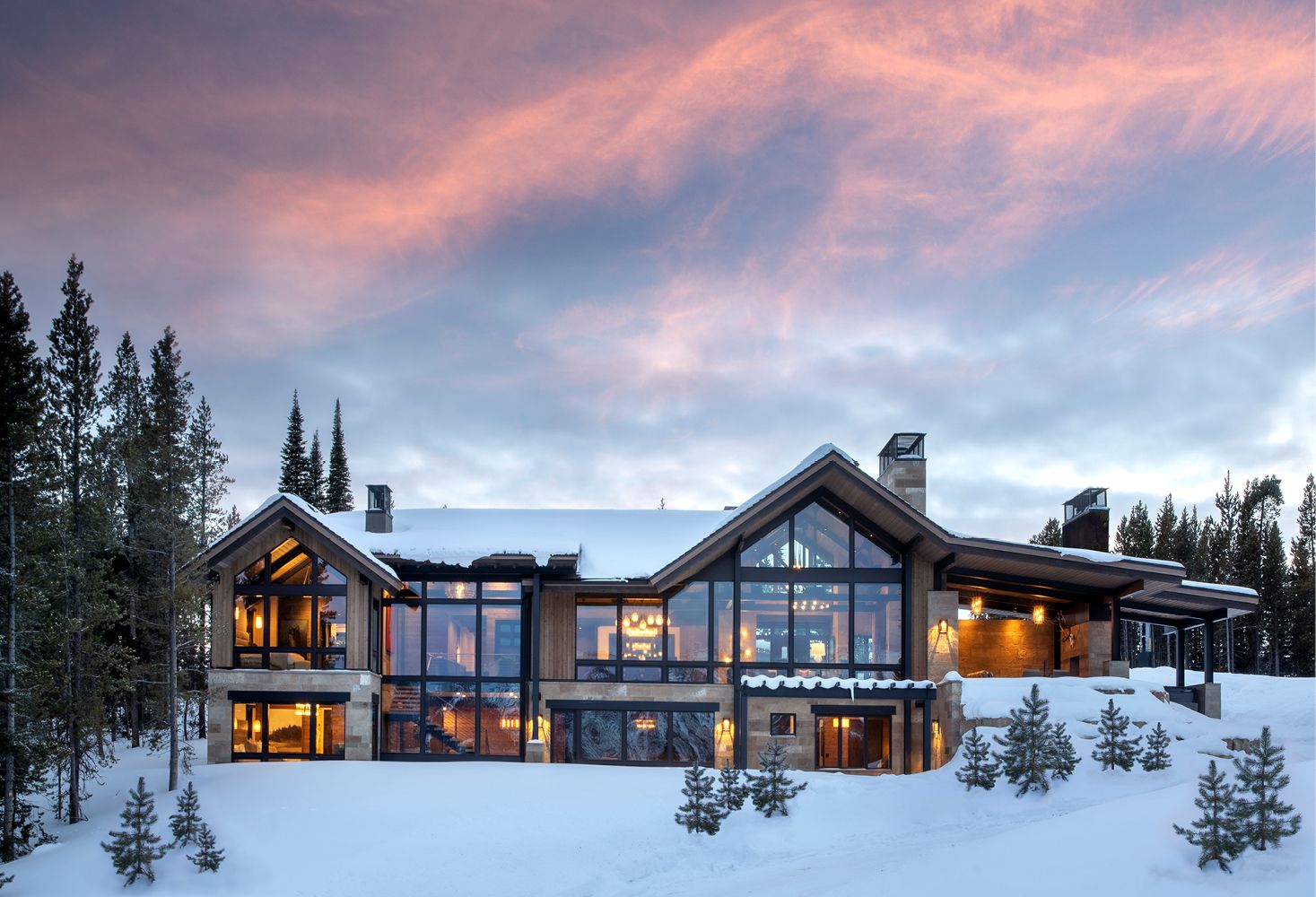
16. Combine Steel Trusses With Traditional Gable Forms
A Big Sky, Montana home designed by Jamie Daugaard of Centre Sky Architecture, built by Peter Lee of Teton Heritage Builders, makes its roofline the actual centerpiece of the design rather than a backdrop to it. Two parallel steel chord trusses run the length of the home before transforming into traditional gable trusses at both ends — a structural hybrid rather than a single roof style. “The rooflines are traditional, but the walls are modern,” says Daugaard. A separate shed-roof section terraces down and ties directly into the site’s topography rather than sitting level above it.
Builder Peter Lee points to the steel itself as the real design statement: “The forms are traditional, yet the steel is the primary expression of the home, and the steel truss is a classic form that adds interest.” The rest of the exterior — shiplap cedar siding and Montana sandstone accents on the arrival side — stays deliberately understated so the roofline can do the visual work.
Designer Tip: If you want a roofline to read as a genuine design statement rather than just a functional shape, look at where a traditional form (a gable, a pitch) meets a modern structural material (steel, glass) — that transition point is usually more interesting than either material used alone.
Mountain Home with Traditional Gable Trusses
Image courtesy of Centre Sky Architecture
Conclusion: Building an Exterior That Belongs to Its Site
Every home in this guide earns its rustic label the same way — not through decoration, but through a genuine response to where it sits. A landscaping plan built before the house design, a roofline that borrows its form from the mountains behind it, stone excavated from the actual building site, log ends tapered by hand rather than milled, perforated steel chosen because it solves a real desert climate problem rather than just looking striking — the same principle runs through all of it.
That’s the real lesson here: a rustic exterior isn’t a style you apply, it’s a set of decisions about how a home responds to its specific land, climate, and view. The details will look different in Montana than in Arizona or Chicago, but the underlying approach — material honesty, site-first design, and one deliberate contrast rather than several competing ones — holds across all of them. Use the ideas in this guide as a starting point, then look at what your own site actually offers before you decide which ones apply.
Frequently Asked Questions About Rustic Exterior Home Ideas
What are some rustic siding options?
Reclaimed and full-round log siding, board-on-board cedar, shiplap cedar, and stucco or plaster are all common rustic siding choices. The right option depends on your region and climate — cedar and log siding suit mountain and forest settings, while stucco works well in desert climates like Arizona’s.
What’s the difference between rustic and modern rustic exterior design?
Traditional rustic exteriors lean on natural materials and traditional forms throughout, while modern rustic (sometimes called “mountain transitional”) pairs those same natural materials — wood, stone — with modern elements like black metal accents, expansive glazing, or steel structural details, usually in a deliberate, singular contrast rather than a full modern overhaul.
What exterior colors work best for a modern rustic home?
Neutral, earth-toned palettes — warm woods, natural stone tones, and muted grays — paired with one deeper contrast color, often black or dark charcoal metal accents on windows, railings, or rooflines, are the most common approach in modern rustic exteriors.
What roofline style works best for a rustic exterior?
Traditional gabled and pitched rooflines are the most common, but many modern rustic homes combine a traditional gable with a modernized shed roof or steel truss structure, letting the roofline reflect the surrounding landscape’s silhouette rather than following one fixed style.
What materials should I choose for a rustic exterior?
Choose materials based on what performs well for your specific site and climate — not just how they look. Stone, wood, and metal each solve different problems (privacy, shade, durability, visual contrast), so the best rustic exteriors usually combine two or three deliberately rather than defaulting to one.
View Recent Posts
Stunning Range Hood Design Ideas
Range hood design ideas covering stone, wood, plaster, copper, and stainless steel — with designer tips on proportion, material selection, and installation.

Fireplace Design Ideas
Discover fireplace design ideas that range from rustic to modern, country, traditional, Scandinavian and farmhouse with stunning photos.
Rustic Bedroom Ideas
Rustic bedroom ideas covering natural materials, layered textiles, color palettes, and professional design strategies for log cabin, modern rustic, Scandinavian, and luxury retreat styles.
Rustic Bathroom Ideas
Rustic bathroom ideas — natural materials, vintage fixtures, earthy palettes, and designer tips for log homes, cabins, and mountain retreats.
Cream Kitchen Cabinet Ideas
Cream kitchen cabinet ideas curated by interior designer Tracy Svendsen. Warmer than white and more versatile than beige, cream cabinets work beautifully across farmhouse, rustic, traditional, and modern kitchens.
Log Home Decorating Ideas
Log home decorating ideas covering color palettes, furniture selection, lighting, stone fireplaces, and modern approaches to handcrafted log home interiors.
Country Kitchen Ideas
Discover 43 country kitchen ideas featuring warm earth tones, natural materials, vintage accents, and expert guidance on cabinets, colors, and styling for an authentic country kitchen design.
Coastal Decorating Ideas
Coastal decorating ideas — color palettes, natural textures, living rooms, bedrooms, and outdoor spaces.
Rustic Backyard Ideas
Rustic backyard ideas — fire pits, natural materials, outdoor seating, container planting, and log home porches.

